KSE-100 surges to new peak on strong corporate results
KSE-100 Index settles at 148,196.42 points, up 1,704.79 points, or 1.16%
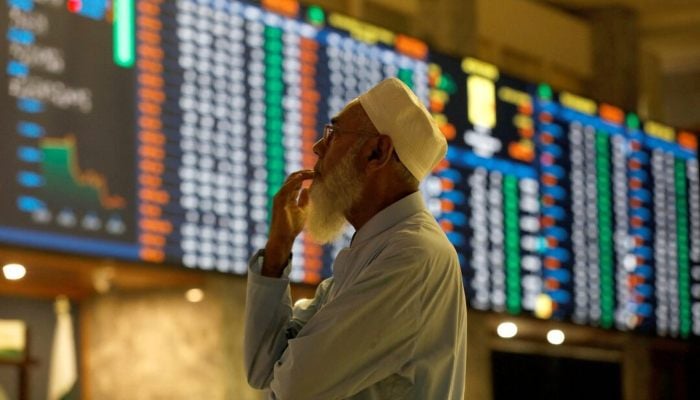
The bourse touched fresh highs on Monday, with investor sentiment boosted by strong corporate results, improving macroecconomic indicators, and expectations of favourable inflation numbers.
“Stability, liquidity, good corporate results, upgrading of Pakistan’s ratings and expectations of tame inflation numbers are all contributing towards market making new highs,” said Ahfaz Mustafa, CEO of Ismail Iqbal Securities.
The Pakistan Stock Exchange’s (PSX) benchmark KSE-100 Index settled at 148,196.42 points, up 1,704.79 points, or 1.16%, from the previous close of 146,491.63.
During the session, the index climbed to an intraday high of 148,395.71, gaining 1,904.08 points, or 1.3%, registered a low of 146,403.64, reflecting a drop of 87.99 points, or 0.06%.
The stock market is expected to remain buoyant in the coming week, supported by optimism over corporate earnings and anticipated progress on circular debt reforms. Sentiment is also expected to stay upbeat with corporate results season in full swing and further clarity awaited on the government’s industrial policy measures, particularly the phasing out of the super tax.
In the energy sector, the power division is set to present its final proposal on debt re-profiling with Chinese independent power producers (IPPs), whose outstanding dues stand at Rs475 billion.
Supporting liquidity in the financial system, deposits at commercial banks reached Rs33.756 trillion as of August 1, 2025, up 12.51% from a year earlier. The rise was driven by stronger remittance inflows and a shift towards formal savings amid easing inflation and reduced cash hoarding, according to central bank data.
Remittances from overseas Pakistanis increased by 7.4% year-on-year to $3.2 billion in July, the highest ever inflow recorded for that month, although they fell 6.0% compared to June.
Meanwhile, Pakistan’s foreign exchange reserves held by the State Bank of Pakistan (SBP) edged up by $11 million to $14.243 billion as of August 8. The country’s total liquid reserves rose by just $1 million to $19.497 billion, with commercial banks’ reserves slipping by $10 million to $5.254 billion. The slight improvement followed Moody’s upgrade of Pakistan’s credit rating by one notch, from ‘Caa2’ to ‘Caa1’, with a ‘stable’ outlook.
The Moody’s revision, alongside earlier upgrades by Fitch and S&P, is expected to enhance Pakistan’s ability to secure external financing. The government maintains that the economy is on a recovery path, supported by a $7 billion IMF bailout.
On Friday, the KSE-100 Index had declined by 37.67 points, or 0.03%, to close at 146,491.63, after trading between a high of 147,534.41 and a low of 146,269.59. Over the course of the outgoing week, the index posted a gain of 1,109 points, or 0.76% week-on-week.


-
 Anthropic to reveal new revenue figures as AI financial race heats up
 -
 HSBC to phase out fixed-pay allowances by 2028 in major compensation overhaul
 -
 TotalEnergies expands US renewable venture with KKR in $1.2B solar portfolio deal
 -
 Australian telecom shares tumble as SpaceX moves closer to direct-to-cell market
 -
 World Bank in crisis aid talks with dozens of nations amid global shocks
 -
 Deutsche Bank chief explains why German election results alarm foreign investors
 -
 China orders development of national blockchain network in economic blueprint: Here’s why
 -
 Tesla renames 'full self-driving' to 'assisted driving' in Europe: What to know