Trump relaxes commercial spaceflight rules in boon to Musk's SpaceX
Executive order eliminates or expedites environmental reviews for launch licenses administered by FAA
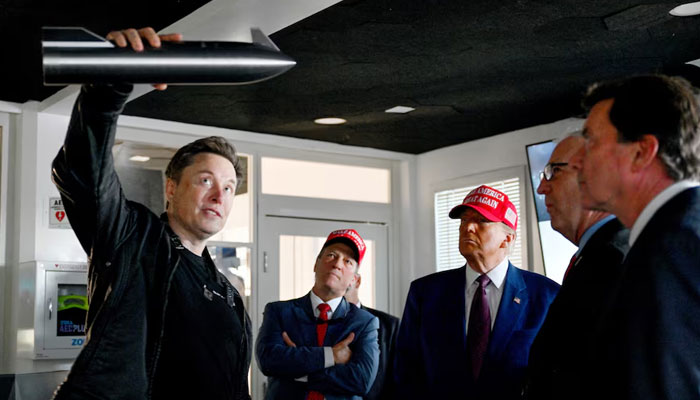
US President Donald Trump has signed an executive order to streamline federal regulation governing commercial rocket launches, a move that could benefit Elon Musk's SpaceX and other private space ventures.
Trump's order, among other things, directs the US transportation secretary to eliminate or expedite environmental reviews for launch licences administered by the Federal Aviation Administration, the White House said in a statement.
The declaration also calls on the secretary to do away with "outdated, redundant or overly restrictive rules for launch and reentry vehicles".
"Inefficient permitting processes discourage investment and innovation, limiting the ability of US companies to lead in global space markets," the executive order states.
While Musk and Trump had a high-profile falling out months ago, the billionaire entrepreneur's SpaceX rocket and satellite venture potentially stands to be the single biggest immediate beneficiary of Trump's order on Wednesday.
SpaceX, though not mentioned by name in Trump's order, easily leads all US space industry entities, including NASA, in the sheer number of launches it routinely conducts for its own satellite network, the US space agency, the Pentagon, and other enterprises.
Jeff Bezos' private rocket company Blue Origin and its space tourism business could also gain from a more relaxed regulatory regime.
Musk has repeatedly complained that environmental impact studies, post-flight mishap investigations and licensing reviews required by the FAA have needlessly slowed testing of SpaceX's Starship rocket, under development at the company's South Texas launch facility.
Starship is the centrepiece of Musk's long-term SpaceX business model, as well as a core component of NASA's ambitions for returning astronauts to the moon's surface, establishing a permanent human lunar presence and ultimately sending crewed missions to Mars.
Musk has viewed FAA oversight as a hindrance to his company's engineering culture, considered more risk-tolerant than many of the aerospace industry's more established players. SpaceX's flight-test strategy is known for pushing spacecraft prototypes to the point of failure, then fine-tuning improvements through frequent repetition.
This has appeared to run afoul of the FAA's mission of safeguarding the public and the environment as it exercises its regulatory jurisdiction over commercial spaceflight.
Earlier this year, the FAA grounded Starship test flights for nearly two months after back-to-back post-launch explosions rained debris over Caribbean islands and forced dozens of airliners to change course. The FAA ended up expanding the aircraft hazard zone along Starship's launch trajectories before licensing future flights.


-
 Trump demands Rep. Ilhan Omar resign after DOJ court filing references over 'fake' name
 -
 Carney rejects Trump administration’s accusation of Canada interfering in US midterm elections
 -
 Ukraine, Russia and US set to hold key talks in Abu Dhabi in early November
 -
 Australia lawmaker Hannah Beazley’s staff threatened days after Helen Haines attack
 -
 New York AG Letitia James challenges attempt to disqualify her from Cornell investigation
 -
 Trump administration targets Alaska Senate race over fears of ballot confusion
 -
 Gunman near Paris kills one, injures several as mayor suspects ‘racist, Islamophobic’ intent
 -
 Trump faces Republican backlash over Ramaswamy ad ahead of Florida rally
-
 DOJ opens criminal investigation into Trump Ally Corey Lewandowski over DHS tenure
 -
UK, France hold first-ever joint nuclear exercise amid Russia tensions
-
Trump says Starlink restrictions lifted, Ukraine disputes claim
-
First Russian diesel shipment en route to New York after Trump-Putin energy deal: Report