WB warns high tariffs crippling Pakistan’s exports, competitiveness
World Bank urges reform of tariff policy to boost competitiveness
The World Bank has raised concerns that Pakistan’s continued tariff-heavy approach is weakening its export performance and putting its economic future at risk.
Exports have shrunk to just over 10% of GDP in 2024, down from more than 15% in the 1990s — one of the lowest shares in the region and among middle-income economies.
In the report titled ‘From Inward to Outward: Pakistan’s Shift Towards Export-led Growth’, the World Bank said the slide reflects worsening constraints on businesses, compounded by recent policy shifts towards higher tariffs.
“Pakistan’s tariff structure — characterised by high average protection rates, cascading import duties, and ad hoc exemptions — has become a barrier to export-led growth,” the report said, noting that tariff rates have risen steadily since reaching their lowest levels in the early 2000s.
Pakistan’s goods exports rose 6.25% year-on-year to $26.86 billion in the first 10 months of FY25, according to data released by the Pakistan Bureau of Statistics (PBS) earlier this month.
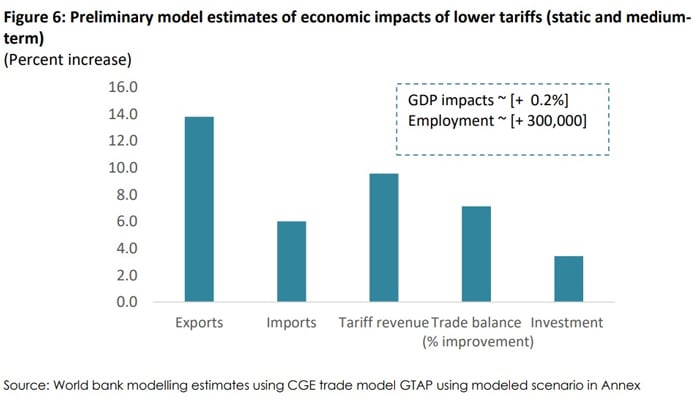
The World Bank’s assessment highlighted structural weaknesses in Pakistan’s trade policy and recommended transferring tariff-setting authority from the Federal Board of Revenue (FBR) to the National Tariff Board.
It also proposed establishing a National Regulatory Delivery Office to streamline policy implementation and reduce red tape.
While the World Bank welcomed the launch of Uraan Pakistan — the government’s five-year plan for reforms and economic growth — in December 2024, it cautioned that tariff reforms must be accompanied by broader structural changes to make the economy more competitive.
The report also pointed to a challenging business climate marked by a misaligned exchange rate regime, high energy costs, regulatory complexity and limited access to credit.
It warned that high import duties on raw materials and intermediate goods have further eroded firm productivity, sales and wages.
Pakistan’s exports face another major threat of now on-hold reciprocal tariffs of up to 29% announced by US President Donald Trump.
The Pakistan Institute of Development Economics (PIDE), a think tank affiliated with the Planning Commission, has warned that the reciprocal tariff on Pakistan might cause a decline in exports to the US in the range of 20-25% translating into an annual loss of $1.1 billion to $1.4 billion.


-
 Qualcomm and Apple extend global patent licensing agreement: What to know
 -
 Chinese AI startup DeepSeek hits $1 billion annualized revenue run rate following API price hikes
 -
 Morgan Stanley staffer accidentally emails Asia deal to outsiders: Key details to know
 -
 Oil prices drop for fifth straight session amid hopes for Iran diplomacy and Saudi pipeline
 -
 Apple aims to take on Microsoft, Nvidia in a rush to lower AI costs with new devices
 -
 SoFi launches first U.S. stablecoin settlements on Mastercard: What users need to know
 -
 Banks raise red flags over AI shopping bots and scam risks: What to know
 -
 Alibaba shares jump 5% as it debuts 'most powerful' AI chip and 10-trillion-parameter model