
Himalayan snow hits 23-year low, posing water risk to 2 billion: report
Report says this trend, now in its third consecutive year, threatens water security for nearly two billion people
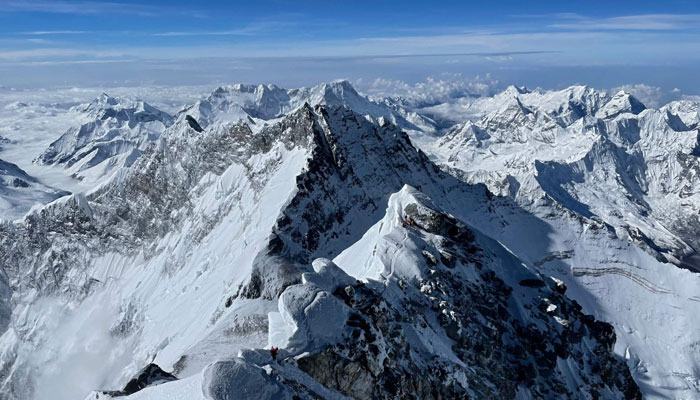
Snowfall across the Hindu Kush-Himalayan region has dropped to its lowest level in 23 years, putting nearly two billion people who rely on seasonal snowmelt for water at serious risk, scientists warned in a new report released Monday.
The Hindu Kush-Himalayan range, which stretches from Afghanistan to Myanmar, holds the largest reserves of ice and snow outside the Arctic and Antarctica and is a vital source of fresh water for about two billion people.
Researchers found "a significant decline in seasonal snow across the Hindu Kush Himalaya region, with snow persistence (the time snow remains on the ground) 23.6% below normal — the lowest in 23 years," the International Centre for Integrated Mountain Development (ICIMOD) said.
"This trend, now in its third consecutive year, threatens water security for nearly two billion people," it said in its Snow Update Report.
The study also warned of "potential lower river flows, increased groundwater reliance, and heightened drought risk".
Sher Muhammad, the lead author of the ICIMOD report, told AFP that "this year the snowfall started late in January and remained low in the winter season on average".
Several countries in the region have already issued drought warnings, with upcoming harvests and access to water at risk for populations already facing longer, hotter, and more frequent heatwaves.
The inter-governmental ICIMOD organisation is made up of member countries Afghanistan, Bangladesh, Bhutan, China, India, Myanmar, Nepal and Pakistan.
It urged countries that rely on the 12 major river basins in the region to develop "improved water management, stronger drought preparedness, better early warning systems, and greater regional cooperation".
The Mekong and Salween basins — the two longest rivers in Southeast Asia, supplying water to China and Myanmar — had lost around half of their snow cover, it noted.
Pema Gyamtsho, ICIMOD's director general, called for changes in policy to address the low snow levels in the long term.
"Carbon emissions have already locked in an irreversible course of recurrent snow anomalies in the HKH (Hindu Kush-Himalayas)," Gyamtsho said.
Asia is the region most affected by climate-related disasters, according to the UN's World Meteorological Organisation, which reported last month that five of the past six years have seen the most rapid glacier retreat on record.






-
 Sarah Pidgeon explains key to portraying Carolyn Bessette Kennedy
 -
 Inside Nicole 'Snooki' Polizzi's 'private' marriage with husband Jionni LaValle amid health scare
 -
 Germany’s ruling coalition backs social media ban for children under 14
 -
 Quinton Aaron reveals why he does not want to speak to wife Margarita ever again
 -
 Why Mikaela Shiffrin celebrated Olympic Gold with Taylor Swift song?
 -
 Political tensions steal spotlight at Berlin Film Festival closing ceremony
 -
 Hong Kong touts stability,unique trade advantages as Trump’s global tariff sparks market volatility
 -
 Friedrich Merz heads to China for high stakes talks in an effort to reset strained trade relations