Next Total Solar Eclipse will take place here
Upcoming Total Solar Eclipse is taking place soon
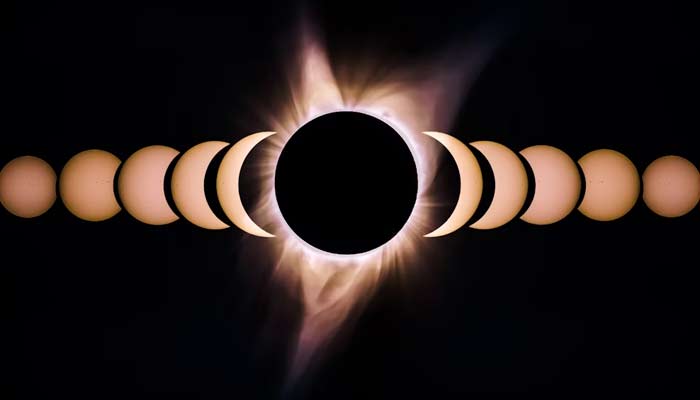
The upcoming Total Solar Eclipse will be visible from parts of Spain, Iceland and Greenland in 2026.
Following is everything that you should know about the next Solar Eclipse, according to Live Science.
Resulting in one of nature's most spectacular sights, Total Solar Eclipses are uncommon and dynamic events.
On Wednesday, August 12, 2026, when it will be possible to experience darkness in the daytime and briefly see the Sun's corona or outermost atmosphere with the naked eye, the next Total Solar Eclipse will take place.
When the Sun appears completely obscured by the Moon, this event is called "totality". The path of totality is the limited zone from which totality is visible on Earth.
Specifically, the places where the Moon's umbra, the darkest central part of its shadow, is projected across the Earth's surface, this path is just the movement of the Moon's shadow across the world.
One must be within this zone to experience totality.
Beginning at the northern tip of Russia, then passing over parts of Greenland, Iceland and Spain, the eclipse's 182-mile-wide (293 kilometres) path of totality will take around 96 minutes to cross the planet on Wednesday, August 12, 2026, according to Space.
Depending on the viewer’s location, the maximum duration of totality will be 2 minutes, and 18 seconds.


-
 Scientists discover new wild cat species in Bolivia for the first time in a century
 -
 SpaceX turns to failed startups for AI training: Here’s why
 -
 Why US is preparing its troops for possible combat around moon
 -
 NASA finds ‘once-in-a-century’ moon crater bigger than Roman Colosseum
 -
 Greenland and Antarctica face major ice loss: Key details explained
 -
 Scientists transplant lab-grown human brain tissue into mice: What they found
 -
 New discovery forces scientists to rethink how Earth formed
 -
 US finally confirms weapons in orbit: What it means for space warfare