
Most monstrous black hole moves closer to Earth
Milky Way's most monstrous stellar-mass black hole is coming close to Earth
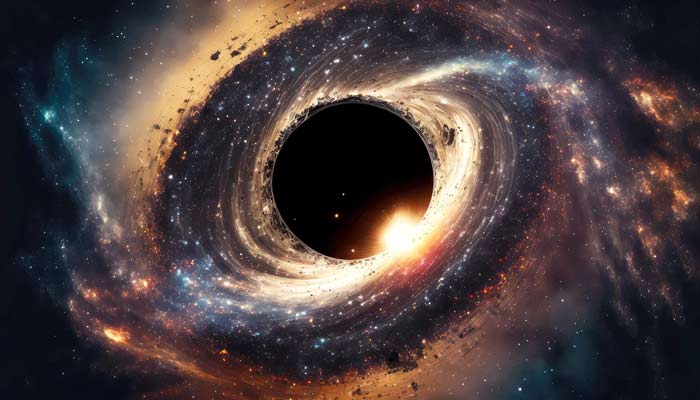
There's a massive newly discovered black hole in the Milky Way, and it looms near the Earth.
Using the European satellite telescope Gaia, which monitors the motion of billions of stars in our galaxy, this sleeping behemoth was found, according to Space.
When a massive star runs out of fuel and collapses, stellar-mass black holes are formed. The recent finding is historic since it is the first close-in discovery of a large black hole with this kind of genesis.
Gaia-BH3 is a stellar-mass black hole with a mass 33 times that of the Sun.
Notably, the most massive black hole of this class previously discovered in the Milky Way was a black hole in an X-ray binary in the Cygnus constellation (Cyg X-1).
In the Milky Way, the typical stellar-mass black hole is roughly ten times heavier than the Sun.
Gaia-BH3 is the second-closest black hole to Earth ever found, situated about 2,000 light years away.
At 1,560 light-years away, Gaia-BH1, another black hole found by Gaia, is the closest black hole to Earth.
Additionally, with a mass of about 9.6 times that of the Sun, Gaia-BH1 is far smaller than this newly discovered black hole.




-
 SpaceX launches another batch of satellites from Cape Canaveral during late-night mission on Saturday
 -
 NASA targets March 6 for launch of crewed mission around moon following successful rocket fueling test
 -
 Greenland ice sheet acts like ‘churning molten rock,’ scientists find
 -
 Space-based solar power could push the world beyond net zero: Here’s how
 -
 Hidden ‘dark galaxy' traced by ancient star clusters could rewrite the cosmic galaxy count
 -
 Astronauts face life threatening risk on Boeing Starliner, NASA says
 -
 Giant tortoise reintroduced to island after almost 200 years
 -
 Blood Falls in Antarctica? What causes the mysterious red waterfall hidden in ice