World
Total solar eclipse 2024: Which US states will see totality?
The rare celestial event will first be visible at 12:23pm in Dallas Texas
By Web Desk
Published April 08, 2024
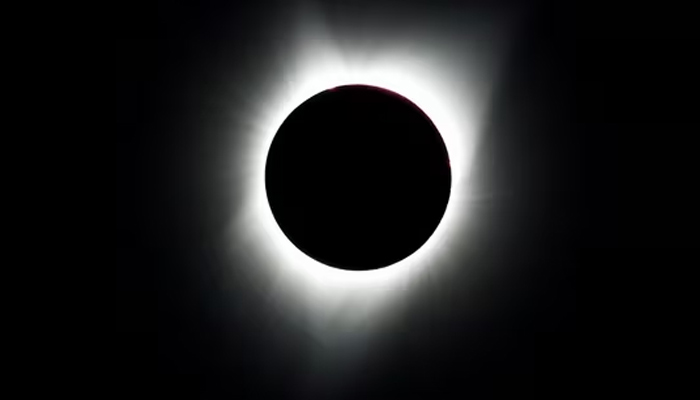
As the highly anticipated total solar eclipse is finally upon us, thousands of spectators are estimated to travel to witness the rare celestial event.
The April 8 solar eclipse will start from the Pacific Coast area of Mexico, then move to Texas and Canada, Geo News reported.
The eclipse will cover a path area of 116 miles.
These US states will see totality
- Texas
- Oklahoma
- Arkansas
- Missouri
- Illinois
- Kentucky
- Indiana
- Ohio
- Pennsylvania
- New York
- Vermont
- New Hampshire
- Maine
What is duration of Total Solar Eclipse 2024?
According to experts, the event cumulatively takes over two hours however, the totality in different parts would occur for only 4 minutes or more.
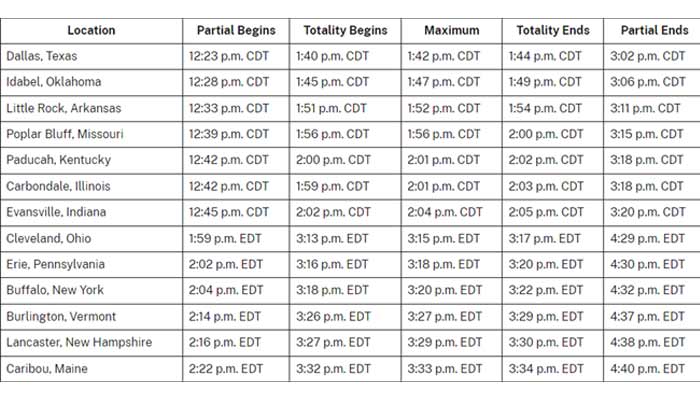
The eclipse will begin in Mexico's Pacific Coast at around 11:07am PDT on April 8, said Nasa.
And the total solar eclipse will gradually exit North America at around 5:16pm NDT from Newfoundland, Canada.
Best places to view eclipse from
- Kerrville, Texas
- Dallas, Texas
- Russellville, Arkansas
- Cape Girardeau, Missouri
- Carbondale, Illinois
- Bloomington, Indiana
- Indianapolis, Indiana
- Cleveland, Ohio
- Erie, Pennsylvania
- Buffalo, New York
- Niagara Region, Ontario
- Burlington, Vermont
- Houlton, Maine


-
 Eight charged after police dismantle massive illicit cannabis grow operation in Ontario
 -
 Trump grant cuts hit health, disaster relief and education across US, analysis finds
 -
 EU plans total social media ban for under 13s as von der Leyen targets big tech
 -
 Pete Hegseth impeachment vote put on hold after House cuts session short
 -
 EU to launch Climate Insurance Alliance to close growing protection gap after extreme temperatures
 -
 US interest rates rise as Fed signals another hike could be coming this year
 -
 Police recover body from pond after massive search for missing Noah Woods
 -
 AI regulation could be nearing dramatic shift, says ‘Godfather of AI’ Yoshua Bengio