Watch Solar Eclipse without glasses following this way
Millions of people will experience celestial event on April 8
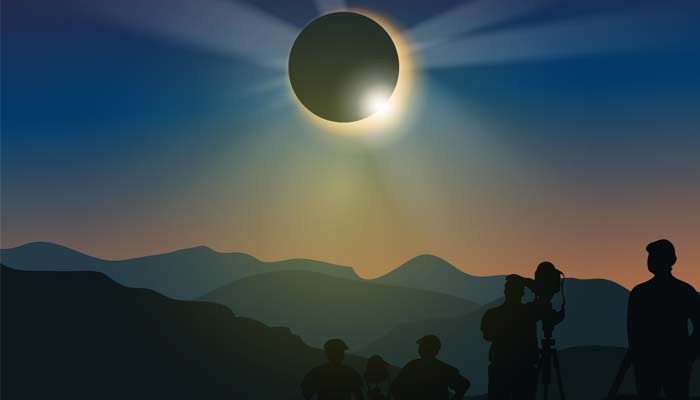
When the sky darkens during a Total Solar Eclipse on April 8, millions of people along a narrow band in North America will look up.
However, safety is key, when they do, according to AP.
Permanent eye damage can occur if people will be staring directly at the sun during a Solar Eclipse at any time.
The period of total darkness when the moon completely covers the sun and during totality, only then the eclipse is safe to witness with the naked eye.
Sunglasses are not protective enough, and binoculars and telescopes without a proper solar filter can magnify light from the sun, making them unsafe.
Eclipse glasses should be bought from a reputable vendor by those eager to experience the eclipse.
But if you don’t have eclipse glasses, you can still enjoy the celestial event through indirect ways such as making a pinhole projector using household materials.
Through a piece of cardstock or cardboard, poke a hole, hold it up during the eclipse and look down to see a partial crescent projected below.
A similar effect will be produced by holding up a colander or a cracker.
Another trick includes, under a shady tree, peering at the ground can yield crescent shadows as the sunlight filters through branches and leaves.
Viewing the eclipse through a phone camera has been warned by the experts.
A phone’s digital components can also be damaged by the sun’s bright rays.
Disclamer: We strongly advise that people buy the eclipse glasses.


-
 SpaceX: Starship V3 all set for debut launch ahead of IPO
 -
 Four alien species recovered from crashed UFOs, Ex-CIA researcher claims
 -
 NASA delays Moon landing as Artemis III shifts to orbit mission
 -
 Scientists reveal shocking early sighting of 3I/ATLAS comet
 -
 Asteroid 2026 JH2 to pass extremely close to Earth on May 18: Should we be concerned?
 -
 Meet the ‘last titan’: Giant new dinosaur identified from fossils in Thailand
 -
 Can we finally find aliens? Scientists reveal a surprising new ‘organizational’ approach
 -
 Study reveals how to tell real alien life from chemical fakes
-
 Scientists find hidden third ancestral group in Japanese genomes
 -
SpaceX ‘Space Junk’ is on a collision course with the Moon, scientists say
-
Do you know what happened on May 10, 1967? NASA's M2-F2 disaster explained
-
Why the Southern Ocean is melting: Antarctica’s sea ice resilience reaches a breaking point