
Milky Way's parent stars finally discovered after 13 billion years by Gaia spacecraft
Gaia discovers "Shakti and Shiva" star streams, that give birth to Milky Way
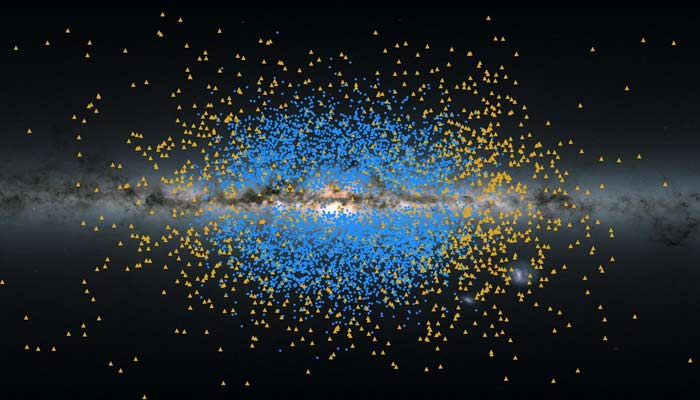
Astronomers have tracked down two streams of stars that likely formed the foundation of the Milky Way, using ESA’s Gaia spacecraft.
The two streams named “Shakti and Shiva” contain about 10 million stars, all of which are 12 to 13 billion years old, according to Universe Today.
These stars likely came together even before the spiral arms and disk were formed. They are moving in roughly similar orbits and have similar compositions. Moreover, they can probably be separate galaxies that merged into the Milky Way shortly after the Big Bang.,
“What’s truly amazing is that we can detect these ancient structures at all,” said lead author Khyati Malhan of the Max Planck Institute for Astronomy (MPIA) in Heidelberg, Germany, in an ESA press release.
“The Milky Way has changed so significantly since these stars were born that we wouldn’t expect to recognise them so clearly as a group – but the unprecedented data we’re getting from Gaia made it possible.”
Gaia uses Astrometry, the precise measurements of the positions and movements of stars and other celestial bodies, is used by Gaia. It is building the largest, most precise three-dimensional map of our Galaxy by surveying nearly two billion objects.
“Shakti and Shiva populations possess an unconventional combination of orbital and abundance properties that have not been observed previously,” the researchers wrote in their paper, published in the Astrophysical journal.



-
 World oceans absorbed record heat in 2025, may trigger intense climate crises, says report
 -
 February full moon 2026: Snow Moon date, time and visibility
 -
 Watch: Beautiful northern lights dazzling over Greenland's skies
 -
 Wildfires are polluting our environment more than we thought: Find out how
 -
 3I/ATLAS flyby: Why is Jupiter’s 96th Moon drawing intense scientific interest?
 -
 NASA spacewalk 2026: Medical issue prompts rare talk of early ISS crew return
 -
 Comet 3I/ATLAS: Scientists examining images they cannot easily explain
 -
 Wolf Moon 2026: Will the full moon outshine the Quadrantid meteor shower?