Rupee plunges on lingering IMF loan limbo
Local currency closes at 266.11 per dollar in the interbank market
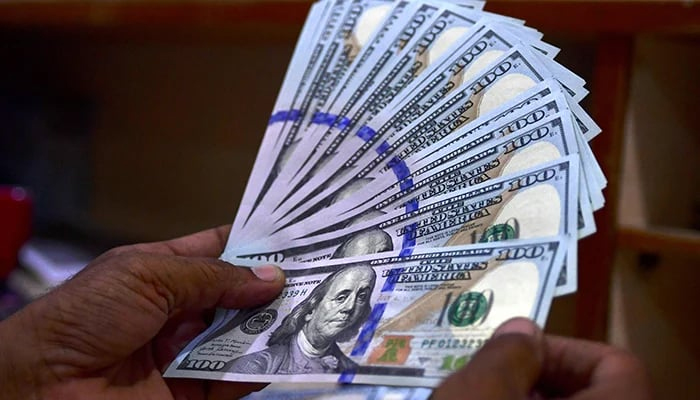
The rupee Wednesday plummeted versus the dollar after reports that the International Monetary Fund (IMF) has raised the loan bar even higher, making it more difficult for the coalition government to meet the herculean conditions for the release of the next tranche.
The rupee fell 4.61 or 1.73% to close at 266.11 in the interbank market, according to the State Bank of Pakistan's (SBP) data, down from the previous close of 261.50.
In a new development, officials engaged with the Fund told The News that the Washington-based lender has asked Pakistan to implement four prior actions, including the imposition of a permanent surcharge of Rs3.82 per unit on electricity.
The implementation of all four prior actions only can pave the way for striking a staff-level agreement and the release of a $1 billion tranche under the $6.5 billion Extended Fund Facility (EFF) signed in 2019.
Policymakers negotiating on behalf of Pakistan have called these prior actions unjustified, the publication stated.
Making a comparison of the prior actions with the 1998 conditions, a top official recalled that there were 24 prior actions for the revival of the IMF programme when Pakistan faced a financing gap of approximately $400 million in 1998.
When all the 24 prior actions were fulfilled, then petty issues came to the surface but the Pakistani side managed to resolve all for paving the way for reviving the IMF programme in January 1999, he added.
Investors also cited Moody's Investors Service slashing Pakistan's sovereign credit rating to 'Caa3' for the decline in the local currency's value.
Moody's slashed the rating amid critical loan talks with the IMF, arguing that the worsening liquidity situation was "significantly raising default risks."
"The currency remained under pressure amid Moody's down gradation of country's rating to CAA3 coupled with IMF requirement of the market-determined exchange rate before the staff level agreement," Arif Habib Limited's Head of Research Tahir Abbas told The News.
The funds are crucial for Pakistan as the foreign exchange reserves are just above $3 billion, which is enough for an import cover of less than a month.
The dollar scarcity in the market has caused several businesses to halt operations or shut down for an indefinite period, while the inflation is also at record highs — making life harder for the already burdened people.


-
 Hyundai to recall nearly 100,000 US vehicles over fire risk from overheating
 -
 Will Tesla and SpaceX merge? Barclays expects announcement ahead of December meeting
 -
 GSK eyes over 1,200 Belgian job cuts in cost-saving drive
 -
 Netflix slashes 1,000 jobs: What’s behind the cuts?
 -
 Anthropic to reveal new revenue figures as AI financial race heats up
 -
 HSBC to phase out fixed-pay allowances by 2028 in major compensation overhaul
 -
 TotalEnergies expands US renewable venture with KKR in $1.2B solar portfolio deal
 -
 Australian telecom shares tumble as SpaceX moves closer to direct-to-cell market
-
 World Bank in crisis aid talks with dozens of nations amid global shocks
 -
Deutsche Bank chief explains why German election results alarm foreign investors
-
China orders development of national blockchain network in economic blueprint: Here’s why
-
Tesla renames 'full self-driving' to 'assisted driving' in Europe: What to know