
Pakistan, India can’t afford another war: PM Shehbaz Sharif
Shehbaz Sharif reiterated Pakistan’s strong resolve to maintain peace in the region, but added that sustainable peace in South Asia was linked to the resolution of the Kashmir issue
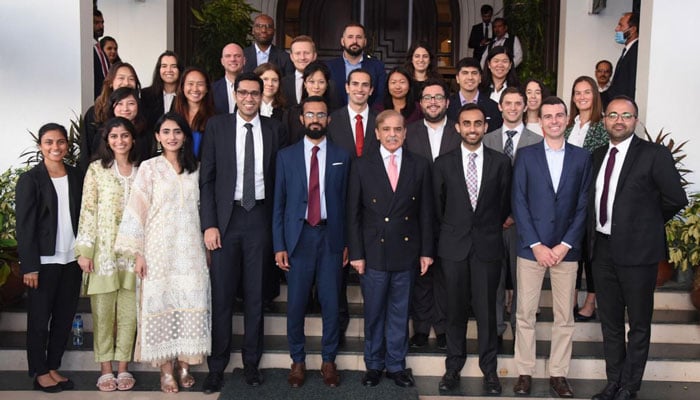
ISLAMABAD: Prime Minister Shehbaz Sharif Friday reiterated Pakistan’s strong resolve to maintain peace in the region, but added that sustainable peace in South Asia was linked to the resolution of Jammu and Kashmir issue in line with the UN resolutions and the wishes of Kashmiris, and nothing short of it would work.
“We want permanent peace with India through dialogue as war is not an option for either of the country,” he said while talking to a group of students from Harvard University, USA. Shehbaz pointed out that Islamabad and New Delhi should have competition in trade, economy and improving the conditions of their people. Pakistan was not an aggressor, but its nuclear assets and the professionally trained army are deterrence. “We spend on our military to protect our frontiers and not for aggression,” Shehbaz Sharif said.
The delegation consisted of students from diverse origins and academic backgrounds. The PM welcomed students and held a candid discussion about contemporary challenges Pakistan was facing today.
In response to a question about the national economy and the IMF programme, the PM said that Pakistan’s economic crisis stem from structural problems along with political instability in the recent decades. He said the first few decades since the inception of Pakistan witnessed impressive growth across all sectors of the economy when there were plans, national will and the implementation mechanism to produce outcomes. “Overtime, we lost the edge in sectors in which we were ahead. The lack of focus, energy and policy action led to reduction in national productivity,” he regretted.
He said that efforts and resources had been deployed to stabilise the economy. Doing so is most crucial, but there is still a bumpy road ahead. “We have a work ahead which involves prudent policies keeping the big picture in mind,” he added.
The PM also shared that his economic action plan has three prongs; revitalisation of economy, making information technology (IT) pivot of national development, and exports leading the economy. The PM also shed light on his futuristic programme of free laptops given to high achievers in PMLN’s previous tenure, which not only helped the students to continue their education in the times of COVID-19, but also helped the youth of Pakistan to get a strong foothold in the global freelance market.
“For Pakistan to develop, we need to focus on vocational, scientific and skilled education. Knowledge-based economy is the buzzword and undeniable reality of our times,” he added. He also said, “The government is working on a plan to unpack the country’s huge but untapped potential in the field of information technology. It is our resolve that we increase our IT exports from the existing $2billion to $15 billion in coming years.”
The PM also emphasised the importance of political stability in the country. He said since the economy is dependent on political stability, he had repeatedly offered grand dialogue, which had Charter of the Economy as its chief highlight.
In reply to a question about Sino-Pak relations, the PM replied that China, Pakistan are time-tested friends and their friendship gained new heights with the signing of China-Pakistan Economic Corridor (CPEC). The relationship with China remains the cornerstone of our foreign policy, he said, adding that CPEC had heralded the beginning of a new era of economic development.
Pakistan is ready to promote the spirit of CPEC, which is a win-win partnership for regional peace, security and development. The relationships in today’s world are not mutually exclusive. “We look forward to engaging with the whole world at bilateral and multilateral levels,” he said.
Responding to a question about climate change, the PM reiterated the importance of the responsibility the developed world carries towards the developing countries like Pakistan which is less than 1% contributor to carbon emissions, but is 5th most vulnerable country regarding the effects of climate change.
He also shared the government’s plans to shift from imported fuels to solar, wind and hydel energy as Pakistan has immense potential in these areas. The students appreciated PM’s progressive approach for uplifting Pakistan’s economy, bringing peace in the region and political stability in the country.
The delegation also spoke very highly of the hospitality extended to them by the government and people of Pakistan during their visit.


