
Pakistan, India on brink of nuclear water war: Bilawal
Bilawal said that India and Pakistan are bound by terms of Indus Waters Treaty (IWT)
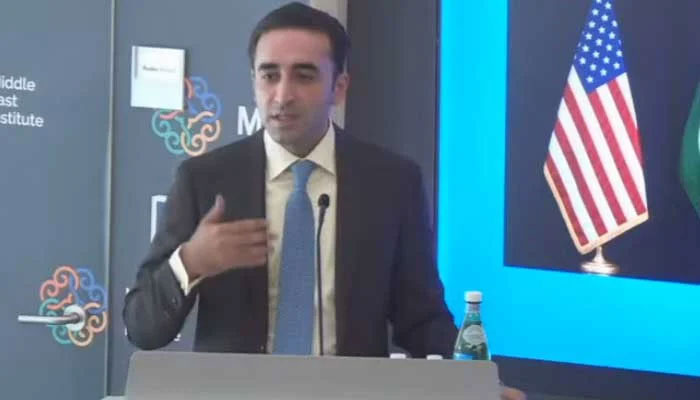
LONDON/BRUSSELS: Bilawal Bhutto Zardari, head of a parliamentary delegation that is touring world capitals to rally support for Pakistan following a recent confrontation with India, has warned that Pakistan and India stand at the edge of a nuclear water war after the Indian government suspended the Indus Waters Treaty (IWT) to block the water flow into Pakistan.
Addressing a press conference at the Pakistan High Commission at the conclusion of his two-day tour of the UK capital, Bilawal Bhutto said that the Pakistan military had made the whole nation proud.
He said: “We are proud that the Pakistan army won the war against India under the leadership of Field Marshal General Asim Munir. Pakistan won the war under General Asim Munir’s leadership. His promotion as the Field Marshal is his recognition. The Pakistan Army proved that it can beat India, both at the military and the diplomatic front. We have shown and established our military strength. India’s war was based on lies and its whole narrative was based on falsehood. Now the whole world recognises this fact.”
Bilawal said that India and Pakistan are bound by the terms of the Indus Waters Treaty (IWT). “Pakistan has said that this will be an act of war if Pakistan’s water is stopped. India is involved in water terrorism against Pakistan. To threaten to stop water coming into Pakistan, this is an act of war. India will have to take back and withdraw its threat. The prospect of a nuclear war over water is a reality.” He said Pakistan may take more aggressive steps if India constructs new canals or dams on the three rivers within its territory.
“India’s threat to shut off the water supply to 240 million people in Pakistan is a violation of the UN Charter. Were they to act on it, Pakistan has been very clear: we’d consider that an act of war,” he said.
He was referring to India’s unilateral suspension of the Indus Waters Treaty after the April 22 militant attack in the Pahalgam area of the Indian Illegally Occupied Jammu and Kashmir (IIOJK).
Bilawal Bhutto Zardari said India was involved in transnational repression. He said the Canadian and Western intelligence services, including the US government, had evidence that India was involved in terrorism on Western soil. He mentioned the killing of Hardeep Singh Nijjar in Canada and the assassination attempt on Gurpatwant Singh Pannun, the Sikhs For Justice (SFJ) leader, on the US soil. Bilawal said that after the Pahalgaam attack, the Western world didn’t side with India because it knows that India is involved in terrorism beyond its borders, its neighbourhood and the region and is striking inside Western countries too.
Bilawal condemned Indian external affairs minister Jaishankar for threatening to “strike deep inside Pakistan”. He said: “Jaishankar speaks like a warmonger and not a diplomat. The real problem is extremism in the Indian government. It’s ironic that Modi is running a government whose reputation speaks for itself. Indian role in targeting Sikhs stands exposed before the world. India is a terrorist state, threatening missile strikes on Pakistan without any proof. It’s not a display of strength but a dangerous sign of regional instability, the word must ask who is warmongering here. To this day, India has been unable to share any identity of the so-called terrorists involved in the Pahalgam attack. The truth is India knows Pakistan has nothing to do with this attack, this is what they are hiding from its people. The Pahalgam attack was India’s intelligence failure. India has gone mad and is pursuing its strategy of warmongering but it will fail.”
Bilawal welcomed President Donald Trump’s offer to media between India and Pakistan. He said Pakistan was thankful to the US government’s pragmatic approach and its offer to mediate. “India wants to sabotage Trump’s peace efforts,” he said.
Bilawal thanked President Trump for internationalising the issue of occupied Kashmir. “Kashmir is not a bilateral issue but an international issue and India is forced to address it. India accepts the issue has gone global.” Bilawal said Pakistan had previously presented a full dossier of Indian involvement in terrorism to the world and a new dossier for the international community will be presented soon to show the true face of Indian terrorism before the world.
Talking to The New York Post in a recent interview, Bilawal warned US lawmakers and diplomats last week that the “threshold” for war between his nation and India is lower than ever following clashes in the disputed region of Kashmir last month.
“We’re incredibly grateful for the role that the US government — President Trump, Secretary [of State] Marco Rubio — created throughout this crisis in helping us all achieve this cease-fire,” Bilawal told The Post.
“But our message has been that the cease-fire is a start, but it is only a start, and what we seek is assistance in our pursuit of peace through dialogue and diplomacy.”
Bilawal warned US lawmakers and diplomats last week that the “threshold” of war between his nation and India is closer than ever following skirmishes in the disputed region of Kashmir last month.
“We’re all a lot less safe as a result of this conflict than we were before,” he added. “The threshold of full-out military conflict between India and Pakistan has been drastically lowered — the lowest it has ever been in our history, as a result of this conflict.” The US-brokered truce between the nuclear-armed nations took effect May 10 after weeks of fighting. The Pakistani delegation that came to Washington expressed a desire to coordinate with India on counter-terrorism — but rejected that Islamabad was involved in any way with the attack.
“The Prime Minister of Pakistan offered an impartial international inquiry because we were confident that Pakistan is not involved in this terrorist incident,” Bilawal said. “The international intelligence community endorses this view.”
“As things stand now, if there’s a terrorist attack anywhere in India,” he went on, “it immediately means war, and the law of reciprocation means, therefore, if there’s a terrorist attack in Pakistan, we are to also treat it as an act of war.” Bilawal also said that India’s threat to cut off Pakistan’s water was “an existential matter” that would be considered “an act of war.”
“If we are to engage in a new dialogue with India, make new promises with one another that could potentially lead to new treaties, then it’s very important that they abide by the old treaties like the Indus Water Treaty,” he said.
“I’m optimistic that the president is passionate about peace and that he will be successful in pushing that message here in the United States,” he said of Trump. “Pakistan is obviously ready.”
“We had a military upper hand when we agreed to the cease-fire. We did so on the stipulation that the cease-fire would be the first step,” he said. “I’m optimistic that the president is passionate about peace and that he will be successful in pushing that message here in the United States.” Later, led by the former foreign minister and PPP Chairman Bilawal BhuttoZardari, the parliamentary delegation arrived in Brussels after successful visits to Washington, New York and London.
Ambassador of Pakistan to the European Union, Belgium and Luxembourg Rahim Hayat Qureshi received the delegation.
One the directive by the prime minister, the delegation will present Pakistan’s position on recent tensions with India and advocate for a just resolution of the Kashmir dispute in line with UN resolutions and the aspirations of the Kashmiri people.
The Bilawal-led delegation includes Climate Change and Environmental Coordination Minister Musadik Malik, Senate Standing Committee on Climate Change and Environmental Coordination Chairperson Sherry Rehman, National Assembly Standing Committee on Foreign Affairs Chairperson Hina Rabbani Khar, former minister for commerce, defence and foreign affairs Khurram Dastgir Khan and Mutahidda Qaumi Movement Parliamentary Leader in the Senate Faisal Ali Subzwari.
The delegation also comprises two former foreign secretaries — Jalil Abbas Jilani, who also served as caretaker foreign minister, and Tehmina Janjua.
In Brussels, the delegation will engage with EU leadership, European Parliament members, EU Commission, European External Action Service, think tanks and media.
They will emphasize Pakistan’s commitment to peace and responsible diplomacy in contrast to India’s provocative actions, calling for dialogue over confrontation, and urging global support for lasting peace in South Asia, including the resumption of the Indus Waters Treaty.


