
A perfect storm
Displacement in war-ridden countries is not stand-alone issue; it is often intertwined with other setbacks
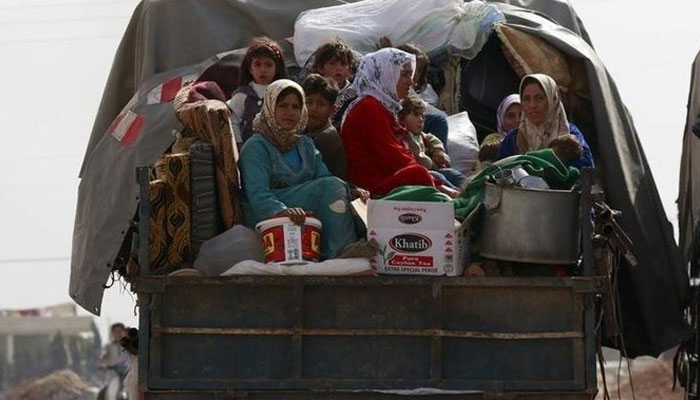
The Global Report on Internal Displacement 2025 (GRID), recently launched by the Internal Displacement Monitoring Centre (IDMC), indicates that over the past decade, 73.5 million people have been internally displaced due to violence and armed conflict, whereas climate-induced disasters displaced 9.8 million.
These figures include people who remain without sustainable resettlement, living in protracted displacement for years in countries such as Afghanistan and Syria – as well as those uprooted by the recent waves of chaos in Palestine, Lebanon and many others.
The year 2024 has also marked a considerable rise in global instability, with 20.1 million people displaced by conflict and 45.8 million by climate disasters in a span of just one year. In the Gaza Strip, 90 per cent of the population, already displaced at the start of 2024, encountered a second displacement as the magnitude of unabated hostilities escalated during the year. According to GRID, approximately 3.2 million people were uprooted in Palestine in 2024. However, the report also states that these statistics underrepresent the true extent of displacement in a region sinking into a relentless Armageddon.
Displacement in war-ridden countries is not a stand-alone issue; it is often intertwined with other setbacks. For instance, heavy bombardment in Lebanon has destroyed agricultural activity, and the restriction on the displaced farmers returning to their areas of origin has further disrupted the sector. This has considerably fueled food insecurity, poverty and inequality, and has reduced the country's national productivity. This shows that such countries are trapped in multiple layers of hardships and are particularly vulnerable to the impacts of climate change. For instance, the carbon footprint in Gaza has intensified due to constant aerial bombardment, ground invasion, and destruction of trees and vegetation. This unprecedented environmental destruction has been declared as an ‘ecocide’ – a possible war crime.
According to IDMC and ND-GAIN, over 75 per cent of people displaced by conflict live in countries highly vulnerable to climate change. In Yemen, floods have destroyed infrastructure, while armed groups block aid to displaced populations.
In South Asia, this month’s Pakistan-India conflict has displaced over 8,000 people near the Line of Control, due to drone strikes, shelling and artillery fire. With ceasefire violations continuing, displacement figures are expected to rise. The region’s volatile power dynamics and climate vulnerability make this an increasingly urgent humanitarian crisis, where conflict and climate pressures compound displacement at alarming rates.
Correspondingly, the Climate Risk Index (2025) has also ranked Pakistan as the fifth most climate-vulnerable country primarily due to devastating floods of 2022 that affected 33 million people, many of whom remain displaced to this day. Hence, a lapse in the Indus Waters Treaty can become a pressing concern because the flow in western rivers falls during dry seasons. Recent droughts in Pakistan have already affected millions – destroying agricultural activities, causing food insecurity and triggering displacements. The increasing water stress is already degrading the soil structure, and as the land’s ability to absorb rainfall declines, the risk of destructive floods rises alongside droughts.
Such cases present a stark reminder of how the multiplier effects of war and climate crisis not only trigger displacement but also undermine the well-being, safety and prospects of those forced to flee. Therefore, in a world where war and climate chaos are converging with unprecedented force, displacement is no longer a temporary issue but is becoming a permanent condition of life for millions. The statistics may quantify the crisis but cannot capture the scale of human suffering or the erosion of stability unfolding right before us. If global and regional actors continue to address conflict and climate change as isolated challenges, they will only perpetuate the cycle of displacement, destruction and despair.
A paradigm shift is urgently needed – one that treats peace, climate resilience and human security as inseparable, and offers a path through which we hope to reclaim the possibility of a livable future for the forcibly displaced.
The writer is a research associate at the Graduate Institute of Development Studies, Lahore School of Economics.


