
Comprehensive report on family-friendly workplace policies in Pakistan launched
Report offers valuable insights into how progressive workplace measures—such as parental leave
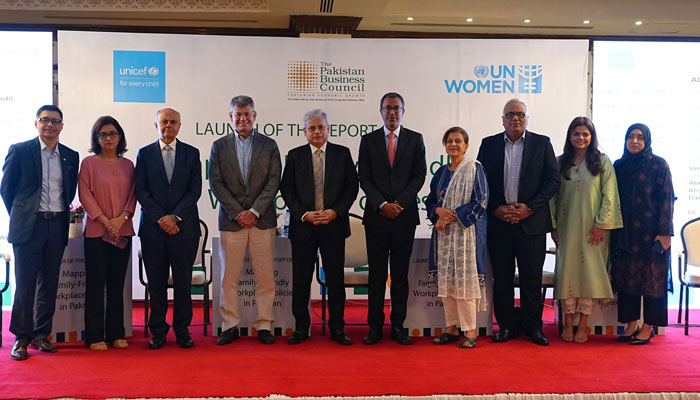
ISLAMABAD: Highlighting the critical role of family-friendly policies in supporting the social sector, businesses, employees, and Pakistan’s broader economic growth, the Pakistan Business Council (PBC), UNICEF, and UN Women jointly launched a landmark report titled “Mapping Family-Friendly Workplace Policies in Pakistan,” on Monday.
The report offers valuable insights into how progressive workplace measures—such as parental leave, flexible working arrangements, and childcare support—can enhance employee well-being, child development, promote gender equality, and contribute to sustainable economic development.
Pakistan is home to over 92 million children under the age of 14, yet formal childcare support remains limited posing a significant challenge for working parents, particularly mothers striving to balance their professional and caregiving responsibilities.
This comprehensive report examines family-friendly workplace policies in Pakistan with a focus on childcare initiatives and their impact on economic growth, gender equality, and workforce retention. Employing a mixed-methods design—including surveys, focus group discussions, in-depth interviews, and observational visits in urban centers such as Karachi, Lahore, and Islamabad—the study integrates both quantitative and qualitative data to provide robust insights.
The report urges businesses to start by understanding the needs of their employees and to explore sustainable childcare models appropriate to their industry. Offering flexible work arrangements and employer-supported childcare solutions are among the most effective ways to support working families and foster a more inclusive workforce.
The report also emphasizes the need to train managers to recognize and reduce bias around caregiving, build cross-sector partnerships to support childcare infrastructure, and embed family-friendly policies into business practices and operations to ensure long-term commitment to support working families.
In his remarks, Ehsan Malik, CEO of PBC, emphasized that, “For the private sector, family-friendly policies have evolved beyond compliance or corporate goodwill—they are now essential for cultivating a modern, resilient, and high-performing workforce. Businesses that invest in supporting working parents benefit from stronger talent retention, lower absenteeism, and greater gender diversity.
This report acts as a practical resource, presenting a variety of adaptable models for companies to tailor to their specific needs. It offers a starting point—or a next step—for organizations aiming to create more inclusive, supportive, and future-ready workplaces.”
“Family-friendly policies are key to unlocking children’s potential, empowering women, and driving economic growth in Pakistan,” said Abdullah Fadil, UNICEF Representative in Pakistan. “With only one in five women in the workforce, flexible work arrangements, access to affordable, quality childcare, and support for working mothers are essential. These policies foster early childhood development that shapes a child’s entire future and contributes towards a more inclusive, productive Pakistan.”
Jamshed Kazi, Country Representative, UN Women Pakistan, said that, “ When workplaces adopt family-friendly policies, they not only support parents—they help build a more gender-diverse and inclusive workforce. These policies challenge traditional gender roles, promote shared caregiving responsibilities, and contribute to shifting social norms both in households and at work. By enabling all caregivers—women and men alike—to thrive professionally while nurturing their families, we lay the foundation for stronger communities and a more equitable, prosperous future for Pakistan.”
In her keynote speech Shaheena Sher Ali, Minister for Women Development, government of Sindh said, “An ideal workplace is one where both women and men are provided with equal opportunities, safety, and professional growth. We envision an environment where women are empowered to excel according to their talents, and men stand beside them as supportive and respectful colleagues. Together, women and men build stronger institutions, economic stability, and a more inclusive society. Mutual respect, collaboration, and equality at the workplace are the pillars that lead us toward a brighter and more developed Pakistan.”







-
 King Charles, Camilla To Snub Prince Harry’s America Meet-up Attempt
 -
 Zendaya Crashes Young Couple Wedding In Las Vegas
 -
 Patrick J. Adams Breaks Silence On How 'The Madison' Role Echoed Family Loss
 -
 Prince William, Kate Middleton Push Drastic Changes
 -
 Prince William Has ‘little Forgiveness’ In Heart For Prince Harry
 -
 Netflix Eyes Shock Revival Of 'The Crown' After Andrew Mountbatten Windsor Controversy
 -
 Jennifer Aniston's Beau Jim Curtis Becomes Her Guiding Light
 -
 Prince Harry, Meghan Markle Swimming Dangerous Waters With Australia Trip
 -
 Lewis Hamilton Warned Against Kim Kardashian Romance To Save Brand Name
 -
 'American Pie' Star Shannon Elizabeth Makes Rare Admission About Legacy Role
 -
 Prince William Spectates Team Wales During Rugby Match In Cardiff
 -
 Teyana Taylor Drops Cryptic Hint About What Could Happen At The Oscars
 -
 Andrew Mountbatten Windsor, Sarah Ferguson 'flagged By Intelligence Services'
 -
 Kim Kardashian Headed For Another Love Crash With Lewis Hamilton
 -
 Kris Jenner Recalls Trying To Save Kylie Jenner From 'biggest Failure' Of Life
 -
 Britney Spears Leaning On The Kardashians Post DUI Arrest