
UN’s Article 51 in focus after Indian aggression
“Pakistan has every right to give a robust response to this act of war imposed by India," says Shehbaz
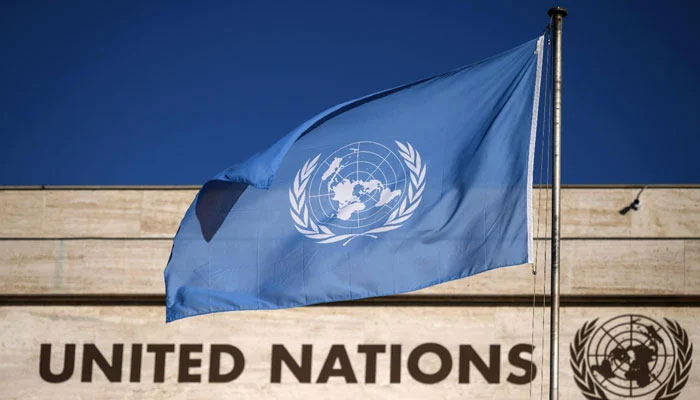
KARACHI: As India insists its military action was “restrained and non-escalatory”, Pakistan has invoked Article 51 of the UN Charter to justify its right to self-defence, warning of a robust response — even as legal experts ponder over how far international law permits retaliation beyond immediate defence.
Indian National Security Adviser Ajit Doval spoke with global leaders on Wednesday and said that India had no intent to escalate -- but added that it would retaliate if Pakistan escalated matters.
Meanwhile, Prime Minister Shehbaz Sharif, too, addressed the nation and spoke in parliament, saying that “Pakistan has every right to give a robust response to this act of war imposed by India, and a strong response is indeed being given”.
Pakistan has been citing Article 51 of the UN Charter for its right to self-defence. Article 51 says: “Nothing in the present charter shall impair the inherent right of individual or collective self-defence if an armed attack occurs against a Member of the United Nations, until the Security Council has taken measures necessary to maintain international peace and security. Measures taken by Members in the exercise of this right of self-defence shall be immediately reported to the Security Council and shall not in any way affect the authority and responsibility of the Security Council under the present Charter to take at any time such action as it deems necessary in order to maintain or restore international peace and security”.
On Wednesday morning, Pakistan’s National Security Committee had categorically stated that Pakistan reserves the right to respond “in self-defence at a time, place, and manner of its choosing”.
With near-consensus in Pakistan that India’s actions constitute unwarranted aggression and an act of war, the country faces two broad choices: escalate militarily in retaliation or treat its current response as a completed act of self-defence -- for now.
On Wednesday, Defence Minister Khawaja Asif said that all options were on the table, telling Geo’s Shahzeb Khanzada that there had “not been any closure yet” and that Pakistan had the “moral justification” to retaliate and even the odds.
While speaking to the media, Adviser to the PM Rana Sanaullah said that Pakistan had given a “resounding response” to India. He added, “If India does anything more, we will also do more. If India does not take any further action, then as a responsible state, we will also not take action” -- but then also told Geo’s Hamid Mir later at night that Pakistan did reserve the right to retaliate and avenge the deaths of civilians.
Speaking to international media on Wednesday, PPP Chairman Bilawal Bhutto Zardari said: “What choice does Pakistan have? Innocent civilians have been killed. Our sovereignty has been violated....”
So what exactly does international law say? And where does Article 51 stand in all this? Talking to Geo News, lawyer Reema Omer said that “Article 51 is about defence -- not retaliation or revenge”, adding that India had also “created this confusion when they first decided to strike. You can’t attack and say this was self-defence”. Omer also said that the current conflagration between India and Pakistan “is not a war, in my opinion, at the moment. These are hostilities. I would not want war because war is horrific and war rules are horrific”. In that context, per Omer, “self-defence doesn’t mean teaching a state a lesson”. She explained that what India did (when it attacked Pakistan) was obviously “against international law” and Pakistan “had the right to self-defence” but that now if Pakistan were to escalate matters, that would be “problematic” and raise questions under international law. According to Reema Omer, “the self-defence ambit is restricted. Now, Pakistan should show restraint”. Speaking to The News, international law expert Jamal Aziz, who is the executive director at the Research Society of International Law (RSIL), said that Pakistan would use Article 51 as the main argument. “What India did was by every threshold of international law an armed attack and Pakistan was entitled to exercise force under Article 51”.
But what happens now? Would Pakistan launching an attack on India still fall under Article 51? Or would it be deemed problematic? Aziz said there were two schools of thought on this. One is that “self-defence is only when we halt or repel an attack while it is happening. So anything we did yesterday would be lawful self-defence -- textbook self-defence”.
But beyond that point, things become more complicated. The conservative legal view, said Aziz, would oppose a delayed response. However, he added that a broader interpretation -- developed post-9/11 -- holds that Article 51 can also apply to continuing threats to future security. “In Pakistan’s case, we can clearly make this argument since India has been trying to create a new normal via Uri, etc”. He cautioned, however, that “the longer we delay, the longer it will become an indication that it is an unlawful retaliation”.
Could India use ‘terror’ as justification for its strike? Aziz argued that India is “openly trying to use counterterror frameworks in a way that distorts international mechanisms -- for example, like the IWT abeyance”.
Still, under classical international law, if an armed attack takes place, Pakistan has the right to respond in self-defence -- regardless of the terrorism argument, said Aziz, since the “attribution test” is very high and “clearly not been met; India hasn’t even tried to do that”.
Overall, said Aziz, “international law would be in favour of Pakistan”. He added that Pakistan could highlight the “effective self-defence we did -- perhaps try strikes that also de-escalate. We don’t want to use language like ‘avenge’; we can say this is self-defence in the face of an ongoing threat. And India is acting as a rogue and irresponsible actor, and we are establishing deterrence and defending our sovereignty.”
This was echoed in Pakistan’s former representative to the UN and twice ambassador to the US Dr Maleeha Lodhi’s assessment. Speaking to Geo News, Dr Lodhi said, “Until Pakistan responds and reestablishes deterrence, there won’t be any encouragement for backchannel talks.” Earlier in the day, she had also told the media that Pakistan wants to establish deterrence “because every few years India violates the border to undertake air or missile strikes”.


