
Concern voiced over shrinking media freedom, growing tide of disinformation
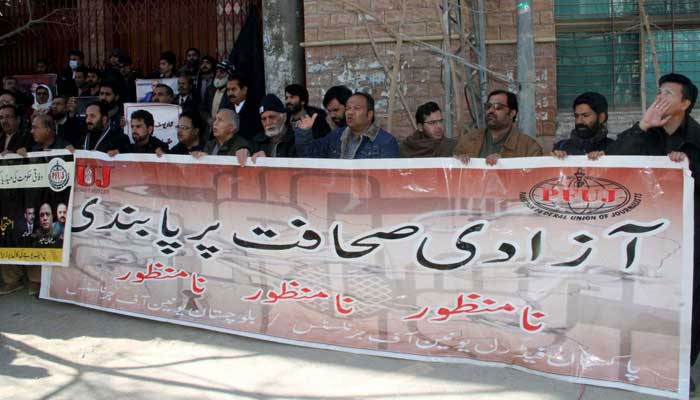
Journalists, academics, and human rights activists came together on World Press Freedom Day on Saturday to raise alarm over the shrinking space for media freedom, increasing state control, declining journalistic standards, and the growing tide of disinformation.
Speaking at a discussion organised by the Human Rights Commission of Pakistan (HRCP) in collaboration with the Karachi Union of Journalists (KUJ) at the Karachi Press Club, speakers warned that state control over the media and repression of critical voices threatened not only journalism but the very foundations of democracy.
Veteran journalist Hussain Naqi said that an atmosphere of fear prevailed in the country and warned that if this fear was allowed to persist, it could destroy the country. He said that learning from past movements could help change the situation.
Journalist Mazhar Abbas said that throughout Pakistan’s history, the most restrictions in every era were imposed on the minds. Academic, editorial and political freedoms had been suppressed, he added.
“If you look at the entire history of Pakistan, from day one there was reluctance to allow complete freedom. A controlled system was in place from the very beginning, and Pakistan has never had anything other than a hybrid system,” he said.
Abbas said the unprecedented unity was witnessed in 1970 when working journalists went on a strike and not a single newspaper got published, but the state managed to weaken that unity to some extent by 1978. In the years that followed, state-driven policies deliberately introduced corruption into politics, journalism, and other institutions.
The journalist lamented that unfortunately, one of the worst laws, Peca, was passed by parliament. It targeted not only journalists, but also human rights defenders, social activists, and political workers. He added that disinformation was spreading because of the government’s tight control over the media, and fake news was thriving due to the state’s unwillingness to share accurate information.
About the prevailing tensions between Pakistan and India, he said: “One of the region’s biggest dilemmas is what’s happening in the Indian media."
"War hysteria is being fueled, and even reputable journalists come under pressure from hardline BJP supporters whenever they express independent views.”
He noted that India was seeing a sharper rise in extremism because such tendencies receive both electoral and media support.
Prof Tauseef Ahmed Khan traced censorship and other laws controlling media back to British colonial rule in the subcontinent, and said that unfortunately, similar draconian laws continued to remain in force even after partition. He added that the Peca law was the worst manifestation of those laws.
He said that since the common man turned to social media as a cheap means of expression, the law had also stripped them of this right.
He lamented that while the editor’s institution had never been established in electronic media, it was already in decline in print journalism, which had taken a toll on the quality of newspapers. As a result, he added, the absence of this institution was weakening democratic structures and undermining the people’s right to know. "The absence of the editor’s institution has damaged both the people’s right to know and the principle of objectivity in journalism," he added.
Ahmed said that both India and Pakistan were currently gripped by war hysteria. Had the editor’s institution existed and news directors been competent and aware of the gravity of war, which concerns 1.5 billion people, such narratives could have been curtailed.
Academic Dr Riaz Ahmed Shaikh said where there was true democracy, there could be no censorship. He warned that the ongoing onslaught against the media would not stop there as it had already reached educational institutions.
"I fear that the situation which prevailed in educational institutions in General Zia-ul-Haq’s era may return to our universities," he said. Dr Shaikh added that progressive thought in universities was under threat, and that a systematic effort was underway, result of which would be evident in a few years.
Veteran journalist Sohail Sangi opined that press freedom, democracy and parliament were interconnected. "If there is no press freedom in the country, there can be no legitimate parliament or democracy," he added.
Rights activist Mehnaz Rehman said that press freedom was not just an issue for journalists but it concerned everyone who believed in democracy and humanity. “This is a collective issue that affects us all,” she stressed.
She lauded the fact that as the KUJ and the HRCP had come together to organise this programme, which, she said, was the beginning of a solution to the problems facing press. She demanded that the information ministry be abolished because it used government advertisements as a tool to control newspapers and suppress journalists. HRCP chairperson Asad Iqbal Butt, journalist Javed Asghar Chaudhry, trade union leader Nasir Mansoor and others also spoke.


