
Civil society stresses system for prevention of violence against children
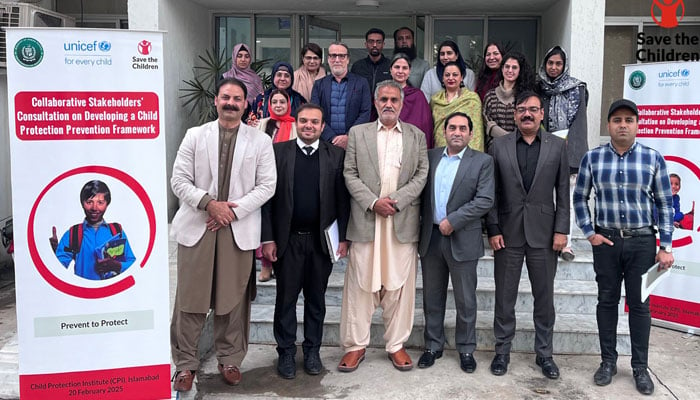
Islamabad:Representatives of prominent civil society organisations and service providers stress to develop and implement framework for prevention of violence against children, besides strengthening the existing protection mechanisms.
They were speaking at a high-level stakeholders' consultation on the development of a Child Protection Prevention Framework (CPPF) held at the Child Protection Institute. The consultation was organized jointly by Save the Children and UNICEF. The consultation brought together representatives from prominent civil society organizations, NADRA, the legal community, and service delivery organizations, emphasizing the urgent need for a collaborative approach to prevent violence against children in any form.
The session was conducted by David Bloomer, Regional Advisor at Save the Children, and child rights expert Rabeea Hadi. Director of the Child Protection Institute, Yousaf Shah gave welcome remarks to formally open the day-long discussion. It was shared that the consultation was first of the series of consultations to be held across the country before finalising the Child Protection Prevention Framework.
Following that, the consultation facilitators gave an overview of the current situation and existing protection mechanism. It was shared that over 3.3 million children aged 5-14 in Pakistan are engaged in child labour, often in hazardous conditions. Child marriage remains prevalent, with 18% of girls married before the age of 18 and 4% before 15. Physical and psychological punishment continues to be a widespread issue, with more than 80% of children in Punjab, Sindh, and Gilgit-Baltistan experiencing violent discipline, according to the Multiple Indicator Cluster Survey (MICS) 2014. While Pakistan has existing child protection laws, enforcement remains weak, and there is a lack of standardized prevention mechanisms across the country at both federal and provincial level. Current responses are often reactive, focusing on victim support rather than prevention.
They said that CPPF aims to bridge these gaps by developing a structured framework that integrates primary (community-based prevention), secondary (targeted intervention for at-risk children), and tertiary (long-term recovery and prevention of recurrence) prevention strategies. The Framework will also establish key performance indicators and monitoring framework to assess and improve child protection efforts and will ensure regional adaptability by integrating the framework into long-term child protection policies, endorsed by provincial and regional authorities. The Framework will also have special focus on strengthening inter-agency collaboration among government institutions, law enforcement, social welfare bodies, and civil society to standardize prevention efforts nationwide.
The participants gave their feedback on proposed Child Protection Prevention Framework (CPPF) targeting three key risks including child labour, child marriage, and violent discipline or physical and humiliating punishment. The discussion centred on strengthening preventive measures to reduce cases of violence against children and improving inter-agency coordination to ensure effective child protection and prevention mechanisms.
The participants identified that all the issues related to child protection are exacerbated by poverty, lack of education and awareness, weak monitoring mechanisms and legal system and limited access to facilities. Participants stressed the need for stronger interventions to prevent children from being forced into labour, child marriage and provide them with protected environment. They highlighted Pakistan’s widespread child protection challenges, emphasizing that despite national and international commitments, millions of children remain vulnerable to violence, abuse, neglect, and exploitation. The consultation underscored the necessity of shifting from reactive approaches to a prevention-focused framework that addresses root causes and reduces harm before it occurs.
The stakeholders reaffirmed their commitment to working collectively to enhance child protection measures in Pakistan. The consultation marked a significant step toward establishing a proactive, sustainable, and child-centred framework that prioritizes prevention and ensures every child’s right to a safe and secure future.


