
Aurat March defies barriers to demand rights amid heavy restrictions
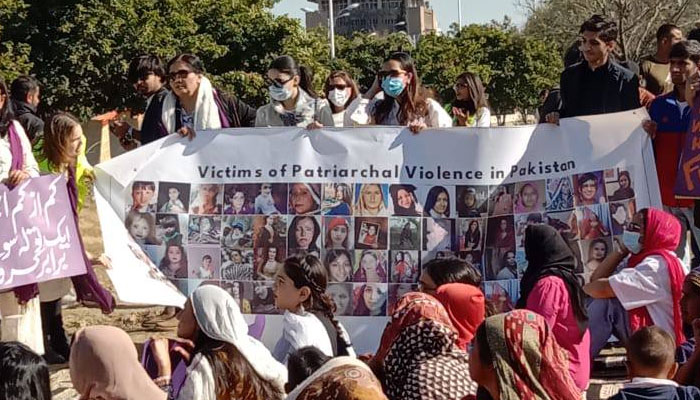
Islamabad : Braving road blockades, police restrictions, and the challenges of fasting during Ramadan, women gathered in front of the National Press Club (NPC) for the annual Aurat March on International Women’s Day. Despite confiscation of their sound system and police limiting entry to a single access point, the event drew a good number of women and men from all walks of life, holding placards with bold and thought-provoking slogans.
Slogans like “Mien aisa ghar banao gi jahan say mujhay koi na nikal sakay” (I will build a home where no one can evict me), “Hansi tou phansi, keep your stupid assumptions to yourself”, and “Apni iftar khud banao” (Make your own iftar) resonated with attendees, highlighting issues of autonomy, gender stereotypes, and domestic labour.
The most striking feature of the march were symbolic funeral processions for five key aspects of Pakistani society: women’s rights, judiciary, democracy, minority rights, and climate justice. Explaining the symbolism, organiser of the march and known women rights activist Farzana Bari told 'The News', “The basic pillars of human rights are in shambles in Pakistan. These institutions and aspects are directly connected to women’s lives, which is why we held these funerals today.”
Veteran human rights activist Tahira Abdullah condemned the authorities’ response to the march, stating, “The state is so afraid of a small group of unarmed women that they have cordoned off the entire area. But such tactics will not dampen our spirits.” Human rights advocate Salman Malik also criticized the state’s approach, noting, “Instead of engaging in dialogue, the state prefers to suppress activities that reflect the real concerns of society. This tendency is deeply unfortunate.”
The protesters recited poetry in regional languages highlighting women rights issues and also held a moving theatre performance reflecting women emancipation. The protesters were not allowed to go to D-Chowk but they held a symbolic walk till the China Chowk and dispersed peacefully.
Held under the theme of “Feminist Politics vs. Patriarchal State,” the Aurat March Islamabad presented a comprehensive list of demands addressing critical human rights, social justice, and environmental issues. The speakers expressed serious concern over the prevailing situation of human rights particularly the rights of women, demanded an immediate end to state silencing and the repeal of laws such as the Peaceful Assembly and Public Order Act (PAPO) 2024 and amendments to the Prevention of Electronic Crimes Act (PECA), which severely restrict fundamental rights like freedom of speech, assembly, and association. They also called for an end to the enforced disappearances and they voiced strong opposition to environmentally destructive projects such as the Green Pakistan Initiative, demanding their immediate halt. They also condemned the government's policy of forcibly deporting Afghan individuals and demand the state to ensure the protection of rights for religious minorities, granting them equal opportunities in employment, education, and healthcare for a dignified life.
As March activities continued in front of the NPC, on the other side of the heavily secured area, a counter-protest was held under the banner of Muslim Talaba Mahaaz, supported by different student and youth organisations. Their demonstration focused on the demand for the release of Aafia Siddiqui, with participants rejecting what they termed a “Western agenda” under the guise of women’s rights. Addressing the gathering, Abdullah Gul, chairman of Tehreek-e-Jawanaan-e-Pakistan, stated, “The youth of Pakistan will not accept Western influences disguised as women’s rights. Islam has given women more rights than any other religion in the world.”
Despite the presence of heavy security and restrictions on movement, the Aurat March Islamabad continued their tradition of gathering at the International Women’s Day, giving a strong message of resistance against oppression and discrimination, depicting their determination to reclaim public spaces and demand their rights.


