
History of Trump's verbal spats with foreign leaders
In July 2017, Trump had tense conversation with Mexican President, Enrique Pena Nieto
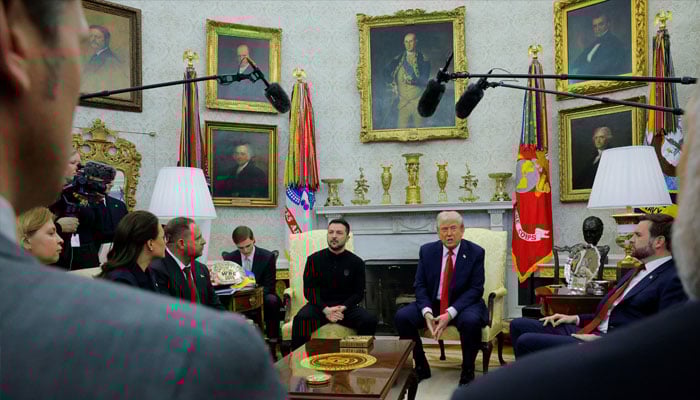
LAHORE: The heated exchange between US President Donald Trump and Ukrainian President, Volodymyr Zelensky, at the White House Friday was an astonishing spectacle, unprecedented and shocking at the same time, but this is not the first time when the 78-year-old American head of state has vented his anger at any foreign counterpart, research shows.
In July 2017, Trump had a tense conversation with a rather passive and subdued Mexican President, Enrique Pena Nieto. His verbal spat flashed headlines everywhere.
On July 7, 2017, an esteemed British newspaper “The Guardian” had reported: “Donald Trump has again humiliated Mexico’s President, Enrique Pena Nieto by repeating his claim - in the presence of the Mexican leader - that America’s southern neighbour would pay for a border wall. Pena Nieto allowed Trump’s comments to go unchallenged when the two leaders met on the sidelines of the G20 meeting in Hamburg. Asked by reporters if he expected Mexico to finance a border wall, Trump responded: “Absolutely.” Pena Nieto sat silently next to him. The meeting - the first between the two leaders since Trump took office - again highlighted Trump’s insensitivities toward Mexico, while Pena Nieto’s passivity brought back bad memories for many Mexicans.”
The media house had added: “The Mexican president was fiercely criticized for failing to contradict Trump. The two presidents were scheduled to meet on January 31, 2017 in Washington, but Pena Nieto cancelled the visit after Trump tweeted his Mexican counterpart shouldn’t bother coming if the wall wasn’t on the agenda.”
It was also in 2017 that Trump had abruptly ended a phone call with the Australian Prime Minister, Malcolm Turnbull, over a refugee agreement.
On February 2, 2017, the “Washington Post” had written: “Trump’s behavior suggests that he is capable of subjecting world leaders, including close allies, to a version of the vitriol he frequently employs against political adversaries and news organizations in speeches and on Twitter. US officials said that Trump has behaved similarly in conversations with leaders of other countries, including Mexico. But his treatment of Premier Turnbull was particularly striking because of the tight bond between the United States and Australia - countries that share intelligence, support one another diplomatically and have fought together in wars including in Iraq and Afghanistan.”
The key American newspaper had asserted: “It should have been one of the most congenial calls for the new commander in chief - a conversation with the leader of Australia, one of America’s staunchest allies, at the end of a triumphant week. Instead, President Trump blasted Australian Prime Minister Malcolm Turnbull over a refugee agreement and boasted about the magnitude of his Electoral College win, according to senior US officials briefed on the verbal exchange. Then, 25 minutes into what was expected to be an hour-long call, Trump abruptly ended it. At one point, Trump informed Turnbull that he had spoken with four other world leaders that day - including Russian President Vladimir Putin - and that “this was the worst call by far.”
Research shows that President John Fitzgerald Kennedy’s strong-worded communication with Israel’s successive prime ministers, David Ben-Gurion and Levi Eshkol, had also created a lot of stir in the global media about 62 years ago, but that was through letters, and not face to face.
President Kennedy wanted to keep nuclear weapons proliferation in check, especially keeping Red China and Israel from developing their own atomic bombs, so he had sent a letter to Prime Minister David Ben-Gurion in June 1963, whereby stating the United States wanted to inspect their nuclear power plant to ensure it wasn’t being used to develop nuclear weapons. Premier Ben-Gurion felt that the American president was greatly over-stepping his bounds.
But his days as prime minister ended in mid-June 1963, and he did not reportedly respond to Kennedy’s letter.
The American President then wrote a letter to the new Prime Minister, Levi Eshkol, and told him that the US commitment and support of Israel “could be seriously jeopardized” if it did not let the United States obtain “reliable information” about its efforts in the nuclear field. This amounted, in effect, to an ultimatum and there was a crisis.
On November 22, 1963, Kennedy was assassinated and rumours were rife that spy agency “Mossad” or the Institute for Intelligence and Special Operations may have killed him!
Kennedy’s murder dramatically changed everything as his successor, President Johnson, wasn’t concerned about inspecting Israel’s nuclear power plant and in 1964, it had its first nuclear bomb.







-
 Why Attorney Says Justin Baldoni 'not Off The Hook' Despite Court Ruling? Report
 -
 'Abuses' Shouted At Andrew Mountbatten-Windsor As Protesters Breach Security
 -
 Jenna Dewan Reveals Mindset She Follows When Life Gets 'nuts'
 -
 Erika Kirk Dating Claims Surface As She Reclaims Charlie Kirk's Legacy
 -
 Karoline Leavitt Joins Erika Kirk At Washington Event
 -
 Lizzo Reveals Major Update About Her Sobriety Journey
 -
 Princess Beatrice’s Husband Edo ‘questioning Marriage’: ‘His Standing & Status Is Impacted’
 -
 Petition To Strip Blake Lively Of 'It Ends With Us' PGA Credit Gains Massive Support
 -
 New Development In Blake Lively Lawsuit After Judge Dismisses Major Claims
 -
 Blake Lively, Taylor Swift Texts Resurface After Court Ruling
 -
 Prince Harry’s Behavior Towards Queen Elizabeth Gets Exposed: ‘He Drove Her To Paranoia’
 -
 Blake Lively, Justin Baldoni's Legal Case Receives Latest Update
 -
 Kylie Jenner Says Goodbye To Her Halloween Era: 'I've Retired It'
 -
 Mel B Reveals Why Spice Girls Documentary May Never Happen
 -
 Maggie Gyllenhaal Recalls Emotional Impact Of Seeing Husband With Other Woman
 -
 Scarlett Johansson Shares Wild First Concert Story