
Students of private schools, colleges clinch top slots in matric, inter exams
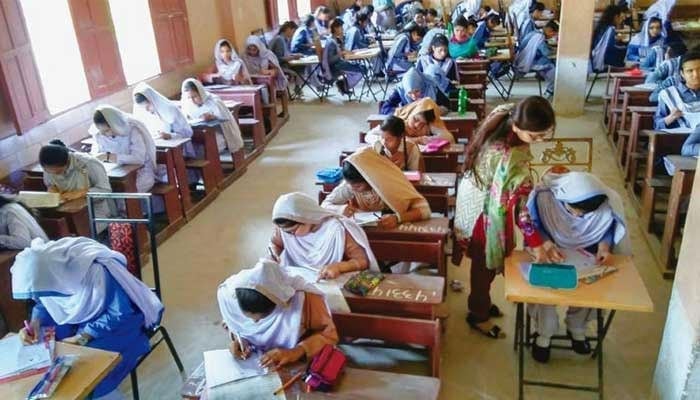
LAHORE:Recent results of secondary school (Matric) and higher secondary (Intermediate) exams from all nine Punjab exam boards reveal a striking trend: despite official claims, the majority of top performers are from private schools and colleges, not government institutions.
A whopping 83% of the overall top positions, including first, second, and third place, in the Intermediate Annual Examination 2024 were secured by students from private colleges while only 17% of the top spots were earned by students from government colleges, according to The News analysis of the results data. In terms of absolute numbers, private colleges claimed 29 top positions, while public colleges secured only 6.
In the 2024 Matric results, the analysis reveals a similar trend. Government schools accounted for only 32% of the overall top three positions, while private schools dominated with 68%. In numbers, private schools secured 28 top positions, while public schools claimed only 13.
Despite the resources available to public schools and colleges, the outperformance of private institutions in securing top positions raises important questions about the quality of education, learning environments, and support systems in public institutions compared to their private counterparts.
While public schools secured 32% of the top positions in the Matric exams, this figure shows a modest improvement compared to the Intermediate results, where only 17% of the positions went to public colleges. This trend becomes more evident when we break it down Board-wise. Punjab's nine Boards of Intermediate & Secondary Education (BISEs)—Lahore, Faisalabad, Gujranwala, Multan, D.G. Khan, Rawalpindi, Sargodha, Bahawalpur, and Sahiwal—highlight these disparities.
In the Matric exams, public school students claimed the overall first positions in BISE Lahore, Faisalabad, Sahiwal, and Sargodha. However, in the remaining five boards, students from private schools secured the top spot.
The gap widens further in Intermediate results, where private college students dominate across all BISEs except D.G. Khan and Sargodha. Interestingly, the overall first position in the Intermediate exam of BISE Multan was shared by three female students all belonging to private colleges. This distribution underscores the continued strength of private institutions in producing top-performing students.
As we now have data analysis revealing the true picture, earlier public claims suggested that students from government schools had outperformed those from private schools in the 2024 Matric exam. Contrary to the facts, Punjab Education Minister Rana Sikandar Hayat had also praised public schools for their supposed dominance in producing top scorers.
The performance gap between public and private institutions cannot be fully explained by a single factor, but the shortage of teaching staff is undeniably a significant contributor. Imran, a teacher at a private school, points out that while in the private institutions a shortage of teachers is almost unheard of, public ones are often plagued by this problem.
For instance, according to the School Information System (SIS) of the School Education Department (SED) Punjab, more than 120,000 teaching positions are vacant across over 48,000 public schools in Punjab.
In order to meet the shortage of teachers at public colleges across the province the Higher Education Department (HED) Punjab recently initiated the recruitment of 7,354 College Teaching Interns (CTIs) for a six-month period to temporarily fill the gap.
This situation clearly explains the point made by Imran about the persistent shortage of teachers in public institutions. Nonetheless, the shortage of schoolteachers raises concerns about the government’s ability to meet Sustainable Development Goal (SDG)-4 on quality education, especially since Pakistan previously missed several education-related MDGs. This shortage is a significant barrier to achieving this goal because it directly impacts the quality of education provided in public schools.
Kashif Adeeb Jawadani, President of All Pakistan Private Schools Management Association (APPSMA), says some 80 percent of private schools are low-cost private schools and are among those securing top positions in the secondary school exams.
“There is intense competition among private schools, where parents can choose from a range of options. To stay competitive, the only way forward is to focus on quality and deliver better exam results,” says Jawadani, highlighting why private institutions surpass government schools in securing top positions. This difference is evident in the 2024 BISE Lahore secondary school exams, where 74% of government school students passed, compared to an 88% pass rate in private schools.
Jawadani attributes private schools’ success to their highly qualified staff. “Because of limited job opportunities and societal norms, many well-educated women join private schools despite lower pay, boosting schools’ performance,” says the APPSMA president. He adds that, unlike in public schools, private school teachers don’t strike or boycott classes, providing students with more consistent learning time.
“APPSMA conducted a similar analysis which shows that private schools secured 120 positions across all categories among boys and girls in this year’s secondary school exams, while government schools managed only 59. Despite this strong performance, the government provides no support to private schools, which, whether high-end or low-cost, are still required to pay 24 different types of taxes and fees,” he added.
Sajjad Ali, whose daughter attended private school and college and scored over 80% in both, said there’s little competition between public and private schools. He noted that, except for a few cases, private schools or even academies (tuition centres) are parents’ top choice because they believe these institutions prepare students better for exams. “Many toppers from public schools have taken private tuition at centres or from well-known teachers,” he added.
Sajjad also mentioned that private schools and tuition centres maintain close contact with parents using mobile apps to keep them informed about their children’s progress, unlike public institutions. He added that students who excel in matric and intermediate exams gain better access to higher education, including local and foreign scholarships, and eventually land good jobs. “Government institutions should ensure their students also achieve high academic performance,” he suggested.







-
 King Charles, Camilla To Snub Prince Harry’s America Meet-up Attempt
 -
 Zendaya Crashes Young Couple Wedding In Las Vegas
 -
 Patrick J. Adams Breaks Silence On How 'The Madison' Role Echoed Family Loss
 -
 Prince William, Kate Middleton Push Drastic Changes
 -
 Prince William Has ‘little Forgiveness’ In Heart For Prince Harry
 -
 Netflix Eyes Shock Revival Of 'The Crown' After Andrew Mountbatten Windsor Controversy
 -
 Jennifer Aniston's Beau Jim Curtis Becomes Her Guiding Light
 -
 Prince Harry, Meghan Markle Swimming Dangerous Waters With Australia Trip
 -
 Lewis Hamilton Warned Against Kim Kardashian Romance To Save Brand Name
 -
 'American Pie' Star Shannon Elizabeth Makes Rare Admission About Legacy Role
 -
 Prince William Spectates Team Wales During Rugby Match In Cardiff
 -
 Teyana Taylor Drops Cryptic Hint About What Could Happen At The Oscars
 -
 Andrew Mountbatten Windsor, Sarah Ferguson 'flagged By Intelligence Services'
 -
 Kim Kardashian Headed For Another Love Crash With Lewis Hamilton
 -
 Kris Jenner Recalls Trying To Save Kylie Jenner From 'biggest Failure' Of Life
 -
 Britney Spears Leaning On The Kardashians Post DUI Arrest