
Speakers discuss Quaid-e-Azam’s strategic vision
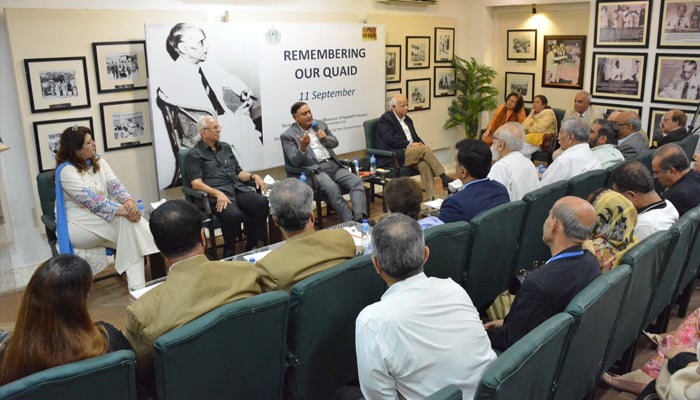
Quaid-e-Azam Muhammad Ali Jinnah’s vision of West Bengal was “two countries one nation,” said the vice chairman of the Board of Management Quaid-e-Azam House
Museum, Ikram Sehgal.
The Board of Management of the Quaid-e-Azam House Museum held a commemorative assembly on Wednesday on “Jinnah’s Legacy and the Role of the Armed Forces in Protecting and Safeguarding the Territorial Integrity of Pakistan.”
Speaking at the session, Sehgal said the Quaid-e-Azam founded the Dawn newspaper in Delhi, and then the paper moved to Karachi after Partition. “Today, on 11 September, unfortunately, we find no mention of the Quaid-e-Azam in Dawn.”
He spoke on the Quaid’s strategic vision post-1940. In 1942, he said, Romans were knocking at the door of Cairo, having defeated the British-aided Indian army, Singapore had fallen, and the Japanese were in Burma on their way to India. The Indian National Army was created in Singapore.
On August 8 of that year, he said Gandhi launched the Quit India Movement, demanding the British leave India and stressing that nobody should join the British Indian Armed Forces. The Muslim League found the movement inimical to Muslims’ interests. On August 25, 1942, he said the Quaid-e-Azam decided to support British India, along with Hindu Mahasabha and the Communist Party of India, in the war against Germany. The Muslims joined the British armed forces.
In 1939, he said, the armed forces of British India were of 100,000 out of which 4,000 were British officers and by the end of the war there were 2.5 million people under arms of which 40 percent were Muslims. He said the sacrifice that the armed forces of Pakistan had given was 30,000 dead and 70,000 injured, and “that is the sacrifice they gave on the call of Quaid-e-Azam.”
Because of this sacrifice, when the Congress was going forward toward undivided India, he said, the senior armed officers of the British said that they had a debt of gratitude to the Muslim soldiers who died for them. “That is one of the reasons, the sacrifice of the Muslim soldiers of India and mostly from the territory now comprising Pakistan, actually gave birth to this country,” he said, adding that it was the first strategic thing Jinnah did.
He said Jinnah mandated West Bengal leader Ffazlul Haque to pursue a united Bengal, which would mean that all of Assam and West Bengal would be a “totally autonomous region.” Jinnah, he said, also reached out to Punjabi Sikh leader Master Tara Singh, propagating for Sikhistan. Jinnah offered him not to divide Punjab but instead make a Sikhistan and call it Khalistan. Sehgal said that had Khalistan been formed, there would not have been a Kashmir dispute.
He said even Lord Mountbatten had a plan for a bigger Pakistan, but Nehru changed the demarcation. Referring to Bangladesh’s current uprising, he said Jinnah’s vision of West Bengal was two countries, one nation. “This is exactly what the Quaid said in 1946,” he said, adding that today we are talking about no visas, no tariffs, and no customs duty. “Whatever you call this you have Pakistan.”
Speaking on Jinnah’s third vision, Sehgal said that Jinnah accepted the divided Punjab and Bengal. “It’s better to have a truncated Pakistan than nothing at all. That was his (Jinnah’s) third strategic decision,” Seghal said.
Lieutenant General (retd) Moinuddin Haider mentioned that Pakistan’s western and eastern borders are not peaceful. He stated that Afghanistan refers to the border as the Durand Line, while Pakistan considers it an international border. At Azad Kashmir, General Haider noted that Pakistan and Indian forces are in close proximity, with the status being a line of control and an international border.
Haider said the Quaid-e-Azam announced in Dhaka before Partition that Urdu would be the official language of Pakistan, which created problems later in Bangladesh as they wanted Bengali to be given the status of national language.







-
 Prince Harry Trip To Australia ‘is Not About Money’
 -
 Kris Jenner Lets Out ‘troublesome’ Opinions About College Education
 -
 James Cameron Fawns His Friendship With Sigourney Weaver
 -
 King Charles, Camilla To Snub Prince Harry’s America Meet-up Attempt
 -
 Zendaya Crashes Young Couple Wedding In Las Vegas
 -
 Patrick J. Adams Breaks Silence On How 'The Madison' Role Echoed Family Loss
 -
 Prince William, Kate Middleton Push Drastic Changes
 -
 Prince William Has ‘little Forgiveness’ In Heart For Prince Harry
 -
 Netflix Eyes Shock Revival Of 'The Crown' After Andrew Mountbatten Windsor Controversy
 -
 Jennifer Aniston's Beau Jim Curtis Becomes Her Guiding Light
 -
 Prince Harry, Meghan Markle Swimming Dangerous Waters With Australia Trip
 -
 Lewis Hamilton Warned Against Kim Kardashian Romance To Save Brand Name
 -
 'American Pie' Star Shannon Elizabeth Makes Rare Admission About Legacy Role
 -
 Prince William Spectates Team Wales During Rugby Match In Cardiff
 -
 Teyana Taylor Drops Cryptic Hint About What Could Happen At The Oscars
 -
 Andrew Mountbatten Windsor, Sarah Ferguson 'flagged By Intelligence Services'