
Adab Festival session unravels exemplary struggles of Pakistani women cricketers
Adab Festival
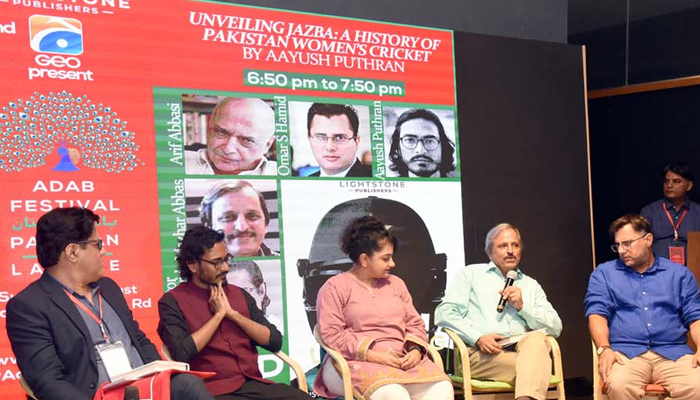
karachi: It was shocking for Indian author and journalist Aayush Puthran when he came to know that a prominent Pakistani woman cricketer once kept a fake identity with the pseudonym of Ayena Naz due to societal fear.
Ayena Naz was actually Nida Dar, the current captain of the Pakistan women's cricket team. This was not the only case in the Pakistani women cricket team when a player chose to hide her identity. Another player, Naheeda Khan, he said, played for Pakistan as the longest-serving opener, but she kept her identity hidden from her neighbours for seven years.
She would play in disguise, go to the stadium quietly in Quetta from Chaman, and only after going to the stadium would she wear her cricket gear. And she’s now the manager of the Pakistani team.
Puthran spoke about these facts on Sunday at a session of the Seventh Adab Festival Karachi about his book, ‘Unveiling Jazbaa: A History of Pakistan Women's Cricket’. He said that he was also doing stories on Afghan women cricketers.
He said that he had earlier written stories about Indian and Sri Lankan female cricketers who had their own share of challenges, “but the hiding of identity just to play cricket was something that stood out and got me intrigued.”
The seventh edition of the Adab Festival was held at Habitt on Sharea Faisal in Karachi on Sunday a day after its sixth edition was held in Lahore. The literary event was organised by the Lightstone Publishers in collaboration with Geo and Mir Khalil-ur-Rahman Foundation, and featured various sessions discussing books and authors.
Puthran said the book intended to document the women’s cricket of Pakistan, ascertain the reasons why the team did not mostly win and explain the struggles of female cricketers owing to sociocultural reasons.
He was of the view that had the Pakistani women cricket team started winning matches, the struggles of its members would have come to the fore.
He said a Pakistani woman cricketer, Saba Nazeer, had to cut her hairs so that she could look like a man and conveniently travel in a bus. She was from Muridke and travelled to Sheikhupura to play cricket.
Once, her parents made it an issue of ‘honour’ and grounded her at home, but she eventually managed to play for Pakistan.
Puthran said Saba’s family initially feared that her playing the game would bring shame to them, but when they realised that it was actually giving them honour and fame, they accepted it.
The Indian author was of the view that the best books about the Pakistani cricket had been penned by British writers and they all were about men’s cricket. The main literature about Pakistani women cricket must come from Pakistani women, he remarked and opined that Pakistani women should set the narrative of the women cricket of the country.
“Sports is just a reflection of what society is and where society is at,” he responded to a comment made by one of the panellists.
He said the struggles of English women cricketers included fighting for a five-day test match as they only got four days.
Commenting on unsatisfactory results of the women cricket team of Pakistan, the Indian author said the Pakistani female cricketers did not enjoy the same facilities the female cricketers of other countries did. He recalled that when the Pakistani female cricketers went to the World Cup in 2018, they had to skip meals just to save some money.
He remarked that when female cricket teams of Australia and Pakistan entered the ground together, it was not actually a level-playing field. “You think Australia is winning just because they’re good? Maybe not.”
Another session at the Adab Festival discussed former bureaucrat Salman Faruqui's book ‘Dear Mr Jinnah: 70 Years in the Life of a Pakistani Civil Servant'.
Speaking on the book, Hameed Haroon said the book covered 70 years of Pakistan. He said the author had described his journey since he entered Lahore from Patiala by a train.
Haroon said the author had also shed light on how Karachi was when it was the federal capital in the 1950s.
There was also a discussion on a book, ‘Betrayal’, penned by police officer and novelist Omar Shahid Hamid. Another session discussed Ayesha Baqir's novel ‘Beyond the Field’.







-
 Johnny Depp's Trump 'prophecy' Leaves Fans Divided
 -
 Shamed Andrew Should Go To ‘bailiffs’ Over His Blunders
 -
 New Poll Results On King Charles US Visit Revealed
 -
 'Trump At Walter Reed Hospital': Health Rumors Prompt White House Reaction
 -
 Blake Lively's Apology To Kate Middleton Resurfaces
 -
 'Vampire Diaries' Star Candice King Marries 'The Originals' Actor Steven Krueger
 -
 JoJo Siwa Gets Candid About Marriage Plans
 -
 Dakota Johnson, 36, Confirms Romance With Role Model, 28, After Breakup With Older Boyfriend
 -
 Shamed Andrew Only Visited By THIS Family Member Amid Exile
 -
 King Charles Could Get ‘golden PR Points’ If He Fixes Harry Issues
 -
 Kristin Cavallari Weighs In On 'silly' Life As The Famous Mum Of Three Kids
 -
 Lauren Conrad Spills The Beans On Sons' Views About Her Fame
 -
 Real Reason King Charles Rejects Reunion With Prince Harry
 -
 Adele To Perform On Major Celebrity's Milestone Birthday In November
 -
 Keith Urban Plans Explosive Tell-all About Nicola Kidman
 -
 'Harry Potter' Star John Lithgow Shares His Two Cents On J.K. Rowling's Controversy