
Cabinet approves PIA restructuring
Minister for Privatization who moved summary, informed cabinet that such step would result in attracting investors towards PIA
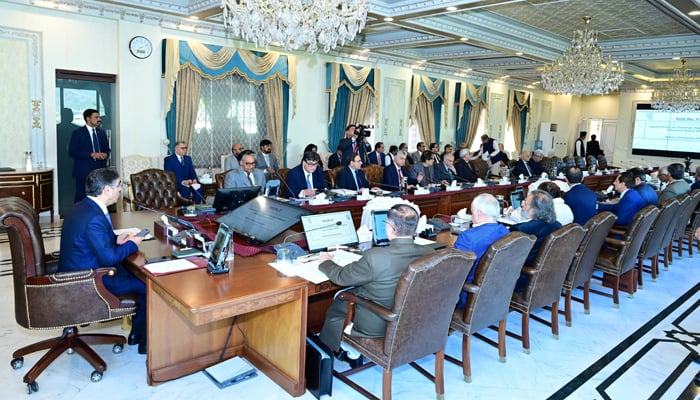
ISLAMABAD: The federal cabinet on Tuesday approved restructuring of the Pakistan International Airlines to bifurcate the national flag carrier into two entities.
The federal cabinet took the crucial decision which could be difficult for the upcoming political government. The meeting with Caretaker Prime Minister Anwaar-ul-Haq Kakar in the chair was informed that in the light of the financial adviser hired for financial restructuring, the functions of national flag carrier would be bifurcated into two companies, namely TopCo and HoldCo.
Some basic operations, including engineering, ground handling, flight kitchen and training, would be assigned to TopCo while Precision Engineering Complex, PIA Investment Limited and subordinate departments and properties would be given to HoldCo.
Minister for Privatization Fuad Hasan Fuad, who moved the summary, informed the cabinet that such a step would result in attracting investors towards PIA. The meeting also directed settling disputes about dues to government organizations against PIA to complete the restructuring process in the shortest-possible time. The cabinet recommendation of the Ministry of Privatisation also okayed the privatization of the First Woman Bank.
The federal cabinet at its meeting on Tuesday decided to stop wheat imports at the government level in view of its huge reserves in the country. The cabinet meeting, chaired by Caretaker Prime Minister Anwaar-ul-Haq, endorsed the decision of the Economic Coordination Committee (ECC) of the Cabinet taken on February 1 regarding ban on import of wheat, which would also result in saving foreign exchange.
The cabinet meeting noted that along with sufficient reserves of wheat, there was also stability in flour prices. It may be pointed out here that recently, the Trading Corporation of Pakistan issued tenders for import of 110,000 metric tons of wheat.
According to estimates, the country would also have bumper wheat crop for the current season as production of wheat would exceed 32.1 million tons, which is 1.8 percent more than the target.
A total of 1.376 million tons of wheat worth Rs113.13 billion have been imported during the first six months of the current fiscal year.
On the recommendation of the Ministry of National Health Services, the cabinet also approved the deregulation of prices of medicines except essential medicines which do not exist on the national list. It was decided to exempt medicines from the Drug Act 1976 by making necessary amendments in the Drug Policy 2018.
It also decided that the Pakistan Medical and Dental Council would ensure that doctors must not prescribe vitamins, multivitamins, minerals and other such drugs to patients. The Drug Regulatory would prepare a list of vitamins, multivitamins, minerals, etc., and would be in contact with provincial governments.
It also allowed the conversion of four out of eight accountability courts in Peshawar into special courts. Apart from this, the proposal of Chief Justice Peshawar High Court has been approved for the appointment of judges in these courts. The remaining courts will continue to function as accountability courts. These changes will not put any additional burden on the national exchequer.
The meeting on the recommendation of the Ministry of Defence Production, also approved the appointment of Lt. General Tahir Hameed Shah as Chairman and member of the Wah Ordinance Factories Board with effect from November 29, 2023.
Waqar Bhatti adds: The Pakistan Pharmaceutical Manufacturers Association (PPMA) and Pharma Bureau have welcomed the federal cabinet’s decision to approve 146 hardship cases pending for over 2 years and to deregulate the prices of medicines outside the essential medicines list based on the World Health Organization (WHO) model list.
In a statement, PPMA and Pharma Bureau said this important step, which follows international best practices and successful pharmaceutical global models, will ensure the availability of quality medicines at competitive rates and build the foundations of an export-focused pharmaceutical sector.
Most importantly, it will ease the sufferings of patients who have faced extreme difficulty in recent months due to non-availability of life-saving medicines, the statement added.
There are 464 medicines in the National Essential Medicines List that will remain under price regulation as compared to 232 in India, 117 in Bangladesh and only 60 in Sri Lanka.


