Sindh health dept orders implementation of COVID-19 SOPs in Karachi, Hyderabad
National positivity ratio jumps to 2.22%; Mardan second most affected city with 4.76% positivity
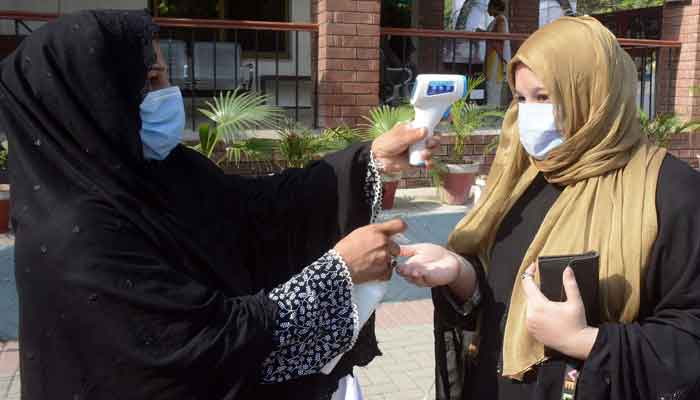
KARACHI: The Sindh Health Department on Thursday issued an advisory to the commissioners of Karachi and Hyderabad, directing them to ensure the implementation of COVID-19 guidelines amid a sharp rise in new infections.
The letter referred to a meeting chaired by the Federal Health Minister Abdul Qadir Patel at the National Command and Operation Centre (NCOC) to review the COVID-19 situation and stated that the increase in the number of cases can be partially attributed to BA4/BA5 Omicron sub-variants that have been recently reported in the country.
The health authorities directed the district administration to ensure the following standard operating procedures (SOPs):
- Mandatory wearing of face masks.
- Social distancing at public places.
- Crowd at weddings less than 300 for indoor events and 500 for outdoor.
- Checking of vaccination cards at high-risk areas including shopping malls, shrines, gyms.
- Occupancy of passengers in public transport to be kept
The development comes as the two cities continue to report high positivity ratios which the experts have linked with increased air travel, waning of vaccine efficacy and non-implementation of SOPs.
Karachi reported 15.85% positivity today when 1,060 tests were conducted in the last 24 hours out of which 168 returned positive.
Despite a major drop in the city's positivity rate since Thursday — when it stood at 21.23% — Karachi is still the most affected city in the country.
Moreover, the positivity rate in Sindh climbed to 6.1%.
In a separate letter to concerned district health officers, the provincial health department advised them to prepare a strategy in consultation with the relevant authorities and follow the guidelines below:
- Increase the number of Rapid Response Team (RRT) of each taluka/ town.
- Increase the number of COVID-19 sampling and cover all talukas/ towns.
- Priority to be given to contact tracing/ sampling.
- Samples must reach the assigned laboratories to get the result in time.
- Health care workers must wear face masks and follow SoPs.
- Follow the one-patient one-attendant policy in the hospital.
- Health Education sessions must be conducted in the community through Health Education officers and LHWs.
- Focusing on booster vaccination of COVID-19 as per target assigned to the district.
- Analysing the situation on a daily basis.
COVID-19 cases
Meanwhile, the national COVID-19 positivity ratio is slowly creeping up, with the positivity rate witnessing nearly a 2% jump within a span of just the last five days, the latest data by the National Institute of Health, Islamabad (NIH) showed Friday morning.
As per the latest stats, the country reported 309 new cases of COVID-19 in a single day, which pushed the positivity rate up to 2.22%.
The fresh cases were detected after diagnostic tests on 13,941 samples.
According to the NIH stats, the second most affected city in the country is Mardan with a 4.76% COVID-19 positivity rate.



-
 France steps up Ebola support in Congo as fears of resurgence grow
 -
 Vance’s fraud crackdown may raise health insurance costs for Americans
 -
 One common mistake elevates blood pressure readings by 7 points, study warns
 -
 Moderna loses US government license defense in patent case
 -
 Novo says new Ozempic shows lower cardiovascular risk compared with Lilly’s Mounjaro
 -
 University of Nottingham researchers say new gel could regrow tooth enamel in weeks
 -
 New Chinese drug extends stroke treatment window from hours to 2 days: study finds
 -
 Trump’s FDA nominee Heidi Overton defends vaccines, contradicting his claims