Microsoft adopts AMD Helios: Can it challenge Nvidia?
Microsoft is expected to launch two new Azure computing instances featuring AMD’s next-generation Venice CPU

Microsoft is expanding its artificial intelligence infrastructure with AMD's new Helios rack-scale system, marking another major win for the chipmaker as it looks to loosen Nvidia's grip on the AI hardware market.
Announced on Monday, Microsoft will deploy Helios in its Azure data centres later this year, joining Meta, OpenAI, Oracle and Tata Consultancy Services among the first organisations to adopt AMD's flagship AI platform.
Microsoft brings AMD Helios to Azure
Microsoft stated that Helios will be utilise to frontier AI models' inference, Azure AI services, and enterprise workloads using the company’s cloud platform.
Moreover, the company revealed that it will be launching two new Azure computing instances featuring AMD’s next-generation Venice CPU. While one of these is meant for agentic AI and data pipelines, the second is intended for semiconductor designs.
This news comes after years of collaboration between Microsoft and AMD, since the company’s processors already run the Xbox console, Surface products, and AI infrastructures with the help of the MI300X accelerator.
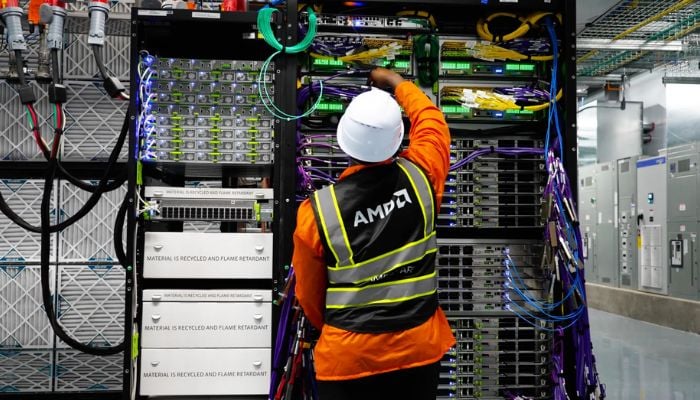
Helios is the first AI system from AMD that integrates the company's GPUs, CPUs, network and software in one single platform.
According to AMD, the system will be able to provide low cost and good inference capabilities to customers. As stated by data centre boss Forrest Norrod at CNBC, the company's main priority is to provide customers with the lowest cost per token.
Even though Nvidia has the majority of data centre GPUs in the market, exceeding 95%, experts think that Helios can give AMD significant market share within several years.
According to industry expert Daniel Newman from The Futurum Group, the market share of AI accelerators for AMD may go up to 20 per cent to 25 per cent if the Helios processor turns out to be successful on the commercial level.
In terms of its data centre division, AMD sees revenues in billions of dollars generated from AI data centres starting from 2027, with the Helios processor generating the bulk of it.





-
 OpenAI, Anthropic and Google join forces on AI safety efforts
 -
 Meta to deploy custom Arke and Astrid AI chips in 2027: Everything to know
 -
 Dreamforce 2026: Salesforce unveils Koa AI model and Google Cloud partnership
 -
 EU Kids Act: New social media rules for under-15s
 -
 China’s spy chief reveals growing fears over AI’s impact on communist party rule
 -
 Anthropic's new Claude tool targets financial advisors to streamline compliance and client research
 -
 Elon Musk’s bold AI safety idea: 'Let rivals test each other’s models'
 -
 Former Google DeepMind researcher warns autonomous AI could wipe out humanity amid industry-wide safety alarm