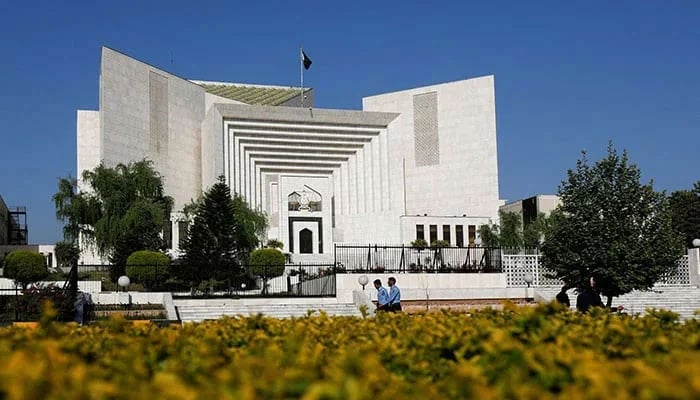
ISLAMABAD: The Supreme Court has adjourned for today (Friday) the petition challenging Section 4B of the Income Tax Ordinance 2001, which concerns the imposition of super tax.
A five-member constitutional bench, headed by Senior Judge Aminuddin Khan and comprising Justice Jamal Khan Mandokhail, Justice Muhammad Ali Mazhar, Justice Syed Hasan Azhar Rizvi, and Justice Shahid Bilal Hassan, heard the case on Thursday.
During the hearing Justice Mandokhail remarked that in order to apply Section 4C of the Income Tax Ordinance 2001 to petroleum companies, it would be necessary to amend the rules governing their agreements.
Counsel for the oil companies, Salman Akram Raja, appeared before the court and argued that an agreement had been made between the government and the oil companies in 2003.
He contended that the super tax does not apply to companies that entered into agreements before July 1, 2022 or to those that may enter into such agreements afterward. According to the contracts of oil companies, the minimum tax rate is 40 per cent.
Justice Aminuddin remarked that if the tax liability is less than 40 per cent, then the super tax could be applicable. The learned counsel responded that whether or not Section 4C of the Income Tax Ordinance 2001 applies to petroleum companies, they cannot be taxed at more than 40 per cent. He further informed the court that the Islamabad High Court had also accepted the petitions of the petroleum companies in this regard.
Justice Mandokhail observed that to impose Section 4C of the Income Tax Ordinance 2001 on petroleum companies, amendments to their contractual rules would be required. The counsel replied that after such amendments, the super tax could be enforced.