Zardari steps in to defuse tensions as PML-N–PPP row intensifies
KARACHI/ ISLAMABAD: Tensions between coalition partners PMLN and PPP escalated sharply on Monday after heated exchanges over Punjab Chief Minister Maryam Nawaz’s public remarks.
The PPP lawmakers staged walkouts from both the National Assembly and the Senate and demanded a formal apology, while PMLN ministers rejected the demand and counter-attacked Sindh’s governance record.
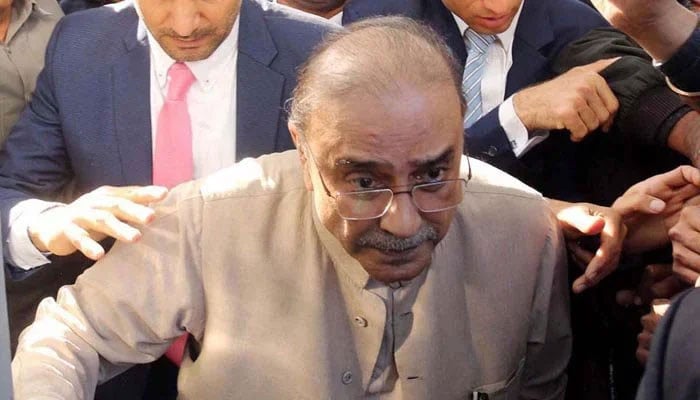
However, President Asif Ali Zardari stepped in to defuse the growing tensions between the Sindh and Punjab governments on Monday, who summoned Interior Minister Mohsin Naqvi to Karachi for urgent consultations.
The president held a telephonic conversation with the interior minister to discuss the ongoing friction between the provincial government of Punjab and Sindh and summoned him to Karachi immediately.
Earlier, in the day, the PPP lawmakers staged walkouts from the Senate and National Assembly, demanding an apology from the Punjab chief minister. In National Assembly, the PPP and Pakistan Tehreek-e-Insaf (PTI) lawmakers separately staged walkouts, forcing an early adjournment of the session without conducting any legislative business. The PPP members boycotted the House proceedings in protest against what they termed “regrettable remarks” made by Punjab CM against their leadership.
Speaking on a point of order, former prime minister and senior PPP leader Raja Pervaiz Ashraf said his party would not participate in the proceedings until the government provided a satisfactory explanation regarding the Punjab CM’s statements.
“Bilawal Bhutto never criticised any PMLN leader; rather he appreciated the Punjab CM’s governance. We are part of this government for the sake of Pakistan’s federation, not confrontation,” Raja said. He added that PPP’s tolerance should not be mistaken for weakness, reminding the House that the party had faced much tougher times, including military dictatorships. Ashraf also criticised the withdrawal of security for the PPP’s parliamentary leader in the Punjab Assembly and called it a violation of the spirit of the Charter of Democracy. “We must not use divisive language or resort to blame games. Respect is more important for us than power,” he added.
Meanwhile, former Speaker Asad Qaiser of PTI, while welcoming what he termed “friendly fire” from the PPP, urged the party to bring a no-confidence motion against the government. “If the PPP is serious, they should move a no-confidence motion, and we will support them in sending this regime packing,” he said.
During the heated exchanges, PPP’s Syed Rafiullah pointed out a lack of quorum after his party’s members staged their walkout. The House was initially found in order, but later PTI’s Nisar Jatt also pointed out quorum after MQM’s Dr Farooq Sattar began praising the prime minister and the army chief for recent diplomatic achievements.
With the government unable to complete the quorum, Deputy Speaker Ghulam Mustafa Shah adjourned the proceedings till Thursday evening. Since the start of the ongoing session on Sept 29, the National Assembly has passed only one bill — on the opening day. The subsequent sitting on Sept 30 (Private Members’ Day) was also disrupted by the PPP’s protest. After a two-day recess (October 1–2), the House reconvened briefly before being adjourned again for two more days, leaving almost the entire session paralysed.
The current session is scheduled to continue until Oct 10 (Friday), though parliamentary activity remains uncertain amid deepening rifts within the ruling coalition. Meanwhile, the PPP warned on Monday the ruling PMLN not to take its support in the coalition government for granted, reiterating its demand for an apology from Maryam Nawaz over her recent remarks against the PPP leadership.
The warning came during a Senate session dominated by protests, walkouts, and heated exchanges between government and opposition benches. The sitting, which was supposed to take up a heavy agenda on private members’ day, was adjourned early due to a lack of quorum caused by successive walkouts of PPP and PTI members.
Speaking on the floor of the House, PPP parliamentary leader Senator Sherry Rehman expressed concern over what she described as “divisive rhetoric” coming from Punjab towards Sindh and the PPP leadership at a time when the nation was reeling from devastating floods.
“Over 6.5 million Pakistanis have been affected by floods — these are not Punjabis or Sindhis, they are Pakistanis. Instead of focusing on their plight, divisive rhetoric is growing. This is no way to manage a crisis or a coalition,” she said.
Sherry Rehman said the ongoing “war of words” between Punjab and Sindh was hurting both the coalition and national unity. She asserted that the PPP had shown restraint and solidarity but a red line was crossed when PMLN leaders “played the Punjab card” and criticised Bilawal Bhutto Zardari and Aseefa Bhutto Zardari.
She lamented that the Punjab government had even withdrawn the security of PPP’s parliamentary leader in the Punjab Assembly. Defending Bilawal’s recent comments, she said he had merely suggested that the Punjab government use Benazir Income Support Programme (BISP) data to identify and compensate flood victims.
Calling BISP one of the world’s most effective social protection mechanisms, she cited a World Bank report to support her point. Sherry maintained that “an apology brings more respect” and that PPP did not believe in “politics of division or hatred”.
“If an apology is not offered, then don’t take our support for granted. The PPP remains the largest party in the Senate,” she warned before leading her party’s walkout. Responding to her remarks, Law Minister Azam Nazeer Tarar struck a conciliatory tone, saying that President Asif Zardari had already taken cognizance of the situation and stepped in to play his constitutional role.
“Prime Minister Shehbaz Sharif and Nawaz Sharif are both proponents of reconciliation. The political temperature will come down soon,” Tarar said, adding humorously that the opposition should not celebrate these “ups and downs” in coalition politics.
The minister also referred to ANP leader Senator Aimal Wali Khan’s earlier criticism of the prime minister’s foreign trips, saying that after clarification, the misunderstanding had been resolved.
Taking the floor, PTI parliamentary leader Senator Ali Zafar said both PPP and PMLN had failed to protect the nation from floods despite ruling for decades. He accused both parties of mismanaging relief efforts and engaging in “point scoring through press conferences”.
“Eighteen million people are still waiting for help. Relief operations became victims of corruption and inefficiency,” he charged, while proposing reforms including depoliticisation of NDMA and PDMA, subsidies for farmers, and expansion of BISP coverage.
ANP Senator Umer Farooq criticised State Minister for Interior Talal Chaudhry’s remarks against his party chief, calling them inappropriate. He clarified that it was Prime Minister Shehbaz Sharif himself who had allotted Aimal Wali Khan a residence in the Ministers’ Enclave.
The session also witnessed a verbal exchange between Acting Chairman Syedaal Khan and some PTI senators before being adjourned till Thursday afternoon due to lack of quorum, as PTI members exited the House.
Meanwhile, Sindh Labour Minister Saeed Ghani called on Prime Minister Shehbaz Sharif to clarify the “conspiracy” allegations levelled against Bilawal Bhutto Zardari by Punjab Information Minister Azma Bokhari, demanding that the PM explain what conspiracy Bilawal was accused of.
Speaking on Geo Pakistan, Saeed Ghani said Bilawal never criticised the Punjab government’s performance but had, in fact, praised it and urged the PM to provide greater assistance to flood-affected people.
“Why is such a situation being created that the PPP appears angry with the federation? The federal government needs our support in the Senate and the National Assembly. We do not want another political or economic crisis to emerge if we step back,” Ghani remarked.
The Sindh minister said Azma Bokhari had alleged that Bilawal “conspired” when he was serving as foreign minister, which he termed a baseless and damaging claim. “Prime Minister Shehbaz Sharif should explain whether Bilawal conspired against him — and if so, what conspiracy it was. The prime minister himself has often praised Bilawal for his successful tenure as foreign minister. When Pakistan was isolated internationally, Bilawal helped restore its diplomatic standing,” he said.
“There is no greater measure than elections. The allegations of Form-47 manipulation were not against PPP’s victorious candidates, but against those belonging to the PMLN,” he asserted.
On the other hand, Punjab Minister for Information and Culture Azma Bokhari said defending Punjab’s rights and presenting its case is their responsibility — and they will continue to fulfil this duty. She challenged the Sindh government to list development projects from its 17-year rule, asking critics to point to concrete accomplishments in Sindh — a line that further fuelled the exchange and prompted rebuttals from Sindh government spokespeople.
She said it had become difficult for some political circles to ‘digest’ Punjab government’s numerous public welfare projects. “Chief Minister Maryam Nawaz is distributing laptops, launching bus services, and inaugurating welfare initiatives — and that seems to bother a few,” added Azma.
She also accepted Sindh Minister Sharjeel Memon’s debate challenge, saying: “Show your 17 years of performance, and I’ll show our two years. Visit South Punjab — Multan, Lodhran, Rahimyar Khan — and see the development yourself and show us development carried out by the PPP government in Nawabshah, Garhi Khuda Bukhsh and other Sindh districts.”
She made it clear: “We didn’t start this unwanted tussle, but Punjab knows how to defend itself.” She highlighted that all development projects are funded through provincial resources without a single rupee from the federal government. “No other province could dictate what happens in Punjab. If every province sticks to its domain, there won’t be any issues,” she said, urging media anchors to visit Karachi and Lahore to see the difference.
Azma stated that Punjab had always promoted national unity, “but when the province is unfairly attacked, we have every right to respond firmly. Our performance is our real answer,” she asserted.
Separately, PPP leader and former advisor to the prime minister on Kashmir Affairs and Gilgit-Baltistan, Chaudhry Qamar Zaman Kaira, urged all political forces in Punjab to exercise restraint and avoid inflammatory rhetoric, warning that the escalating political confrontation could repeat the divisive mistakes of the past that undermined democracy and strengthened authoritarian tendencies.
Speaking to the media at Dera Kaira in Lalamusa, he said the political discourse in Punjab had “crossed acceptable limits” and both sides must show maturity. “Instead of trading accusations, we should focus on solving problems,” he said, cautioning that renewed hostility could “revive the ugly battles of the past.”
Kaira said the current tensions stemmed from the non-implementation of a written agreement reached between coalition partners during government formation. “We held several meetings to resolve the issues, and while some were addressed, those concerning Punjab remain pending,” he explained. Despite that, the PPP chose to stay in the coalition to avoid instability. “If the PMLN interprets our patience as compulsion, that would be a misunderstanding,” he added.
Meanwhile, PPP MNA Ali Musa Gilani accused the Punjab government of adopting a biased attitude towards the PPP and attempting to sideline its representatives. Speaking to journalists, he reminded the PMLN that the PPP enjoyed a strong public mandate in south Punjab, and “no administrative order can erase the people’s trust.” He said it was the constitutional right of elected PPP representatives to raise public issues before district and provincial authorities.
“Efforts to silence or marginalise us only reflect the insecurity of those in power,” he said, adding that the PPP would not be “intimidated, blackmailed, or silenced.” Gilani stressed that the party would continue to uphold its values of integrity, tolerance, and respect, despite political differences.


-
 Aurangzeb confirms Saudi Arabia $10bn interest, says B2B shift ongoing
 -
 Pakistan to build artificial island to boost oil exploration
 -
 Special pink bus service launched for women on Green Line route
 -
 Same number plates from other provinces lead to wrong e-challans for Karachiites
 -
 State institutions ‘fail’ to perform constitutional duties: KP CM
 -
 CTD orders psychological testing of police on VVIP security duty
 -
 Navy busts drug consignment valued at $130m
 -
 Three ex-secretaries in race for ETPB chief post