Scientists finally solve the mystery of 5 billion sea stars’ die-off
Scientists believe that they have finally cracked the enigma of mass sea stars apocalypse
Scientists have finally lifted the curtain on a long-held mystery behind the death of 5 billion sea stars off the Pacific coast of North America.
The researchers have struggled for a decade to find out the leading cause of the die-off. Finally, the enigma has been resolved.
According to a recent study published in the journal Nature Ecology and Evolution on August 4, the main culprit behind the killings is a bacterium called Vibrio pectenicida.
According to Rebecca Vega Thurbur, a marine microbiologist at University of California, “The findings solve a long-standing question about a very serious and deadly disease in the ocean.”
A decades-long journey
The journey to find the main culprit was not the easy one; it was filled with roadblocks, twists and turns along the way.
The early research findings hinted at the virus that might be responsible for the disease. The discovery led to the densovirus that actually was a normal resident inside healthy stars and not found to be associated with the disease.
However, the latest study led by marine disease ecologist Alyssa-Lois Gehman of the Hakai Institute in British Columbia and colleagues, revolves around the detailed analysis of the fluid called coelomic fluid, where the bacteria were found.
Microbiologist Blake Ushijima of the University of North Carolina said: “It’s incredibly difficult to trace the source of so many environmental diseases, especially underwater. And the team’s work was really smart and significant.”
Life-threatening disease
The decades-long epidemic started in 2013 characterized by the mysterious sea star wasting disease that caused massive destruction from Mexico to Alaska. The unknown disease melted away more than 20 species and continues today.
Among all the species of giant sea star, the worst affected were the sunflower sea star as 90 percent of its population has been lost in the first five years of the outbreak.
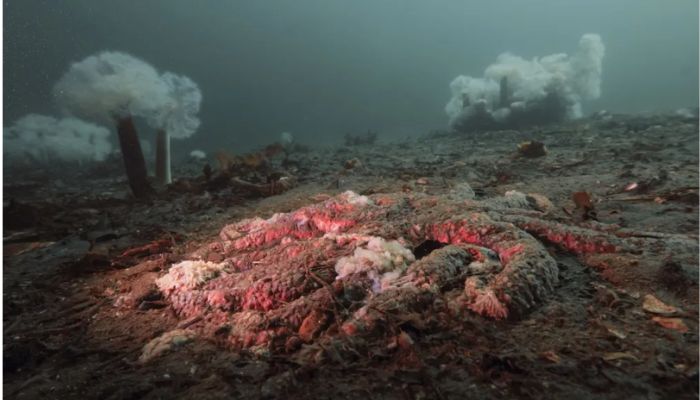
This gruesome disease is responsible for causing the lesions on the puffy arms, leading to falling off their healthy arms.
The researchers hope that this recent breakthrough will further drive the efforts to restore sea star populations.


-
 Adele to perform on major celebrity's milestone birthday in November
 -
 'Harry Potter' star John Lithgow shares his two cents on J.K. Rowling's controversy
 -
 Britney Spears 'swears to clear the slate' as fears grow after DUI arrest
 -
 Ozzy Osbourne's daughter Kelly drops ice-cold message for ex-fiancé Slipknot DJ Sid Wilson
 -
 Netflix surprises Gordon Ramsay with special gift for his 60th birthday: 'It's absolutely huge'
 -
 Alison Hammond gushes over younger boyfriend in candid confession
 -
 'The Young and the Restless' star Dee Freeman passes away at 66
 -
 Kanye West and Lauryn Hill send SoFi Stadium into total meltdown: 'GOAT is back'