
MotoGP apologises for cutting out disputed Kashmir region from India's map
MotoGP incident shows maps can be sensitive issue as New Delhi's official depictions show entire IIOJK including Pakistani side as Indian territory
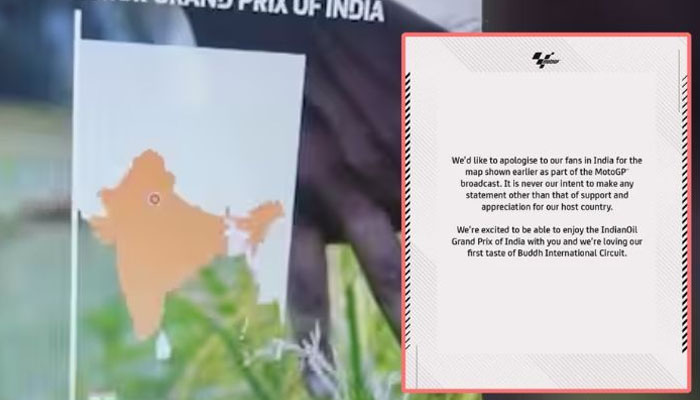
MotoGP apologised to Indian fans on Friday, on its live feed of a practise session for showing a map of India without Indian Illegally Occupied Jammu and Kashmir (IIOJK), which is also a contested land claimed by Pakistan.
India's territorial integrity is a touchstone issue for the ruling Hindu national Bharatiya Janata Party (BJP) and its supporters.
New Delhi controls most of the Muslim-majority IIOJK, but it is divided between India and Pakistan, with both countries claiming it in full and fighting two wars over the Himalayan territory.
The premier global motorbike competition is holding its first-ever race in India to tap into a growing two-wheeler market in the world´s most populous nation and fifth-biggest economy.
Angry fans took to social media and demanded redress when MotoGP showed a map of India without any part of the Jammu and IIOJK region on their live feed.
MotoGP soon posted an apology on social media.
"We'd like to apologise to our fans in India for the map shown earlier as part of the MotoGP broadcast," the statement read.
"It is never our intent to make any statement other than that of support and appreciation for our host country," it added.
Maps can be a sensitive issue in India — New Delhi's own depictions incorporate the whole IIOJK, including the Pakistani side.





-
 Barack Obama addresses UFO mystery: Aliens are ‘real’ but debunks Area 51 conspiracy theories
 -
 Rosie O’Donnell secretly returned to US to test safety
 -
 'Harry Potter' star Rupert Grint shares where he stands politically
 -
 Drama outside Nancy Guthrie's home unfolds described as 'circus'
 -
 Marco Rubio sends message of unity to Europe
 -
 Hilarie Burton reveals Valentine's Day plans with Jeffrey Dean Morgan
 -
 Jacob Elordi, Margot Robbie on 'devastating' scene in 'Wuthering Heights'
 -
 China to implement zero tariffs on African imports in major trade shift