
Why Russian lunar lander Luna-25 failed?
Moscow's space mission Luna-25 blasted off to the moon on August 11 and was scheduled to land Monday
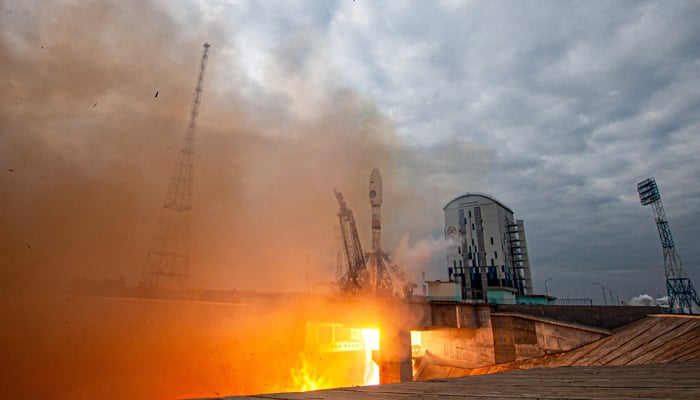
Russian space ambitions could not materialise as its lunar lander Luna-25 crash-landed on the moon's surface, just a day after the space agency Roscosmos announced that its spacecraft witnessed an abnormality and failed to conduct manoeuvre in accordance with the required parameters.
Moscow's space mission to the Earth's natural satellite blasted off on August 11 and was scheduled to land Monday — becoming the first Russian spacecraft to do so since 1976.
However, Luna-25 malfunctioned and crashed.
Here's what went wrong with the Russian spacecraft.
Russian Luna-25 mission
The Luna-25 mission aimed to reignite Russia's lunar exploration following a lengthy hiatus since the Soviet Union's Luna-24 mission in 1976.
Launched from the Vostochny Cosmodrome, the Soyuz 2.1 rocket carrying Luna-25 embarked on its journey on August 11. After entering the moon's orbit on August 16, the spacecraft was poised for a soft landing on August 21.
Crashing of Luna-25
Russia's space agency Roscosmos said that an "abnormal situation" transpired during an attempt to transition the craft into a pre-landing orbit.
Communication with the spacecraft was lost shortly thereafter. Afterwards, in a statement, the agency confirmed that Luna-25 met an untimely end due to a collision with the lunar surface.
Where Russia stands?
The failure of the mission underscores Russia's declining status in the global space race, in contrast to its historic achievements during the Cold War days.
The mission's failure highlights challenges in Russian technology and the ability to remain competitive, with billions of dollars in investment.
This setback also put a dent in the Russian attempt to reclaim its lost glory.
Previous lunar missions, including the 2011 Fobos-Grunt endeavour, which fell short of escaping Earth's orbit, reveal the intricate challenges facing Russia's space aspirations.
The road to Luna-25 was marked by delays stemming from the aftermath of the Soviet Union's dissolution and ensuing political and economic turmoil.
As Russia forges ahead in its lunar aspirations, the Luna-25 incident serves as a poignant reminder of the complexities inherent in space exploration.
While the Luna-25 mission encountered unforeseen obstacles, its reverberations across Russia's space endeavours and scientific ambitions will likely spark renewed determination to overcome challenges and strive for lunar exploration success.



-
 Shanghai Fusion ‘Artificial Sun’ achieves groundbreaking results with plasma control record
 -
 Polar vortex ‘exceptional’ disruption: Rare shift signals extreme February winter
 -
 Netherlands repatriates 3500-year-old Egyptian sculpture looted during Arab Spring
 -
 Archaeologists recreate 3,500-year-old Egyptian perfumes for modern museums
 -
 Smartphones in orbit? NASA’s Crew-12 and Artemis II missions to use latest mobile tech
 -
 Rare deep-sea discovery: ‘School bus-size’ phantom jellyfish spotted in Argentina
 -
 NASA eyes March moon mission launch following test run setbacks
 -
 February offers 8 must-see sky events including rare eclipse and planet parade