Rupee reaches all-time low in interbank
The over 9% decline was its highest since October 30, 1999, when the currency slumped 9.4%
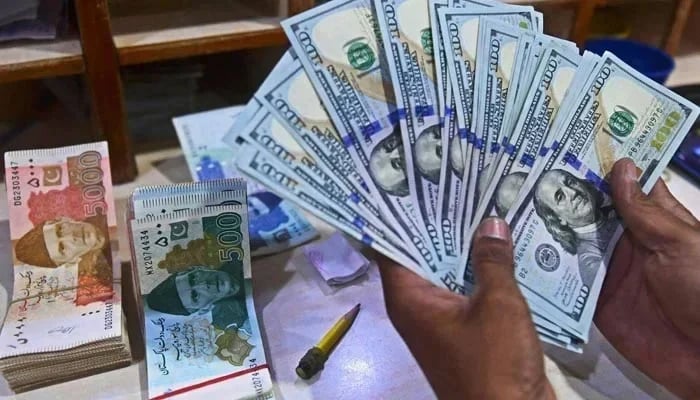
KARACHI: The rupee posted its biggest single-day decline against the dollar in more than two decades, after rapidly depleting foreign exchange reserves and an unyielding International Monetary Fund (IMF) forced the government to relax its grip on the currency.
Following the government's decision to end its control over the rupee-dollar exchange rate as part of the International Monetary Fund (IMF) condition, the currency slid 9.61%, or Rs24.5, to a record low of 255.43 against the US dollar compared to Wednesday's close of Rs230.89.
The over 9% decline was its highest since October 30, 1999, when the currency slumped 9.4%.
“SBP is seemingly adjusting the exchange rate to the market rate — closer to open market to address the widening difference between the official and open market rate and to curb the flow of dollars through the informal market,” said Saad Ali, capital market expert.
The central bank had imposed a tight 227-230 range against the dollar for the currency since September to rein in Pakistan’s depleting foreign exchange reserves.
Under the four major conditions laid forth by the lender of the last resort for Pakistan's loan tranche pending since September, the IMF had asked Islamabad to let the market forces determine the exchange rate.
The local unit last plunged to its all-time low of 239.94 on July 28, 2022, following which the currency recovered as Ishaq Dar assumed charge as the finance minister replacing his predecessor Miftah Ismail.
Meanwhile, the rupee dropped to 262 against the greenback in the open market, after depreciating Rs21, data released by the Exchange Companies Association of Pakistan (ECAP) showed.
Ali further mentioned that the government's decision to let the currency rate be determined by the market is an "important step" to ensure the resumption of the IMF's Extended Fund Facility (EFF) programme.
Meanwhile, Ministry of Finance’s former adviser Dr Khaqan Hassan Najeeb said that it was the “right move” to let the market forces adjust the rupee’s value as the country was facing a “severe dollar liquidity crunch, scarce reserves, as well as Pakistan's need for moving ahead with the IMF”.
“Pakistan is in a market-determined exchange rate regime. In this regime trade deficit, supply and demand factors, fundamentals of the economy make a lot of impact on currency changes,” the financial expert told Geo.tv.
Dr Najeeb further said that the closing of the gap between market rates and interbank will force “remittances to move to formal channels as well as exporters to offload their receipts”.
“This may help ease the supply of dollars in the interbank,” explained the former adviser.


-
 OPEC+ agrees to keep November oil targets steady amid market uncertainty
 -
 Meta’s AI data centers: What to know about its major tax strategy
 -
 Tesla’s Cybercab faces a tough test after rocky Austin debut: Here's why
 -
 Trump pushes South Korea on Alaska LNG deal: Why Seoul is hesitant
 -
 AI boom could trigger severe market shocks, Bank of England warns
 -
 US inflation rises less than expected: What to know
 -
 OpenAI’s revenue run rate nears $70 billion: What to know
 -
 Canada’s economy records zero growth in July as key sectors decline
-
 UK diesel price hits all-time high amid Middle East supply crunch, RAC warns
 -
Meta’s Muse AI agent gets new tools for small businesses: What to know
-
China weighs allowing ByteDance, Alibaba to purchase new Nvidia RTX Pro 5500 chips
-
Why Bill Gates is calling for stronger AI rules amid growing safety concerns