
Strategic culture, economic interest intertwined: Kidwai
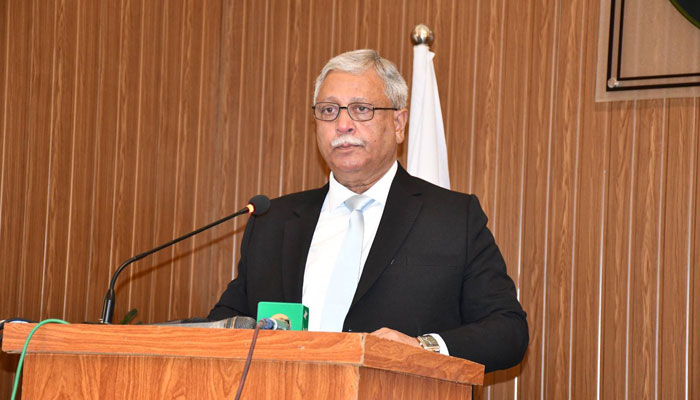
Islamabad:Lt Gen (r) Khalid Ahmed Kidwai, adviser, National Command Authority, has said that a shift in strategic culture emphasises Pakistan's security concerns and economic interests in the Arabian Sea and Indian Ocean Region.
Gen Qidwai was speaking at a seminar organised here by Institute of Regional Studies, (IRS). Gen Qidwai urged re-evaluation of ‘Continental Pakistan’ within a broader strategic framework, viewing the land mass (75%) and Oceanic Pakistan (25%) as a cohesive whole rather than two separate entities.
“We cannot afford to continue to ignore 25 % of Pakistan especially when there are mounting security and economic challenges in the Indian Ocean Region,” he remarked. In response to a query about missile range expansion, Gen Kidwai remarked that Pakistan’s strategic focus is primarily India-centric, therefore, it does not seek to extend its missile range. He reiterated that Pakistan aims to avoid an arms race stating that its threat assessments and strategic culture are stable and unlikely to change soon.
Gen Kidwai referred to Pakistan’s strategic weapons, particularly tactical nuclear weapons, as ‘weapons of peace’ asserting that they help maintain strategic stability in South Asia. He noted the rising global demand for Pakistani troops in peacekeeping roles as a testament to Pakistan's role as a peace-loving and promoting nation.
Former Defence Minister Khurram Dastagir Khan acknowledged Pakistan's effective management of eastern border security but urged the integration of western border security into the national strategy. He criticised the inadequate responses to ceasefire violations and India's revocation of Article 370, which has fostered a more assertive Indian stance. He emphasised the need to move beyond mere survival against Indian actions and to reformulate strategic doctrine in response to new challenges from India, Afghanistan and militants in Balochistan and Khyber-Pakhtunkhwa.
Jauhar Saleem, President, IRS, asserted that Pakistan’s nuclear development was pivotal in counterbalancing India's conventional superiority, serving as an effective deterrent against conflict initiation by New Delhi. He warned that India's pursuit of advanced weaponry is instigating an arms race and undermining strategic stability in South Asia, while its ultra-nationalism breeds mistrust among nuclear states, further destabilising the region.
Dr Qamar Cheema, executive director, Sanober Institute, urged a reassessment of Pakistan’s strategic culture in light of India's evolving stance on its "No First Use" policy, which poses risks to regional stability. He expressed concern over India's establishment of Integrated Battle Groups (IBGs) along the Line of Actual Control (LAC), suggesting that similar formations could emerge along the Line of Control (LoC), necessitating vigilance and preparedness from Pakistan.


