
Pakistan seeking rescheduling of $27bn bilateral debt: Dar
Dar says he views the “true value” of the rupee at a level under 200 to the dollar
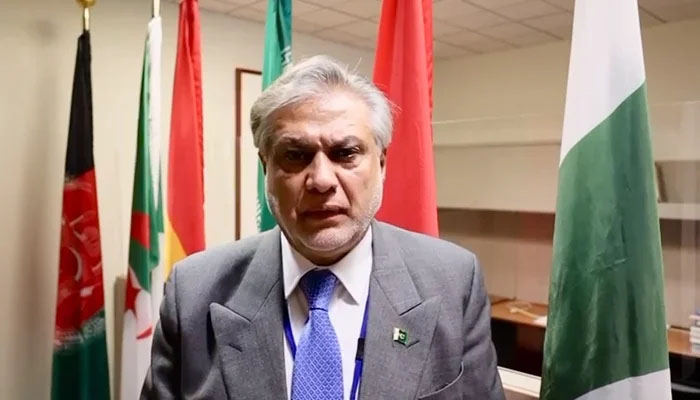
WASHINGTON: Finance Minister, Ishaq Dar, told Reuters on Friday that he will seek rescheduling of some $27 billion worth of non-Paris Club debt largely owed to China, but will not pursue haircuts as part of any restructuring. The finance minister also sought to reassure international lenders of staying true to economic reforms and completing the IMF programme.
In an interview, Dar ruled out the possibility of a default on Pakistan’s debt, an extension of the maturity date on bonds due in December or renegotiation of Pakistan’s current International Monetary Fund program.
The veteran finance minister said multilateral development banks and international donors have been “quite flexible” with ways to meet Pakistan’s external financing needs to be estimated at about $32 billion after devastating floods. Some of this may come from reallocating funds from previously approved, slower-disbursing development loans, he added.
Dar, who is participating in the IMF and World Bank annual meetings just over two weeks after taking office, said that Pakistan will seek restructuring on equal terms for all bilateral creditors. He declined to comment when asked whether he thought it would be difficult to persuade China, creditor, for about $23 billion of the debt, to participate. But asked whether Pakistan would seek to reduce debt principal, he said “rescheduling is fine, but we are not seeking a haircut. That’s not fair.”
Dar, who served as Pakistan’s finance minister three previous times, most recently from 2013 to 2017, is known as a staunch defender of the rupee. He said Pakistan has not engaged in physical intervention in the currency, which has been battered this year by a strong US dollar, but which has rallied some 10% since his appointment.
Dar said that he views the “true value” of the rupee at a level under 200 to the dollar. It last traded at 219. “I am for a stable currency, I am for a realistic rate. I am for market-based, but not subject to a currency being taken hostage” and making speculators billions of dollars
Asked whether he discussed with IMF officials the possibility of borrowing from the Fund’s new Resilience and Sustainability Trust for middle-income countries, Dar said, “We have discussed all options.”
The finance minister added that the IMF’s new emergency “food shock” borrowing window may also be a good fit for the country, which has lost crops due to devastating floods and may need to import up to half a million of tons of wheat in the next year. “In this scenario, we have the possibility of approaching and accessing this facility,” he said.
In an interview with AFP, the finance minister promised international lenders to stay true to economic reforms despite a new estimate that Pakistan quickly needs more than $16 billion to recover from devastating floods.
Ishaq Dar also said that a flood donors conference promised by French President Emmanuel Macron would take place next month which he hoped would help Pakistan both with immediate and longer-term needs. “It will be our endeavour, even at the cost of extra effort, that we should complete the programme successfully,” Dar told AFP in an interview Friday evening in Washington. Doing so “sends a positive signal to the international community and the markets,” he said, voicing appreciation to the “very responsive” promises of other nations for Pakistan. Dar said that a new study commissioned in part by the World Bank and the Asian Development Bank found that Pakistan sustained $32.4 billion in flood losses and would require $16.2 billion for reconstruction and rehabilitation. “With that challenge, obviously, we have to go to the drawing board” to allocate funding, he said.
He said that minor adjustments may be needed but “everything is in order” for the next review of the IMF which could release further funding.
Dar said he expected Macron’s donor conference sometime in November and that he hoped it would address needs beyond the three to four years typically eyed for immediate disaster recovery.
The World Bank earlier this month once again downgraded the growth forecast for Pakistan, expecting its economy to expand by only two per cent in the year through June due to the floods as well as inflation and troubled finances.
Dar, while not criticising the World Bank´s methodology, said he was a “little more optimistic” and envisioned growth of three per cent. “I think things are settling down already,” he said, while not ruling out impacts from global troubles.
Jihad Azour, director of the IMF´s Middle East and Central Asia department, said that a mission would visit Pakistan next month to start the next review. He reiterated concern about Pakistan´s blanket fuel subsidies, calling the policy “very regressive.”
“We are encouraging Pakistan as well as also other countries to move from an untargeted subsidy that is a waste of resources and to dedicate those resources to those who need it,” Azour told reporters.
Meanwhile, a high-level round table meeting on ‘Pakistan’s Floods: Impact and Response’ was held in Washington. All major bilateral and multilateral development partners and donors attended the round table discussion. Finance Minister Ishaq Dar led the Pakistani delegation in the meeting. Initial findings of Pakistan’s post-disaster need assessment jointly prepared by the World Bank, Asian Development Bank, United Nations Development Programme (UNDP), European Union (EU) and government of Pakistan were presented at the meeting.
This event, organised by the World Bank, was co-chaired by Martin Raiser, Vice President for South Asia, World Bank, and Nigel Casey, UK Prime Minister’s Special Envoy for Pakistan and Afghanistan.
The Roundtable was attended by senior representatives of all major bilateral and multilateral partners and donors. Initial findings of Pakistan’s post-disaster need assessment (PDNA), which are jointly prepared by the World Bank, Asian Development Bank, UNDP, EU and the GoP were presented in the Roundtable.
The participants expressed their sympathies on the tragic loss of life and property due to the devastating floods in Pakistan.
Finance Minister Ishaq Dar, in his address, appreciated the international community for playing a vital role since the floods came to the surface. However, he stressed continuing their support so that a rehabilitation plan could be executed. “I have no words to thank the international community especially, the WB for their generous support for the flood-affected people,” he concluded.
Federal Minister for Planning and Development Ahsan Iqbal also spoke on zoom from Islamabad. Pakistan has emphasized the need for continued support from the international community, in the construction and rehabilitation phase, which will be announced formally by Prime Minister Shehbaz Sharif on October 24.
The international community has generously supported the relief and rescue operations. Now the government seeks further support in the reconstruction and rehabilitation of flood-affected people, said Ahsan Iqbal while addressing the Roundtable on joint presentation and the key findings on the Post-Disaster Need Assessment (PDNA).
Speaking on the occasion, Ahsan Iqbal highlighted the significance of a comprehensive post-damage and need assessment exercise, which was completed in collaboration with the WB, Asian Development Bank, European Union (EU) and the United Nations (UN).
Iqbal, while highlighting the key policy imperatives for resilient and recovery plan, said that several initiatives have been taken, which include building back better, participatory and inclusive recovery plan and implementation and to prioritise people values.
Similarly, during the Roundtable, it was also highlighted that the focus of the infrastructure will be climate resilience as the calamity is the biggest threat and Pakistan is the victim.
The minister informed the participants that the devastating floods have adversely impacted about 33 million people and inundated 15% of the country, causing major hardships in the provinces of Sindh and Balochistan. “The rehabilitation plan needs to be implemented with the same spirit of rescue efforts and it is not possible without the support of international community,” said the minister, while stating that the climate disaster has turned into hyper poverty and hyper malnutrition.
The minister further added that it was time for the richest people of the world to help the poorest people of Pakistan, the victims of the development of advanced world.
Meanwhile, the minister for finance, who is currently visiting the US, also met with Ms Vicky Ford, United Kingdom’s Minister of State for Development in the Foreign, Commonwealth & Development Office (FCDO). He thanked the UK government for humanitarian assistance and financial support to meet the challenges posed by the devastating floods. He also appreciated the trade concessions accorded to Pakistan and other developing countries under the DCTS Scheme.
The minister also shared the GoP’s vision for stabilising the economy and carrying out sustainable and resilient recovery. Minister Ford conveyed the condolences of the UK government on the devastation caused by the floods and appreciated the government’s rescue and relief efforts. She reiterated the United Kingdom’s continued support for Pakistan during this difficult period.
The finance minister in his meeting with Sultan Abdur Rehman Almurshed, CEO Saudi Fund for Development, conveyed the GoP’s deep gratitude for the support provided by the brotherly Kingdom of Saudi Arabia during all challenging times for Pakistan. He also welcomed the upcoming visit of the Saudi Fund team to Pakistan. Almurshed conveyed condolences on the tragic loss of life and damages caused by the floods. He assured that the SFD would continue to work with and support the GoP.
Ramin Toloui, Assistant Secretary for the Bureau of Economic and Business Affairs, and Donald Lu, Assistant Secretary for South and Central Asia Bureau, US Department of State, called on the finance minister at the Embassy of Pakistan to express the United States Government’s solidarity with the government and people of Pakistan on the tragic loss of life and property due to the floods. They assured continuous US support for recovery and relief efforts of the GoP. Other issues of mutual interest were also discussed.
The finance minister reiterated Pakistan’s commitment to implement the ongoing IMF program along with highlighting the economic priorities of the government in his interviews to Bloomberg, Wall Street Journal, Reuters, AP and AFP and in a subsequent evening engagement at the Pakistan House with senior representatives of various think thanks and US media.
Dar, along with Minister for Economic Affairs Sardar Ayaz Sadiq, also attended the 2022 Annual Plenary of the IMF/World Bank. The delegation members met senior representative of UNCTAD and participated in several events being held on the sidelines of the Annual Meetings, including meeting the leadership of US Pakistan Business Council and representatives of major US multi-national companies operating in Pakistan.
In his meeting with Jihad Azour, Director of MCD, IMF, the finance minister discussed the implementation of IMF program. Azour sympathised with the losses caused by the flood. He appreciated the GOP’s commitment to implement the ongoing IMF program and assured of continued support by the Fund.


