Come May, nine of Pakistan’s brightest rising stars will be competing with over 1700 of their counterparts from more than 75 countries for about $4 million in prizes at the Intel International Science and Engineering Fair (Intel ISEF).
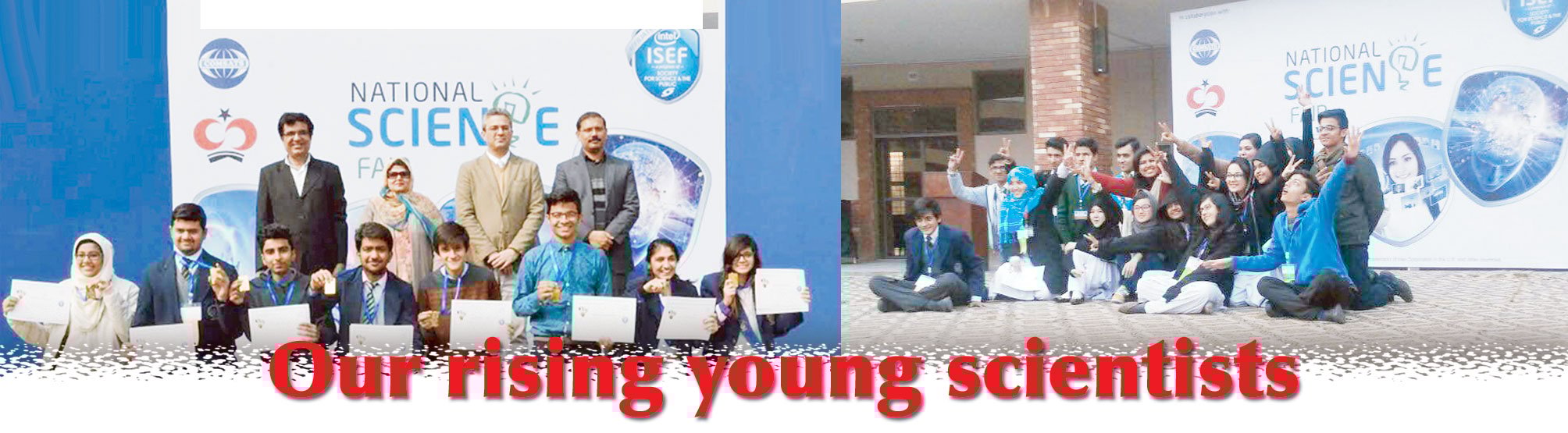
Come May, nine of Pakistan’s brightest rising stars will be competing with over 1700 of their counterparts from more than 75 countries for about $4 million in prizes at the Intel International Science and Engineering Fair (Intel ISEF). ISEF is the world’s largest international pre-college science competition in which students from all over the world showcase their independent research. The competition is for students in grades 9–12. This year, Intel ISEF 2016 will be held in Phoenix, Arizona from May 8 to 13.
Intel Pakistan has been holding science fairs for almost two decades now. The competition has a set format; the contestants first compete at district level and the winners then contend at provincial level. The students whose projects are short-listed get to compete at national level.
This year, too, the National Science Fair showcased more than 110 science projects submitted by 254 young scientists from all four provinces. Two teams of three students and three individual were selected to represent Pakistan at ISEF in the USA.
The winners in the group category are Ahmad Bin Abdur Rehman, Muhammad Hashim Khan from Divisional Public School, Township branch, Lahore, and Minahil Mustafa, Sameen Mehdi, Abdullah Khan from Beaconhouse School System, Valencia Town Campus, Lahore.
The winners in the individual projects category are Shahmir Khan Niazi from Beaconhouse School System, Valencia Town Campus, Lahore; Khasheaa Nadeem from Aga Khan Higher Secondary School, Karimabad, Karachi and Sarmad Saeed Nasir from Engro Grammar School, Dharki, District Ghotki, Sindh.
Us spoke to the proud winners to find out about their projects, and their prospects at ISEF 2016.
Khasheaa Nadeem’s Pollution Filter Mask
“It was a wonderful experience. Really enjoyed as it was something unique for me,” shared Khasheaa Nadeem, a student of first year pre-med from Aga Khan Higher Secondary School. Coming across as a very focused and articulate young lady, this girl wionder, not even 17 yet, has managed to snag the gold medal in individual capacity at Intel National Science and Engineering Fair.
Explaining how she came to participate at the Science Fair, Khasheaa said, “In our college there was this huge hype about the competition. I was interested because I thought I could come up with something new. I had read that in Japan people use surgical masks as a preventive measure against pollution while commuting. In Pakistan also I have seen people wearing masks. In Islamabad, masks are used because there is pollen in the air. I thought about making a pollution filter mask specifically. I submitted the abstract to the Intel Science Committee and got the green light from them to go ahead. My mentor, Ms Shama Shoukat, who is my chemistry teacher, guided me. Ms Shama considers independent research as a great exercise in character building and she encouraged me to do that. Initially, my friends Rafia Ameen and Maryam Sajjad also involved with the project. I spent countless hours researching my topic. When I found something important and interesting I discussed it Ms Shama. She guided me, but did not take over the research. She was the one who pointed me in the right direction. All the months spent researching into the deep hours of the night, the classes missed, the sweat, blood and tears shed, the repetitive testing, all the navigation of red tape cumulated into that one moment where my name was announced as one of the three Individual Grand Winners given the opportunity to go to the United States of America to compete at the International Level.
Khasheaa had a word of advice for the future contestants and mentors: “I think I want more guidance for students who participate in the competition. I went in there almost blind about the process, how to make a research and log book. Detailed information should be provided to the participants instead of fragmented info. The participants should have a clear idea of what they want to achieve. It’s about being a scientist, about their goals and ideas.
Talking about her chances of winning, she seemed optimistic. “I think I have a good chance at winning. I am grateful to Allah, my parents and mentor for my success so far. But I believe it’s not about winning alone; it’s about wanting to improve the future and making our world a better place.”
Milkaumentar –
Sarmad Saeed Nasir’s innovation
Sarmad Saeed Nasir from Engro Grammar School, Daharki, won in individual capacity. Confident and smart, the young man is extremely bright and confident. Talking to Us, he said: “It was my first ever competition. I mean I was into debating and stuff, but a science fair! I learnt a lot and it was a great experience.”
So what gave Sarmad the idea to compete in Intel Science Fair? “One day, my friend asked me to attend the workshop on ISEF held at school. Project Manager, Ms Khadija, briefed us about the competition and said we had to come up with an original idea for the project. Listening to her, I thought to myself I would be the one, and my project would be selected from my school! My friend also encouraged me to try and think of an idea for the project.
“Sitting alone, I came up with lots of weird ideas. One of them was to somehow use the smoke that emits from cars as an eco-friendly pesticide! I had many such crazy ideas. Then I went to my farmhouse and observed my grandfather feeding the cattle. I had a conversation with him and the germs of an idea originated in my mind. You see, some time back, an injection called boostin got banned by the government. It was used to increase milk yield in cows, and the cows were giving 25 to 30 litres of milk. But this milk caused hormonal imbalance in the children who used it. I got the idea of coming up with a healthy alternate. I came up with a supplement that increased milk yield to 20 to 25 litres, less than that of the injection, but still a great leap.
“It wasn’t very easy; I watched my grandfather, had conversations with him about grains and stuff, spent countless hours on the internet researching. I also went to Food Science Institution with my project … I went shopping for the ingredients I needed from the local market. Once it was ready, I went to Bahauddin Zakaria University to get the tests done. They gave me the green signal, which was needed for subject testing. For that I went to Cattle Colony in Landhi, Karachi. I would also like to mention Doctors Dairy Feed, a company that gave me a supervisor and he helped me with quantity and other things. My dad, who teaches Urdu to O- and A-level students helped me with logistics – subject testing, etc. “Through out the entire process, I was upbeat about my prospects. I knew I would win and it wasn’t overconfidence. During my provincial and national competitions, my principal asked me what my chances were. I told her I would win. I am good at communication and presentation, which helps a lot.”
To the future participants, Sarmad advised, “Ask your school to get you a good mentor to help you. And work on your communications skills. There were some amazing projects at the National Science Fair and I was truly surprised they did not get selected. I think the problem with those guys were they were not articulate enough to explain their projects to the judges. After such hard work! So all the participants should work on their communication skills and be confident,” Sarmad concluded.
Minahil Mustafa -
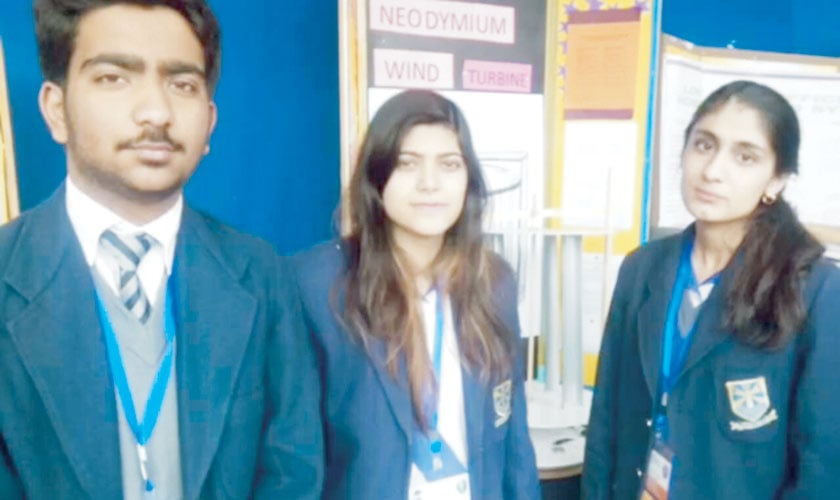
The Neodymium Wind Turbine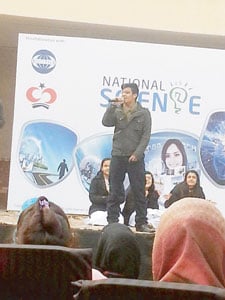
A girl whose hobbies include singing and reading books, whose father works in real estate business and whose mother is an O-Levels teacher (Urdu) at Beaconhouse School System (BSS), Lahore, one can just feel the lively vibes coming off Minahil even as the interview is conducted over phone.
Minahil’s project, The Neodymium Wind Turbine, secured one of the winning slots at the national level. They were studying the same topic in class when she was introduced to ISEF. Said to be the most powerful permanent magnets available globally, Neodymium magnets are also referred to as the rare earth magnets or NIB super magnets based on the fact that these elements are part of their composition. Besides, attributes like an extremely high resistance to demagnetization, working well in ambient temperature, and being easily affordable and portable, make them a good choice to generate electricity among their various industrial and commercial applications.
However, there are a few hazards (e.g. bodily harm and risk to particular electronic and mechanical devices) that the magnets entail. While class discussions inspired her to develop an economically feasible, eco-friendly, and efficient alternative to the simple wind turbine, it wasn’t enough. Minahil had to spend a significant time online, pursuing sites like Wikipedia, enhancing her knowledge on the potential problems expected with this project, especially in relation to the energy-producing and wind turbines.
At present, Minahil is in her last year of O-level; the school assisted with the finances ; her physics teacher as well as her class fellows helped her out with at various fronts such as the availability of material and setting up a prototype.
She’ll be presenting the mechanism of their model at the ISEF (Phoenix, Arizona) while Abdullah Khan and Sameen Mehdi (her team members) will discuss the introduction and comparison with other resources respectively.
“The basic thing to aim for is selection. It’s obvious that you should have a good project, that is beneficial at a global level instead of for a handful, but it’s more important for you to have excellent communication skills if you are to impress the judges,” she added as her advice to future participants.
Ahmad bin Abdur Rahman on minimising energy wastage
You know someone wants to win real bad when being a runner-up doesn’t satisfy them and they brainstorm and come up with a new idea to submit for evaluation next year only, and (guess what?) succeeds to represent the country internationally! This year, Ahmad took a step away from photo-electrolysis to inventing a solar-powered hydrogen vehicle.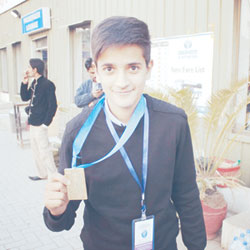
Such was his determination that he kept himself on toes the whole year working on his new project. Since the whole idea was to ensure their project was indeed a better option than a vehicle being run on fossil fuels, they researched previous works to finally come up with a solution that could minimize energy wastage, which leads to greenhouse effect, along with the fast consumption of the non-renewable source of energy.
Ahmed has just sat for his Grade 10 examinations and he is pretty excited to be accompanying Muhammad Hashim Khan from his school, Divisional Public School, Township Branch (Lahore), who would be speaking specifically about shock absorbers as part of their concept on the big day. .
It’s no secret that the modern-day transportation has been the primary reason for the dreadful condition of our environment. As useful as it has been to our benefit, Ahmad’s invention combining solar-power and current-inducing shock absorbers is meaningful because it promises both quick as well as an efficient travel in future without – and this is important – having to resort to the early forms (e.g. animal-drawn vehicles).
Given that his family has been a major source of finance for this journey – the school having helped with a meagre amount only – there’s a lot he has at stake here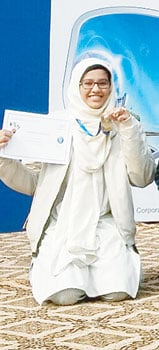
When asked if he has any advice for talented young Pakistanis eager to be part of ISEF in future, Ahmad replied, “Many people discouraged me; a lot of them said that it’s not easy, that I would have to endure yet another loss, etc. However, I did not listen to them and I did not put off working on my project. I don’t think it actually matters to them whether I win or lose; it’s, you know, ‘haters gonna hate’ sort of thing so my advice is: don’t let anyone tell you what to do and what not to do; just do what you want to!”
Wishing the winners best of luck, Naveed Siraj, Country Manager, Intel Pakistan said: “The number of students who have qualified for the National Science Fair and the ones who’ve further secured a position in the International Science & Engineering Fair in Phoenix, Arizona are proof that Pakistan has incredible talent. One of the core outcomes of education is to produce productive citizens and role models for tomorrow, which we can only achieve by enabling students in becoming acquainted with and excelling in technology.”
Us wishes our young scientists the best of good luck!