Omicron in Pakistan: First case of new COVID-19 variant confirmed, says NIH
NIH says this is the first confirmed case of Omicron but continued surveillance of suspected samples is in place to identify the trend
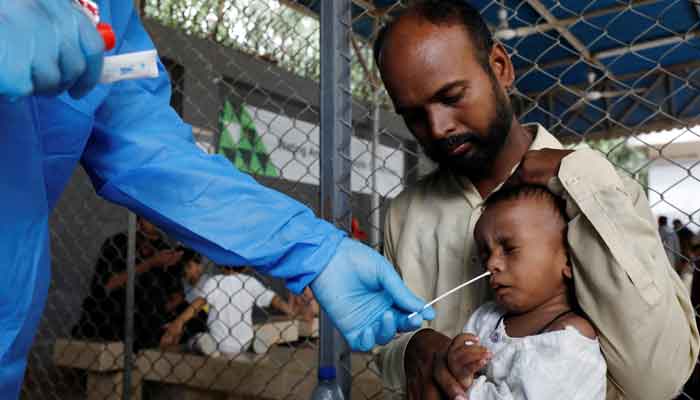
KARACHI: Pakistan on Monday reported its first case of the Omicron variant of coronavirus that has spread to over 60 countries around the world, triggering travel restrictions.
The National Institute of Health (NIH) issued a statement Monday after analyzing the samples of a patient admitted last week.


“The NIH has been able to confirm (via whole genome sequencing) that a recently suspected sample from Karachi is indeed the ‘Omicron variant’ of SARS-CoV2,” it said on Twitter.
The NIH added that this is the first confirmed case but continued surveillance of suspected samples is in place to identify the trends.
“The importance of getting vaccinated to protect from serious effects of existing and new variants is therefore highlighted. Please get yourself vaccinated according to guidelines issued by the NCOC,” it added.
Separately, Aga Khan University Hospital (AKUH) also confirmed the presence of the Omicron variant after gene sequencing.
"Gene sequencing at AKUH has confirmed the presence of the COVID-19 Omicron variant in the first patient. The patient is at home and doing well."
It added that no other patients with the Omicron variant have been identified at AKUH.
Last week, Sindh Health Minister Azra Sindh Health Minister Dr Azra Pechuho had said that a 57-year-old patient have contracted the virus that is behaving like Omicron but gene sequencing will be done to confirm the presence.
Later, the NIH also issued a statement, saying the institute will obtain the samples and carry out further test to confirm it.
More transmissible
On Sunday, the World Health Organization said that the Omicron coronavirus variant is more transmissible than the Delta strain and reduces vaccine efficacy but causes less severe symptoms according to early data.
The Delta variant, first identified in India earlier this year, is responsible for most of the world´s coronavirus infections.
But South Africa´s discovery of Omicron -- which has a large number of mutations -- last month prompted countries around the world to impose travel bans on southern African countries and reintroduce domestic restrictions to slow its spread.
The WHO said Omicron had spread to 63 countries as of December 9. Faster transmission was noted in South Africa, where Delta is less prevalent, and in Britain, where Delta is the dominant strain.
But it stressed that a lack of data meant it could not say if Omicron’s rate of transmission was because it was less prone to immune responses, higher transmissibility or a combination of both.


-
 Punjab by-polls: Notices served on minister, SAPM for ‘violating’ election code of conduct
 -
 27th Amendment empowers FCC to hear all constitutional cases: minister
 -
 JF-17 attracts strong attention at Dubai Airshow as friendly country inks procurement MoU
 -
 US lawmakers laud Punjab govt's initiative to modernise brick-kiln
 -
 Security forces gun down 30 terrorists in multiple IBOs in KP: ISPR
 -
 MQM-P calls for new province in Sindh
 -
 US report validates Pakistan military edge over India: PM
 -
 Banned TTP poses serious threat to Pakistan security: UNSC panel