Trump releases AI accord with tech executives, formally introduces 'super intelligence'
White House signs voluntary safety pact with major tech CEOs while issuing an executive order to officially rebrand AI across federal agencies
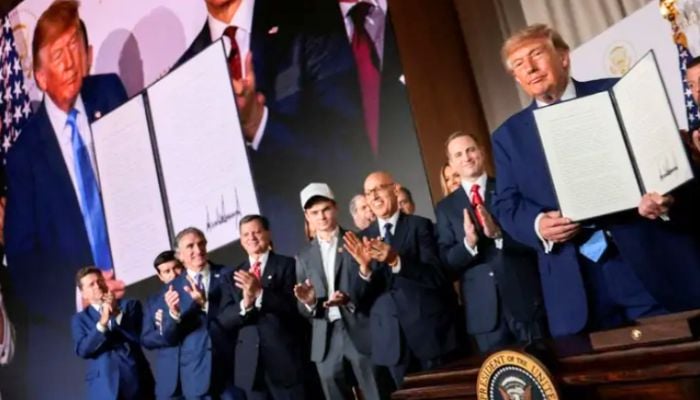
President Donald Trump and leaders from the nation's premier artificial intelligence firms (AI) have signed a high-profile voluntary accord at the White House, committing major tech corporations to a framework of self-policing and independent safety audits.
Trump released the one-page document on his Truth Social platform - which he had earlier described as "morally binding"-and that urged four layers of controls in companies.
The document was signed by Trump and the bosses of Google, Anthropic, Meta, OpenAI, social media platform X and NVIDIA.
The accord asked companies to partner with an external auditor or evaluator to carry out independent assessments of whether a company's AI control and monitoring systems were operating as intended.
It also urged them to designate an independent committee of the board of directors to oversee and receive reports from internal and external auditors and from teams operating AI controls.
The accord asked companies to have an internal team to ensure "all of the controls, monitoring and detection are operating as intended."
Additionally it asked for internal controls to monitor capabilities and alignment of AI models during training and deployment around areas like cybersecurity, biosecurity and chemical threats to ensure that models "do not hack or access technical systems in unintended ways."
The agreement brings together chief executives including Meta’s Mark Zuckerberg, Google’s Sundar Pichai, Anthropic’s Dario Amodei, and Nvidia’s Jensen Huang.
The newly unveiled White House Accord on Superintelligence establishes multiple layers of safeguards, requiring participating companies to utilize external auditors and designate independent board committees to monitor advanced systems.
The pact focuses heavily on mitigating high-stakes hazards such as cybersecurity exploits, biosecurity threats, and unauthorized system self-preservation behaviors.
Trump described the pact as a "morally binding" document akin to a corporate constitution, emphasizing that the administration intends to foster rapid innovation while maintaining accountability.
Concurrently, the administration announced a sweeping executive directive requiring federal executive agencies to officially replace the term "artificial intelligence" with "super intelligence" or "SI" in all official government documentation.
While industry leaders welcomed the alignment on self-regulation standards, the summit also addressed contentious infrastructure hurdles, including the massive energy and data-center expansions required to fuel future model training across the country.


-
 South Korea reveals why Zelenskyy disclosed secret POW transfer
 -
 Flydubai flight diversion to Saudi Arabia: Israel rules out hijacking
 -
 Mark Carney’s Trump clash puts him in Nobel Peace Prize, Time Person of the Year Spotlight
 -
 Judge orders New York City to restart Secondary-Home Tax rollout; City immediately appeals
 -
 Cornell rape case: New York AG launches review as prosecutors reopen case
 -
 Carney threatens legal action against US steelmaker over tariff-linked layoffs
 -
 Morocco makes history as king names country’s first female prime minister
 -
 Christa Pike 'feels connection' with Lindsay Clancy ahead of her execution
-
 FBI faces internal criticism after hackers steal sensitive employee data
 -
Argentina threatens UK with international legal action over Falkland Islands oil exploration
-
Trump says ICE can arrest migrants without criminal records
-
Tennessee prepares to execute first female inmate in more than two centuries