Meta rolls out TRIBE v2 to predict human brain activity
Meta’s TRIBE v2 maps how the brain reacts to sight, sound and language in seconds
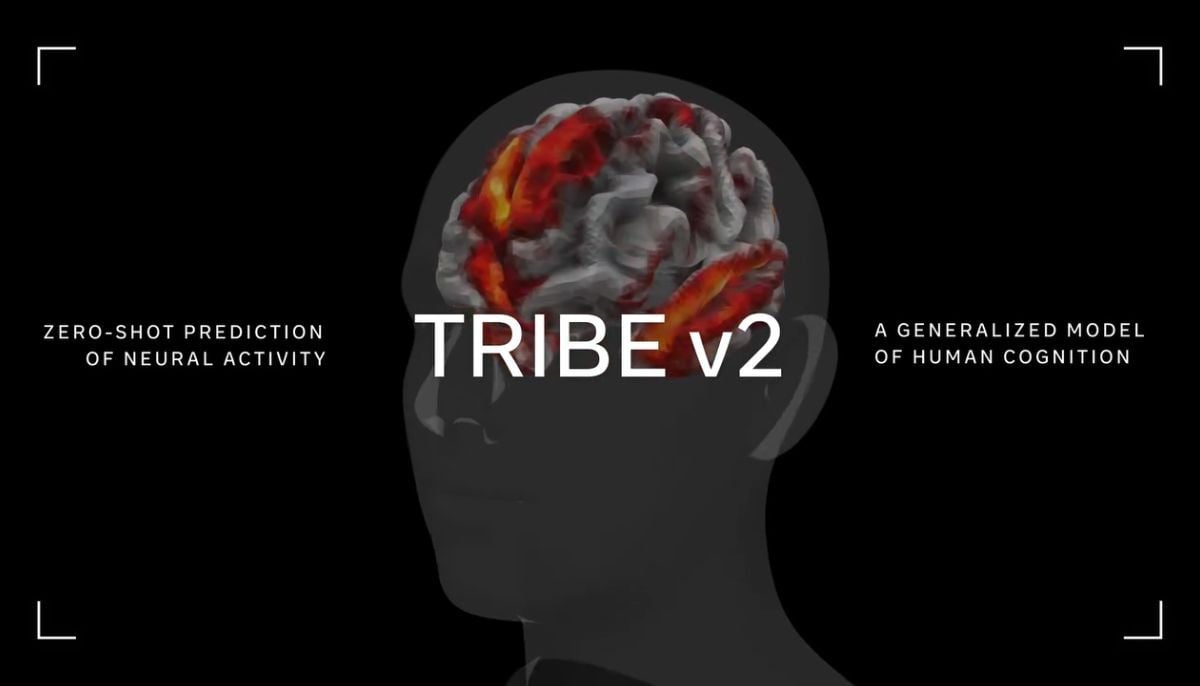
Meta has unveiled TRIBE v2, a foundation AI model that predicts how the human brain responds to sight, sound and language. The model, launched this week by Meta AI, aims to accelerate neuroscience experiments, reduce research costs, and potentially move the company closer to superintelligent AI that interacts with the world like humans do.
By mirroring human brain activity, TRIBE v2 offers insights into perception, cognition and neurological function.
How Meta TRIBE v2 works?
The three-stage process of the brain encoder works as follows: First, the model translates visual, audio, and text-based information into numerical form. Then the model analyses these signals to identify patterns in human information processing. After which, the model predicts the brain regions that are more likely to be activated in response to certain visual, audio, or text-based inputs.
The new model, according to Meta AI, can generate a more detailed map of brain activity compared to the earlier model. This is because the model was trained on larger datasets with more participants, making its predictions more accurate, even in noisy or inconsistent fMRI scans.
Brain activity patterns have traditionally been understood through repeated scans, which are costly and time-consuming. However, the new model can replicate these patterns, reducing months-long experiments to just seconds of computation.
The model is open source, with its paper, code and weights released publicly. Meta says this will help researchers in neuroscience, healthcare and artificial intelligence collaborate more effectively.


-
 WhatsApp to add birthday reminders to its contacts tab
 -
 UN security council hears AI warning from tech leaders
 -
 Meta's new Ray-Ban glasses put privacy first by ditching cameras
 -
 Meta unveils 'Muse Charm' AI gadget in bold push beyond smartphones and smart glasses
 -
 Qualcomm announces two Snapdragon 8 Elite Gen 6 chips
 -
 Meta launches new VR glasses with 5K displays, IMAX support
 -
 Anthropic reveals how Claude AI helped discover novel CRISPR-like enzyme
 -
 Australia says OpenAI AI agent hacked government system, but informed months later