Ishaq Dar asserts Pakistan will not default even without IMF deal
“Rumours” about default should not be spread, says finance minister
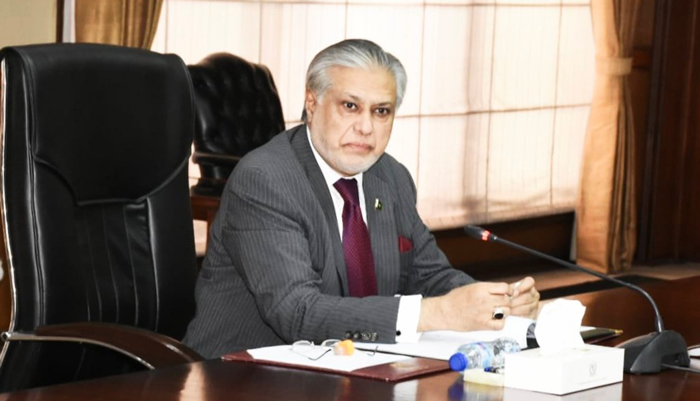
Days after Moody’s International Service warned of the possibility that Pakistan could default, Finance Minister Ishaq Dar rubbished what he termed as “rumours” on Thursday.
Addressing the Islamabad Security Dialogue, he asserted that Pakistan would not default, even if a stalled loan programme with the International Monetary Fund (IMF) was not revived.
He made the comments while addressing the delay in signing a staff-level agreement (SLA) with the IMF for the release of a crucial economic bailout.
Earlier this week, Moody’s Investor Service warned that the country could default without an IMF programme as its foreign exchange reserves were “very weak”.
Prior to that, Fitch Ratings also said that risks are large and a default or debt restructuring was an “increasingly real possibility” for Pakistan.
However, Dar said “rumours” about Pakistan defaulting on its debt obligations should not be spread. “Whether [the deal with the] IMF is [there] or not, Pakistan will not default,” he asserted.
The financial czar also said Pakistan had fulfilled all conditions and taken steps towards reaching an agreement with the international lender for reviving the stalled loan programme.
“International politics based on injustice with Pakistan should be ended. Internationally, people are amazed at how Pakistan is managing,” he added.
Dar added that Pakistan had to pay debts amounting to $3.7 billion till June, adding that Pakistan would fulfil all promises and make payments on time.
Technical discussions with the IMF ended on February 9 and there was a “gap” on the matter of the external account, he said.
“If the IMF wants more time for the staff-level agreement, it can take it. The [external debt repayments] in May and June will be done on time,” he reiterated.
International rating agencies should not discuss Pakistan’s default, he said, adding that financing would be arranged for payments in the current fiscal year as friendly countries had promised help.
Pakistan has been negotiating to restart a $6.5 billion bailout with the IMF for about half a year, as its foreign exchange reserves — which currently provide an import cover of nearly one month — come under pressure. The country has secured financing support from countries in the Middle East and China — a key IMF condition.
The country is reeling from an economic crisis with inflation surging to 36.4%, the highest in its history and the highest in South Asia, while a bruising political battle is raging between the government and former prime minister Imran Khan.
The government has removed caps on the exchange rate, imposed taxes, raised energy tariffs, and scaled back subsidies in an attempt to unlock IMF funding. It has also raised key interest rates to a record 21%.
Despite Dar’s repeated assurances in recent months that Pakistan would not default, analysts say the country is on the brink of it as its foreign reserves continue to remain at a critical level.


-
 Google agrees biggest carbon-removal deal: What to know
 -
 UK FCA eyes tokenized gold to boost London wholesale market liquidity—Here's why it matters
 -
 Meta launches new subscription with enhanced AI features and premium tools
 -
 AI stocks crash as top lab CEOs demand emergency technology slowdown amid extinction fears
 -
 Carney proposes new EU role for Canada: Key details to know
 -
 Micron gives Taiwan workers up to 68 months pay after strike threat
 -
 SpaceX landed its fourth billion-dollar AI customer
 -
 EU approves major investment in Ukraine’s air defense: How patriot missiles work