Ishaq Dar rules out possibility of reaching SLA with IMF this week
“Staff level agreement with IMF unlikely this week," Finance Minister Ishaq Dar says, but assures Pakistan "very close" to sealing deal
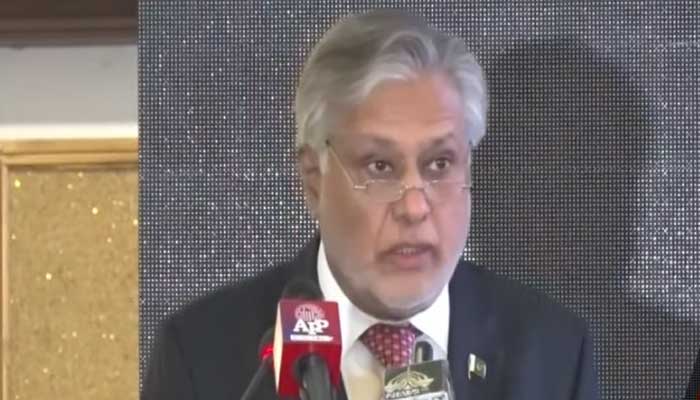
Finance Minister Senator Ishaq Dar ruled out on Thursday the possibility of reaching a staff-level agreement with the International Monetary Fund (IMF) this week, however, assured that Islamabad was "very close" to sealing the deal as Pakistan had “satisfied “ the global lender.
“A staff level agreement with IMF is unlikely this week," said the finance minister while addressing a seminar, titled 'Reviving economic stability through the strengthening of Public Financial Management'.
When asked that he had assured of striking the SLA by this week, Dar responded by saying that he had said "a few days not this week".
Earlier during the presser, the finmin admitted that it had taken longer than expected for Pakistan to complete the ninth review of the IMF's Extended Fund Facility (EFF), but had assured that Pakistan seemed to be very close to signing the SLA "in the next few days".
"I think we owe to this nation that we show seriousness, we deliver and we demonstrate to the world that we can honour the sovereign commitments no matter who made those," said Dar.
'Absolutely committed to complete programme'
He also assured that his team was "absolutely committed" to complete the programme with the "best" of their ability.
While berating the Imran Khan-led government, Dar shared the situation of the economy when the Pakistan Muslim League-Nawaz (PML-N) government left in 2018.
The minister said that it pained him to see the economy fall to the rank of 47 in 2022 after it was predicted that Pakistan would join G20 by the end of 2030.
The senator also highlighted that the Pakistan Stock Exchange's (PSX) market capitalisation was over $100 billion but dropped to $26 billion in the last few years.
"Another serious issue that we should be pondering about is debt sustainability of Pakistan," said the finance minister. He added that it was under $30 trillion in 2018 and has now climbed to $55 trillion in 2022.
"As a consequence this country which used to have debt servicing of less than $2 trillion per annum in fiscal year 2016-17 has risen to over $5 trillion," said Dar.
"I think in the last few years, we should see what mistakes we have made on the economic front and we should try to correct those as soon as possible," said the finance minister.


-
 OPEC+ agrees to keep November oil targets steady amid market uncertainty
 -
 Meta’s AI data centers: What to know about its major tax strategy
 -
 Tesla’s Cybercab faces a tough test after rocky Austin debut: Here's why
 -
 Trump pushes South Korea on Alaska LNG deal: Why Seoul is hesitant
 -
 AI boom could trigger severe market shocks, Bank of England warns
 -
 US inflation rises less than expected: What to know
 -
 OpenAI’s revenue run rate nears $70 billion: What to know
 -
 Canada’s economy records zero growth in July as key sectors decline
-
 UK diesel price hits all-time high amid Middle East supply crunch, RAC warns
 -
Meta’s Muse AI agent gets new tools for small businesses: What to know
-
China weighs allowing ByteDance, Alibaba to purchase new Nvidia RTX Pro 5500 chips
-
Why Bill Gates is calling for stronger AI rules amid growing safety concerns