

Print Story
X




The Kartarpur corridor is being constructed without any attention to the holy site’s original spiritual character
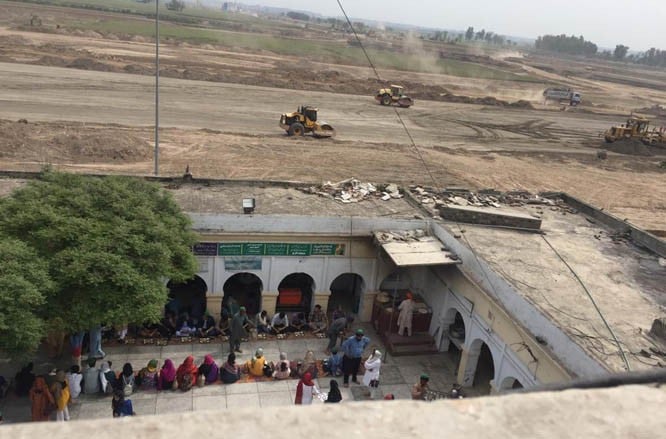
What is happening in Kartarpur is what one always feared would happen if development was allowed there.
It had been a sleepy place that did not allow easy access to Sikhs and that ensured that it did not change much. The Gurdawara built by the Maharaja of Patiala in place of the one that had got swept away in the flood of the 1920s has remained properly maintained in its true shape for all these decades. The guava orchards which Guru Nanak tended with love and care survived too and were looked upon with the same reverence as other parts of the shrine. It was and remained a true retreat, calm and quiet and unruffled for those wanting to meditate, an ideal location that exemplified the serenity that should be the character of such places.
But since the two governments on the initiative of Navjot Singh Sidhu, after mutual exchange of whispers between him and the Pakistan Army chief, decided to allow Indian pilgrims to visit, apparently a corridor is being constructed over the river Ravi which will allow pilgrims from India to come and pay their respects at one of the more revered sites in Sikh religion.
Due to the exigencies of partition, Kartarpur on the western side of the River Ravi became Pakistan while the river became the dividing line between the two countries, and with political conditions taking the turn as did they did in the past seven decades the pilgrimage to the site became more and more difficult. Just across the river on the Indian side which is probably Batala is another shrine Dera Baba Nanak and from there for decades the Sikhs looked across the river through a telescope to fulfill their religious urge and obligation.
It was far easier for the Sikhs living outside India to visit the site that Indian nationals couldn’t. Even if visas were issued to the Indian nationals for pilgrimage for other sites in the country Kartarpur was left out because of its location and proximity to the border. From the same area, Ahsan Iqbal, aware of the long standing demands of the Sikhs, had planned a similar pilgrimage access but in the five years that the PML N was in power nothing tangible was done towards this end. But as a friendly humanitarian gesture the government of Pakistan took this bold and right step and the dream of visiting this holy site became close to being fulfilled when just a few months ago it only seemed like a wish that would never be fulfilled. The Sikhs were jubilant and the government of PTI seemed to have scored a diplomatic coup.
Kartarpur is where Guru Nanak spent the last decade and a half of his life. The village Pakhoke was renamed Katarpur because of him. Nanak was an avid traveler and he is said to have visited Mecca twice, Baghdad, Palestine, Sri Lanka, Tibet, Sikkim, other parts of the subcontinent and some say that he even ventured into China, Turkey and current Central Asia. These journeys known as udasis (wonder whether there is an etymological connection with odyssey) - travels across Asia to centres of various religions and scholarship were journeys of spiritual enlightenment and formed the building blocks of a new order.
Guru Nanak was hugely influenced by the Bhagti movement and hence was a great proponent of bringing the two main religions, Islam and Hinduism together. His effort was to bring about a synthesis and it is no wonder that most of the kalaam of Sufi poets particularly Baba Fareed has been preserved as part of the holy granth. His closest companion was Bhai Mardana who set to compositions his sayings and verses. This forms the body of most of the sabds and kirtaans that are sung as part of religious rituals.
In the last decade-and-a-half of his life he decided to settle down in a retreat, cultivate land and live along the River Ravi. He planted and tended a guava orchard and set an example by working his land himself to spread the message of the origins of his religion which was peasant-friendly, valued labour, tillers, and the working classes, if those terms can be used in retrospect.
And when he died, his body was claimed by both the Hindus and the Musallmans for performing the last rites. The Hindus wanted the body to be cremated and the Musallmans to be buried and thus ensued a conflict that could have generated into violence as it had and still happens so often. But when the chaadar was removed under which lay the dead body there were no earthily remains but only a heap of flowers. The place was converted into a gurdawara and is revered to be one of the holiest sites for the Sikhs.
It is now a construction site and in the zeal to make it convenient for the pilgrims, some of the historical and religious landmarks has been demolished or cleaned up. The historic orchard which is believed to have been planted and tended by Nanak is nowhere to be seen. The place is full of concrete blocks, boulders, steel excavators, cranes, loaders, dumpers and iron fencing. The road leading to the gurdawara is being widened and it appears that in the distance the bridge over the river is being constructed.
No one is against providing conveniences to the pilgrims and travelers but then the essential characteristic of the site should not be destroyed. The tranquility and serenity once so captivating has been totally done away with and no effort, it seems, is being made to retain it.