

Print Story
X




How a much-discussed Facebook profile of an art graduate makes mistaken claims about plagiarism in art
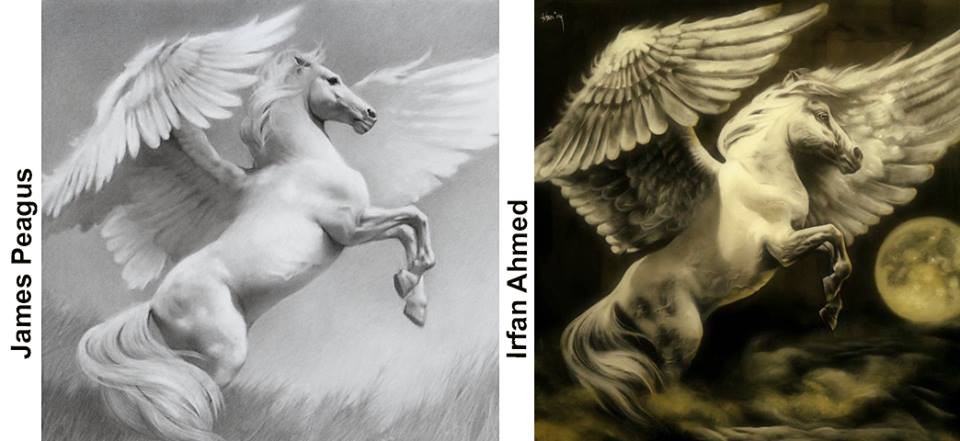
The Facebook profile of Khoshbu Ahmed describes her as a person born on January 1, 1990, who studied at the Punjab University College of Art and Design, has till I last checked 863 followers and 1776 friends from the art world. This may seem like a usual profile of anyone from the Pakistani art scene. But the real reason behind her fame is the things she posts on her page. It is her keen and continuous interest in Pakistani art that makes her the talk of artists in every town.
In her photos two albums, ‘Paintings_Resemblance’ (111 entries) and ‘Timeline Photos’ (58 entries), contain comparisons of artists’ works. One finds works of celebrated artists of our country next to images which appear so much like them. However, not only does she disclose or deconstruct the authenticity of established artists, on her page, one often comes across names that are not too well-known or usually shown at art galleries.
Thus, her interest in digging the hidden links is not only about famous artists using unknown painters’ imagery or a Pakistani artist imitating an international name. In this cathedral of echoes, there are no distinctions or boundaries between regions and recognition. The latest addition she has made to this list is works of Shahzia Sikander and Ali Kazim placed side-by-side.
In some cases, Khoshbu Ahmed clarifies the difference between original and the copy (Ali Abbas’s painting is notified as original and its look alike by S A Noory is described as a copy) but, by and large, it is understood that visitors of her page would gather who was following whom. It is normally presumed that artists belonging to the periphery imitate mainstream art. This is a colonial hangover and is reinforced in recent times through exhibitions such as ‘The Other Story’ and their reviews in which British critics have found connections between Ahmed Parvez and Alan Davie, Anwar Jalal Shemza and Paul Klee, F. N. Souza and Picasso.
The Facebook page of Khoshbu Ahmed is constructed on the same premise. Thus, when it comes to two comparatively unknown artists, she needs to explain who the initiator was and who the imitator is. She also includes works of Gulgee and his follower Tariq Hussain, of Jamil Naqsh and his disciples Iqbal Durrani and Chitra Pritam, who are painting canvas after canvas in the style of their mentors -- of course at a cheaper rate for the local market. Going through her posts, one feels that Ahmed makes no distinction with respect to stature or nationality.
Some people suspect this is a fake profile and that there is no real person as Khoshbu Ahmed and the profile too is an imitation of someone else. Why would a 25-year-old young graduate be interested in demolishing myths about our established artists, and spends hours, days and weeks trying to search works that look like ones made by famous artists? It must have been quite a feat to locate links and post them on the page. Perhaps, the person behind this page is more informed about these juxtapositions than a recent graduate would be.
Regardless of the identity of Khoshbu or her intent, one is concerned about the whole idea of the original and the replica. Strangely, Ahmed has not included works of Laurie Anderson or Cindy Sherman, since the former recreates past art works in their entirety as her work, and the latter photographs herself as versions of paintings from the history. Maybe, she is more interested in revealing the secrets of the practice of artists, by making their source of inspirations or imagery public. But anyone aware of the creative process and cultural milieu can testify that many of her links are just examples of coincidences, as how can an artist like Imran Qureshi be aware of Andrela Rush or Waqas Khan of Annie Vought?
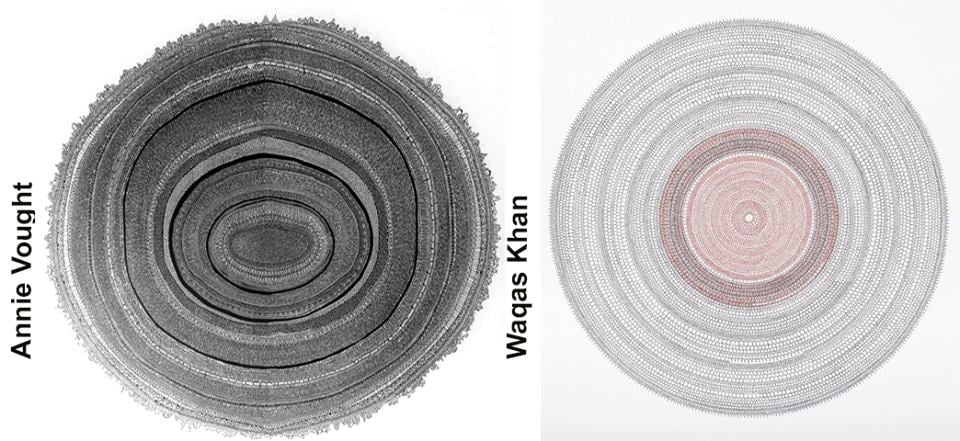
Yet, for an untrained eye -- of which there are a plenty on the social media, there must be an origin of these art pieces, traces of which were never revealed before.
This is a superficial, if not stupid, assumption on the part of someone who is not conscious of art history and the act of art-making. If this page had existed in the times of Picasso and Matisse, we would have witnessed several pictures of African masks, sculptures and oriental carpets next to their masterpieces. Had Facebook existed in the age of Renaissance, Khoshbu Ahmed would have posted links about Leonardo da Vinci and Michelangelo using works of earlier generations to forge their own.
Ahmed’s Facebook page in those epochs would have been irrelevant because, in the tradition of image-making, it was necessary to follow what had happened before. So one comes across paintings on the pages of manuscripts with a gap of hundreds of years, yet following the same subjects, elements and compositions -- albeit with a few alterations. In the realm of miniature painting, it was required to emulate your master and produce work along the same lines.
This tradition of image-making continues in our times where the idea of authenticity is not about inventing a new item; because even if an artist claims to be innovative in his approach and artwork, he is not entirely original. He is a part of the larger art discourse and is creating works in continuity of or in response to a particular tradition.
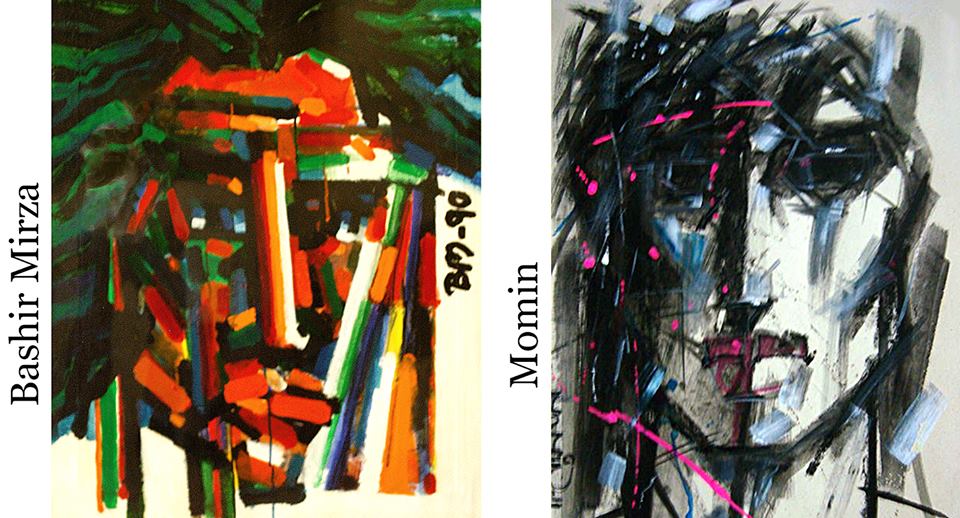
In contrast with scientists who invent new things, artists are required to contribute something else: they make us see our reality in its actuality or/and in a different version; a reality that is composed of multiple strands from various regions, cultures and periods. In the Middle Ages and after, an artist was aware of these connections; hence there were no qualms about sharing these with others. Even in the modern era, no matter how original a person, he is part of his surroundings, society and set of customs. Thus, like in the biological world, in the realm of art too, it is impossible to be disconnected from your origins.
Actually, the worth of an artist is not determined by what he invents, but how he reorganises the existing matter in order to produce something new. In this surge, one is bound to have a connection with what happened before, but it would be cruel to decree that an artist is aware of all that took place before him. Besides, picking only one work can be misleading, as to know an artist’s ideas and originality, one must look at his entire aura.
Yet, artists working at one time and place may have some similarities in terms of their inspirations, influences, techniques, methods and creations. So if a person living in Lahore makes a work that is similar to the work of an artist residing in Lima, it hardly matters because one does not know of the other, yet the two are heirs to the vast tradition of human creativity in which it is not unusual to have twins in far off regions.