Print Story
X




New exhibition at Doha’s Mathaf Museum gathers artists who confront censorship, conflict and exile
| L |
ike a popular product, censorship comes in many shapes, wrappings and seasons. Some impose it in the name of religion; others prefer to label it as ethics. A few enforce it through ethnicity, many through so-called standards. Political positions have been a major factor, too. Whatever the packaging, it targets those who express their views through words, images and other forms of creative expression.
If one were to survey the present moment, the crisis in Palestine and the genocide in the Gaza Strip have emerged as the defining issues of our time. Public rallies have been held across the globe, from Santiago to San Francisco, Berlin to Birmingham, Madrid to Milan. What began with Hamas capturing Israeli civilians as hostages in 2023 ended with a fragile peace agreement in 2025. The two-year saga not only shocked the world but also hardened its ideological frontlines.
A number of writers, including Adania Shibli from Palestine and Mohammed Hanif from Pakistan, were either refused entry by authorities or, by choice, declined to participate in literary and cultural events because of their open support for Palestine. This is not a new phenomenon. History is full of examples of rejection, banning and prohibition, from the censorship of Lady Chatterley’s Lover to the modern debates around “cancel culture.”
Artists and authors who have lived under dictatorships have long experienced such suppression. Books have been burnt, writers imprisoned and dissenting performers, filmmakers and visual artists expelled. In Pakistan, during the military regime of Gen Zia-ul-Haq, creators of words, images and sound faced these constraints when state venues were closed to them. One notable incident involved the painter Iqbal Hussain, who was denied permission to exhibit his work at Lahore’s Alhamra Art Gallery, a public cultural space meant for artistic freedom.
The exhibition we refuse d, recently opened at Mathaf: Arab Museum of Modern Art in Doha, Qatar. It brings together work that was either rejected or withheld by artists as an act of defiance. Curated by Vasif Kortun and Nadia Radwan, the show features 15 artists and collectives, and runs from October 31, 2025, to February 9, 2026.
The title itself, we refuse_d, plays on dual meanings: to be excluded and to decline participation. It also echoes the spirit of the Salon des Refusés, not as a historical reference, but as a symbolic gesture of dissent. The exhibition explores what it means to say no: to authority, to institutions, to systems of control.
Its Arabic title, narufdh/ rafadhna, sounds strikingly similar to the English when spoken aloud, especially in a South Asian accent. The resemblance underscores a shared universality, that the act of refusal transcends vocabularies and geographies. It affirms the courage to say no to an unjust ruler, a restrictive law, a damaging custom or a violent conflict, even when doing so risks material security, professional standing or physical safety.
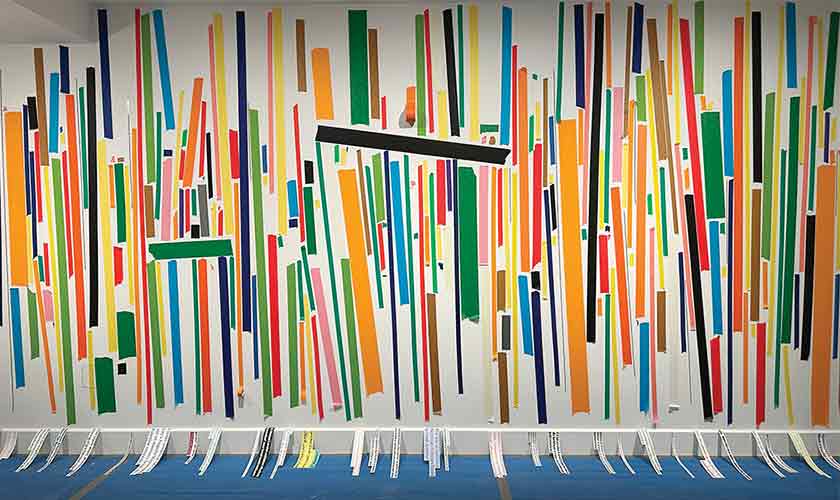
The artists featured in we refuse_d span generations, born between 1936 and 1991, and employ a range of visual strategies. Among them, Walid Raad’s installation I Thought I’d Escape My Fate (Again) presents a conceptual archive of “statements from those who have cancelled art exhibitions, lectures and concerts related to Palestine, as well as voices of those whose projects were cancelled.”
On the wall, delicate strips of transparent coloured paper lead to fragments of text documenting cancelled events, in English, French, Arabic and German, revealing how art can become a threat to institutional power. It is a paradox of the creative world: a work is born in solitude, yet it needs a platform, a gallery, publisher or stage, to reach the public.
Raad’s work reflects on this uneasy dependence. One of his included lines reads, “Leadership told him they wanted to avoid picking a side,” a statement that feels both bureaucratic and evasive. The text, rendered in white tape and layered repeatedly, becomes almost indecipherable, a metaphor for silenced voices.
Even the peeled edges of tape, the kind usually discarded during installation, appear scattered across the floor, hanging loosely from threads or stuck carelessly to surfaces. These fragments, often considered waste, become part of the artwork itself. By incorporating the remnants of creation, Raad extends the idea of “refuse” beyond rejection to include what is literally refused — the discarded, the overlooked and the thrown away.
Refusal, in art as in life, can be both a wound and a weapon, a way to reclaim agency when the right to speak, show or sing is denied.
Through such gestures, we refuse_d transforms acts of censorship and exclusion into statements of resilience. It suggests that refusal, in art as in life, can be both a wound and a weapon, a way to reclaim agency when the right to speak, show or sing is denied.
Another compelling document of refusal comes from the paintings of Samia Halaby, the eldest participant in the exhibition. Her modernist canvases explore layers of abstraction, yet her retrospective at Indiana University was cancelled in 2024, reportedly due to the politically charged titles of her non-figurative work: Massacre of the Innocents, Gaza (2024); A Jerusalem Window (2020); Our Beautiful Land Stolen in the Night of History (2016); Worldwide Intifadah (1989); and a series of eight gouache-on-paper pieces titled Occupied Jerusalem (1995).
Halaby’s art dismantles the myth that abstraction is detached from reality, or that, as Cold War narratives suggested, abstract art was promoted by the CIA to counter the influence of social realism. Her language of colour, form and rhythm invokes violence, resistance and displacement. Through her fractured geometries and luminous surfaces, she speaks of Palestine, yet the emotional cadence of her work allows anyone, anywhere, to hear echoes in their own accent of loss.
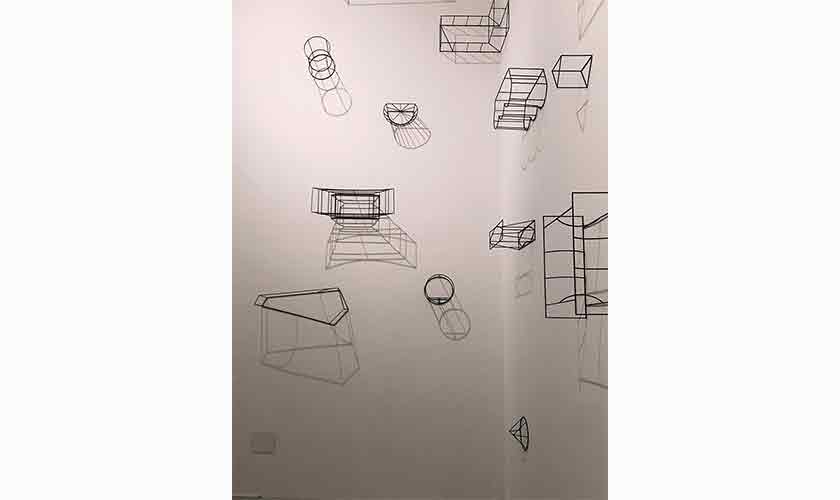
The idea of focusing on the particular and extending it to the universal is also evident in the installation by Bar Do rusöz. In Interstices, a dizzying constellation of forms, the artist constructs 46 black-painted diagrams made of basswood and balsa, each derived from the outlines of weapons recently used in Lebanon, Palestine and Syria. Stripped of their original mass and menace, they stand as skeletal line sculptures, suspended within the pristine white cube of the gallery.
Do rusöz’s installation transforms instruments of destruction into fragile objects of contemplation. The work becomes a meditation on memory, material and scale, a reminder of how war shapes not only land but also imagination. In creating this “parallel industry,” as he calls it, the artist reconfigures the machinery of violence into a network of delicate traces: not detached, yet no longer lethal. Rather than desensitising the viewer to the realities of conflict, Interstices reinforces its brutality, urging reflection on how beauty can emerge from the ruins of devastation.
In war-torn regions, occupied zones or during the partition of territories, people often flee their homes with the fragile hope of return. Their memories, plans and emotions become condensed into objects, most poignantly, into keys: keys to houses, cars, cupboards, trunks and boxes; possessions that cannot be carried in haste, yet symbolise the possibility of reclaiming a lost life.
Many migrants who crossed between India and Pakistan in 1947 endured this trauma, a grief now echoed in the experience of Palestinians dispossessed of their homeland. Taysir Batniji, born in Gaza, has for years been unable to return to his birthplace. His practice remains deeply engaged with themes of absence, identity and belonging within an unstable political landscape.
Batniji’s Keys, part of the We refuse_d exhibition, consists of photographs of bunches of keys, each tied to a chain or holder, each bearing traces of ownership. Beneath the images, hand-scrawled Arabic lines lend the work an intimate, almost confessional tone. The prints speak to the enduring bond between people and the places they once inhabited. Both land and object, he suggests, are extensions of the self.
Forcibly displaced people from the Indian subcontinent once carried their keys in the same way — as tokens of memory, symbols of deferred return. Most never went back. The same may be true for countless Palestinians. They live, as the Kashmiri poet Agha Shahid Ali once wrote, in “the country without a post office,” forever suspended between belonging and exile.
Alongside Keys, Batniji presents Homeless Colours, a series made from found crayons, ballpoint pens and felt-tip markers. These simple materials, stripped of conventional imagery, appear mute, as if silenced by displacement. In their quiet austerity, they evoke the condition of statelessness. Objects, like people, become wanderers, carrying with them the colour of loss.
Similarly, the background of a refugee community reflects a profound sense of unbelonging. DAAR, a collaboration between Sandi Hilal and Alessandro Petti, explores this condition in Refugee Heritage, a project that presents the living history of a displaced neighbourhood. Rather than depicting tents, temporary shelters or secure yet marginalised zones, the work maps spaces that are as restless as they are rootless.
Displayed in a series of light boxes at the exhibition’s entrance, the images glow with scenes of decaying houses, collapsing walls, makeshift extensions, unplanned colour combinations, cluttered streets and layered graffiti. These landscapes of impermanence reveal both endurance and erasure. The inhabitants remain unseen, yet their presence lingers in peeling paint, scattered belongings and improvised repairs.
In this way, the portraits of refugees, though invisible, embody the spirit of we refuse_d. They represent those expelled from one home and denied entry to another, much like artists themselves, who, in their creative pursuits, remain persistent wayfarers, always in search of belonging.
The writer is a visual artist, an art critic, a curator and a professor at the School of Visual Arts and Design, Beaconhouse National University, Lahore. He can be contacted at quddusmirza@gmail.com.