Print Story
X




Durre Waseem’s paintings, in her exhibition being held at Zulfi’s Gallery in Lahore, bear the unmistakable mark of her pictorial vocabulary
"Scenery can be a violent stimulant".
--Margaret Drabble
No matter how different a white man is from a black man, a Chinese from an Indian, an Aboriginal Australian from an Aztec American in their physical features, underneath they all share identical organs and functions that are crucial to sustain life. Yet each human develops a unique way of thinking and living, often shaped through his society and age.
So a man is a combination of shared elements, given features and personal traits; all this makes diversity an interesting experience.
Like humans, our planet also has much similarity across cultural and political borders. Governments, soldiers and patriotic persons fight over a piece of land, carrying the tag of identity, claiming to love its climate, scenery and flora and fauna without realising all this is found in the next door country too. One can observe nature’s conquest over nationalism while flying in a plane: the same terrain, rivers, valleys, forests and deserts continue beyond a political map.
Travelling to India, a Pakistani citizen goes to a ‘rival’ state but upon crossing the international border, especially on foot, one is surprised to see the same soil, trees, crops, animals, birds and flowers on the other side. But even when a region is far from the other and has distinct climate, resources and forms of culture, there are a few common elements such as soil, vegetation, water and wind.
It is thus important in this world of demarcations and discriminations that an artist locates and reaffirms the essence of humanity and nature, and resists the temptation of patriotism. One recalls the famous exchange with Shakir Ali who, when once asked why he was not making patriotic works during the war of 1965, replied that he was painting moon that shines on both side of the border and flowers which grow across the line of control.
An artist in some way levitates the limitations of any sort, to seek, present, portray and convey the essence of truth. This is identified, shared and owned by a large number of people despite having individual experiences and observations. Perhaps the most potent example of this is the novel One Hundred Years of Solitude in which Marquez has created a story in a fictional town from Colombia, South America but every reader translates and transforms the narrative to his or her own environment.
The eye which identifies common human elements is the same that sees similar features in the physical world. So when artists observe the fields of Punjab with buffalos or boulevards of Paris crowded with people, they find common aspects in different locations, yet keep the local flavour intact. The new paintings of Durre Waseem bring forth the essence of our views and vision whether we are looking at the Eiffel Tower, or a church in USA, canals in Venice or waterways in Punjab, kids from California or cows in Lahore, orchards in spring or road crossings in winter. All these communicate how an artist deals with a subject and turns it into her personal voice.
But this process is long and time-consuming because one has to study art -- either at school or in training the eye, developing the technique and knowing materials in order to acquire sufficient knowledge of the art of painting. Yet some artists even after years of struggle lack the ability to engage the viewer through their creative outputs. Art is not something that can be learnt academically; it is an indispensible part of a person.
In Durre Waseem’s exhibition (being held from Feb 3-17, 2016 at Zulfi’s Gallery, Lahore), one finds characteristics that infuse a canvas with life and liveliness. Paintings made at different locations, including the US (her current country of residence), Europe, Karachi and Lahore bear the unmistakable mark of Durre’s pictorial vocabulary which, like the painter, is natural, raw, uninhibited and informal.
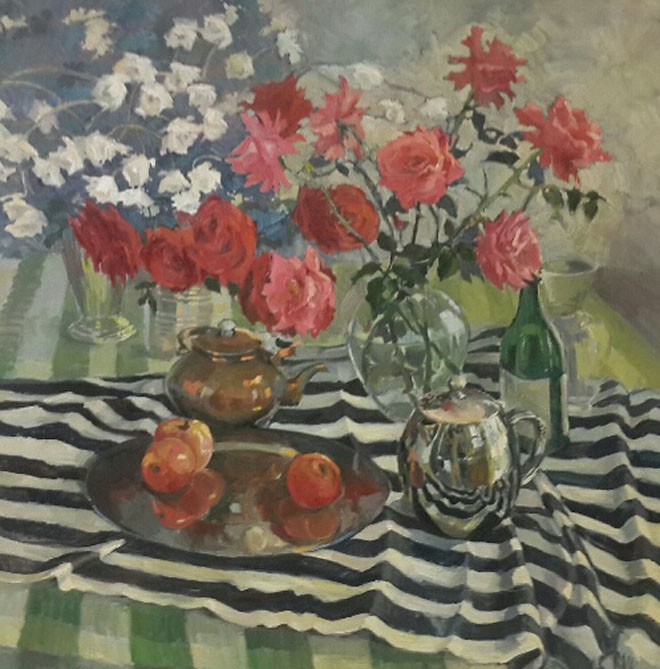
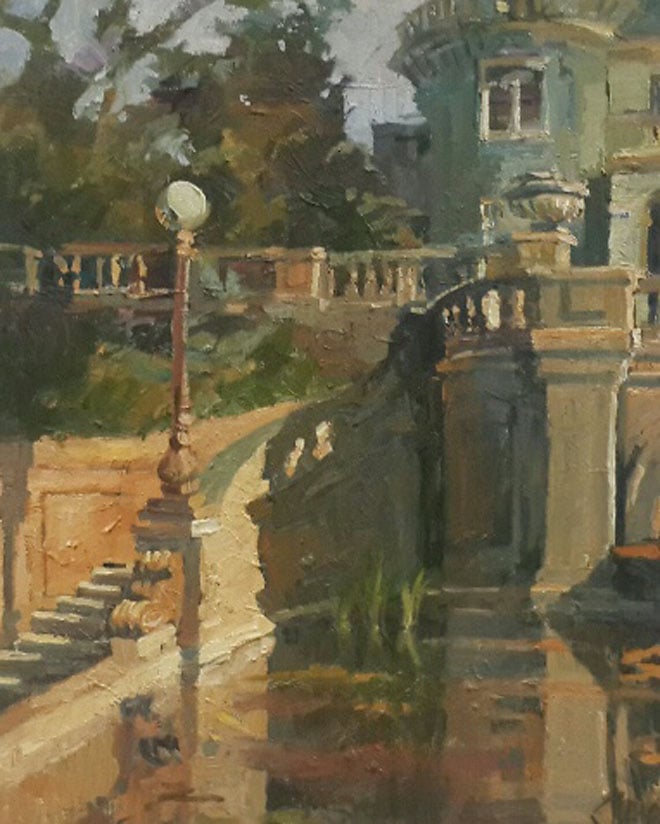
In her solo show, whether it is a still life with a metal kettle reflecting striped drapery, railway line with cattle, man sitting with piles of clay pots, collection of bicycles, passage in the Lahore Fort, restaurant from California, reflections of buildings, trees and sky on the gleaming surface of water, the artist has put broken and irregular strokes to ‘write’ reality which takes its comprehensive view when a person moves back and looks at it from a distance. Thus her canvases can be enjoyed as the interplay of bright, vivid, strong and sensitive hues but complete the picture in the eyes of a beholder after he steps back.
In a way, it hardly makes a difference if she has put her easel on a roadside in Paris or a rural site in Punjab, inside a Californian club or lane with historical monuments of Lahore, the brush of the painter that captures light, contours, shades and textures captivates the viewer. Through her sensitive observation, attention to detail, mastery of rendering, but most of all her remarkable painterly quality, Waseem recreates the sensation of being in the presence of a living world, not its lifeless replica.
Hence, the urge to touch whatever is in front of us is unstoppable.