

Print Story
X




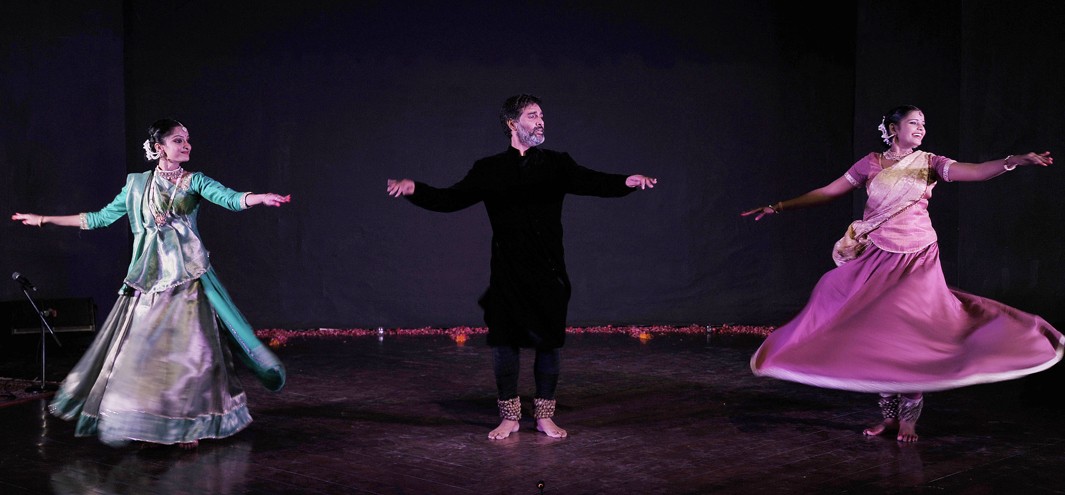
Two Indian performers Jeena Kumari and Nalakshi danced with a Pakistani Adnan Jahangir at Alhamra Lahore
It is always a surprise and a pleasant one when one receives an invitation for a dance performance in a public space. A surprise because there is so much opposition, antagonism and perhaps prejudice against the performing art forms, dance in particular. Its mere survival has something of a heroic dimension about it and needs to be mentioned as such.
And the surprise is pleasant if the performer happens to be from India.
In the normal course of events, there should have been very frequent exchanges of cultural events and personalities between India and Pakistan but due to the hostilities and animosities tethering on jingoism of mutual destruction, only intermittent exchanges have taken place. Though Indian films are imported and displayed in public spaces, other exchanges like plays, dance performances, music recitals, mushairas, poetry reading, and painting exhibitions are rather rare or have to be managed.
Even the most ardent of promoters end up by becoming cynical and defeatist in their mindset because of the effort involved in getting visas, no objection certificates and other clearances from the law and order authorities. The entire initiative does not appear to be worth the effort. This is exactly the purpose of the restrictions and clampdowns, and till now has been defied only in patches through sporadic attempts made by the few who have attempted and persisted with it too.
The programme titled Sargam had two Indian performers Jeena Kumari and Nalakshi, and they danced with a Pakistani Adnan Jahangir in a show that lasted about an hour and a half viewed by an audience that nearly filled Hall 11 at the Alhamra. The two Indian dancers were primarily trained in the kathak tradition and employed most of the techniques and postures while also partaking of its repertoire. Adnan Jahangir has also been trained in the kathak style but his approach being different did not follow the kathak sequence of parts in the traditional sequence.
Since dance in Pakistan has developed in all possible directions in the absence of any mediated design, it has borrowed, imitated with impunity from all sources to have a variegated shape all its own. It has been ironic that while dance in film was permitted by the censors, it was not permitted on television, which was state sponsored, or by the arts councils in a meaningful manner, which too depended for finances and directions from the government.
In our society, dance is still associated with the salons and most people in their hour of merriment or celebration or even grief engaged dancers for a private performance. The scene usually gets raucous by the minute with drunken people showering money on the female performers. The form of a concert dance performance has really not caught on and is still an alien institution.
In Adnan Jahangir, one can see the influence of some of the folk dance styles as well as the dance forms that is heavily imbued with dhamal-like movements and gestures. The only living tradition in Pakistan has been on the shrines of the various sufis where the numbers are exclusively performed by men to the rhythmic variations of the dhol.
If a reference is made to the classical tradition in dance, usually kathak is referred to and the other forms like bharatnatyam, manipuri and odyssi since the separation of East Pakistan are hardly mentioned. Indu Mitha should be given credit for being the lone torch bearer of bharatnatyam in a society that is not really bothered about the niceties of the form but only in its crude social fallouts.
In the traditional repertoire of kathak, the dance numbers have been choreographed against the very rich lore of the various anecdotes, incidents and happenings that have been part of our cultural make up. The mudras have a stylised dimension; the audiences do not generally have a problem associating with being exposed to traditional cultural references. Since this is no longer the current practice in our country, words are required to fill in the void.
Similarly, when lyrics are rendered in the song format the entire focus shifts to song and lyrics again limiting the possibilities inherent in the movement of the body. The two Indian dancers also went through some of the kathak repertoire, moving on to the last part of pure dance tatkaar with subtle rhythmic variation on intricate taals.
It has been rare that the top Indian performers, whether in music or dance, have visited Pakistan. Only when programmes are arranged by the Indian High Commission on their national days has one got the opportunity to see and hear the likes of Ustad Bismillah Khan, Pandits Jasraj, Pandit Hari Prasad Chaurasia, Ustad Amjad Ali Khan and Ustad Haleem Jaffer Khan. Otherwise, their top performers due to the difficulties mentioned above prefer to go west rather than Pakistan, though most have ardently expressed their desire to perform before Pakistani audiences acknowledged as being initiated and hard to please.
Despite the problems, it is still hoped that a more liberal visa regime will increase the number of exchanges between the two countries with better and well-known artistes travelling and sharing their artistic riches with the people. Many of our top of the line artistes have performed in India, probably with relatively greater frequency. At one time Mehdi Hasan and then Ghulam Ali visited often and these days probably Abida Parveen is no stranger to that country.