

Print Story
X




The story behind Rori Sahib, a gurdwara built to commemorate Guru Nanak’s capture from Eminabad

Summers are usually very hot in the plains of central Punjab; although it rains often in monsoon season but as soon as it stops pouring, the heavy and overcast weather makes everyone sweat.
It was such kind of a day in early August while we were travelling to our maternal village, 65 kilometers away from district Gujranwala along with my paternal uncle who is a senior advocate. As the roads leading to the village are in a bad shape, so we decided to take a longer route. Being a part of the famous rice belt, the countryside of Gujranwala is beautiful with lush and verdant fields sprawling across hundreds of acres. The plantation of paddy plants that locals call ‘Moonji’ was in full swing, and there were men, women and children bending in knee-deep water and sowing young saplings into the fields.
After half an hour we reached Eminabad, a small town 15 kilometers away from Gujranwala that used to be a thriving trade and agricultural market before partition--famous for its havelis and Hindu temples, that is not all about its charms. This town was once a Mayfair of Sikh festivals especially Katak Puranmashi and Baisakhi in its three historically important Sikh shrines i.e. Gurdwara Khushi Bhai Lalo, Gurdwara Chakki Sahib and Gurdwara Rori Sahib. It was the last monument that we had had an opportunity to visit.
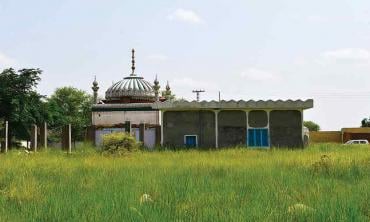
In order to reach there, we mistakenly chose the wrong path; just a small tract of mud that was dusty, full of potholes and brambles--and it was a miracle that the vehicle passed through it without any mishap. However, the environment was serene--typical of the Punjabi countryside. There were some dilipidated old buildings on the way that looked like ghosts from the past. What we eventually saw was something that was both majestic and strange given the wilderness around it. The red brick building with its imposing three umbrella-like structures was like a phantom gradually rising on the horizon and getting bigger as one approached it. It was Rori Sahib, a gurdwara that was built to commemorate an event related to rori (pebbles) and that’s how it became sacred here.
According to SikhiWiki, an online encyclopedia about Sikhism-- the story goes like this: when Mughal Emperor Babar entered Punjab in 1521, the founder of Sikh religion, Baba Guru Nanak, was present in Eminabad town and was staying with Bhai Lalo. When the town was captured by the armies, they also arrested some local people including Baba Guru Nanak among them. According to the tradition, when the Guru was captured he was sitting on Rori (Punjabi for pebbles, small stones) and was busy in prayers. Thus, in order to commemorate this event, an imposing Gurdwara was built on the site and was named Rori Sahib.
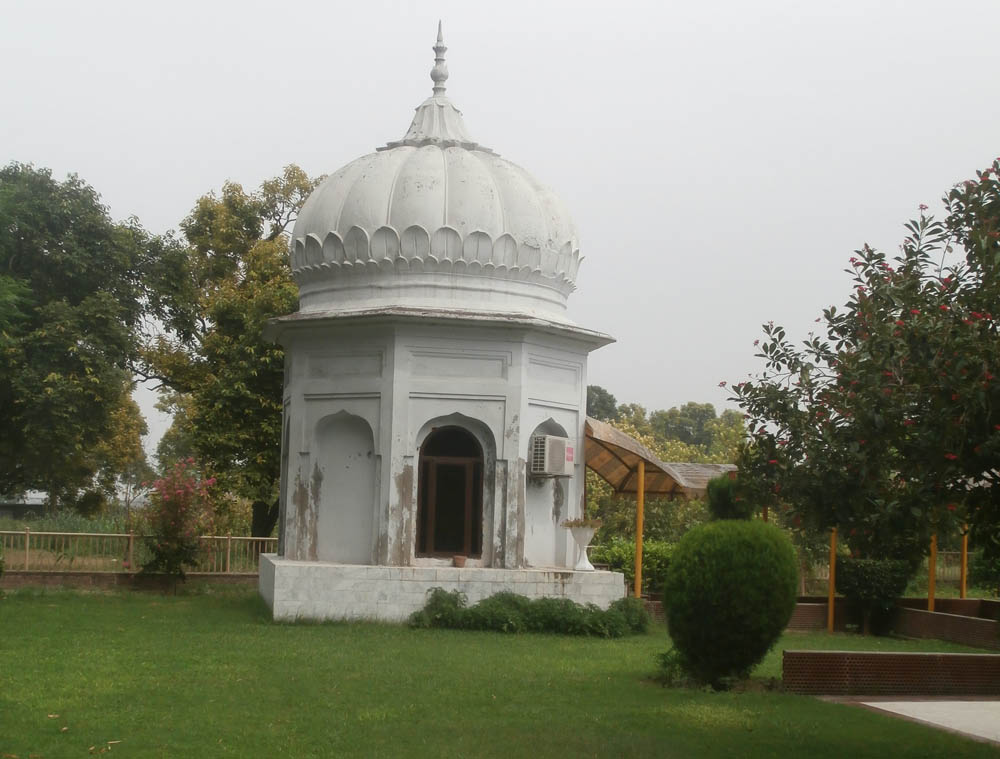
The Gurdwara is a large fenced structure and its entryway is a magnificent three-storied archway leading to the inner sanctum. The arched gateway is made of rust-red coloured cut bricks and topped with three smaller umbrella-like domes finally decorated with finials. Once inside, one can see an inverted lotus shaped-dome and a small room with circular verandah. This building is raised over the place where Guru Nanak sat at the time of his capture, although there is no rori right now, only polished marble. Then there is a large pond or sarovar, where people take bath when they gather here at the time of Baisakhi. There are some more arched passageways that enhance the beauty and grandeur of the building.
A large estate and surrounding agricultural lands have been endowed to the Gurdwara from the time of Maharaja Ranjit Singh. Before partition, there used to be week-long celebrations of Baisakhi and congregational gatherings of Sikhs from all over India. Although the Gurdwara still hosts a large number of Sikhs at the time of Baisakhi from across the world, its past glory has faded somehow. The empty pond and other structures seemed to echo the tales of bygone days and past splendour in hushed voices. Soon after the partition of Indo-Pak, the building was attacked by a mob and was set on fire, but it was reconstructed by the government and now seems to have recovered from old wounds.
It seems true that through the virtuous touch of a pious human being, even lifeless stone pebbles can be exalted to gain a sacred status.