

Print Story
X




A chat with Iqbal Geoffrey who keeps astonishing the viewers with his innovative approach and great sense of humour on the sidelines of his latest show at Zahor ul Akhlaq Gallery
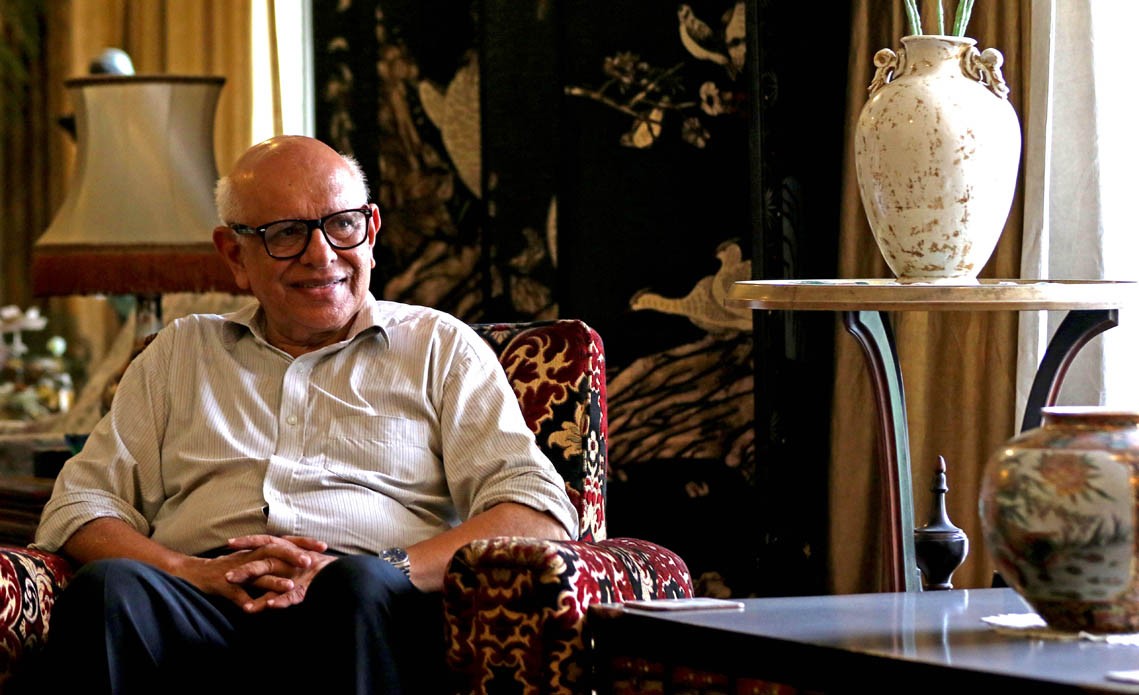
The moment you are in front of his office on the fourth floor you see a semi-locked door. Through the chink in the closed doors, you can have a glimpse of Iqbal Geoffrey, sitting behind his table, with rows of books stalked behind his back.
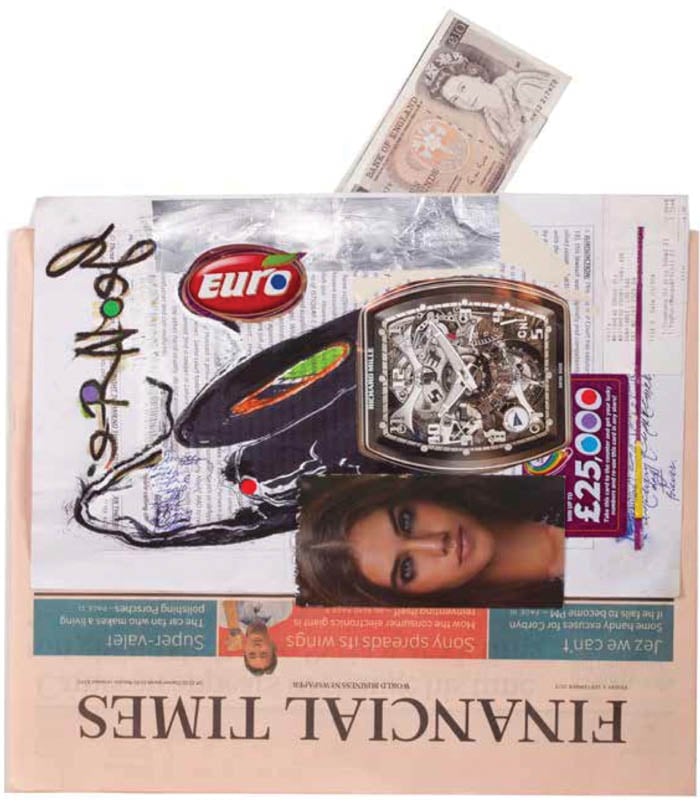
He looks like a typical lawyer but there is something else that makes his office and appearance unusual. It is the works of art scattered on his table, hung on the walls, stored in boxes, and put on shelves that distinguish him.
Arguably, Iqbal Geoffrey is one of the few people who are practicing the Greek term Just in its complete sense. As Umberto Eco points out, the Greeks did not have a word for beauty, instead they employed the term Just. Hence anything that is correct is pretty. So in the life and practice of Iqbal Geoffrey, probably there is not much difference between the making of art and seeking justice in courts.
Early one morning, before the court hours, I went to his office/studio and talked about his latest exhibition being held at the Zahoor ul Akhlaq Gallery, NCA. However, the following text is constructed -- like his works in collage -- from various discussions held with Geoffrey over the past several years.
Addressing the question to comment on this new body of work, Geoffrey said the real thing is that the viewer must know the context of his art pieces and the history of the artist: "I started making drawings at a very young age, probably aged two, and the first of these drawings was of River Chenab. I also suggested different options for Pakistan’s flag -- back in 1946."
Responding to a question about conceptual art, of which he is the foremost proponent, Geoffrey recalled: "The first Post Conceptual exhibition was held in 1965, in which I put a bag with an envelope inside. I said that anything a visitor puts in it will become art. But sadly no one wrote about the exhibition. That was the first Post Conceptual show anywhere in the world, followed by my other exhibitions around the world".
He did not mention some of these shows. One of these consisted of going to Victoria Miro Gallery in London at a precise time and day (previously announced in the newspapers) and appropriating someone else’s works hanging on the wall as his for one whole hour. Or the exhibition Love Hair at the National Gallery, London where he spread pubic hair. These conceptual works would be applauded today as subversive, alternate and public art projects but were not included then or today in the narrative of Pakistan’s art history.
Iqbal Geoffrey describes conceptual art as art that "deals with the exchange of concepts -- the prioritisation of ideas from the execution of objects. It is the first real breakthrough from the ghetto of painting. It confirms that art is a seed, not its fruit. In my work, the next stage of post conceptual was the appropriation of pure ideas. In 1992 I sowed some seeds in Hyde Park London, so they become trees. Also in 1971at the Johnson Museum of Cornell University, I sent clouds as my works of art, visible only to good people".
A similar kind of work was created in another exhibition, curated by Sadia Sherazi a few years ago at Khoj International New Delhi, in which he sent invisible rain from Lahore.
The history of these conceptual pieces is long, as these never required a special venue, occasion or documentation. Geoffrey recalled one such work: "I submitted my PhD thesis at Harvard University in 1967, which were only black papers. Actually this work was borrowed from my exhibition at Everson Art Museum at Syracuse University".
Hearing about these works created in a period in which conceptual art was not a popular or familiar idiom, one wonders about the recognition of Iqbal Geoffrey in Pakistani art. He is -- in a true sense -- the Other; despite the fact that his work is highly and truly appreciated by artists of all generations in Pakistan.
Ali Imam once shared his experience of seeing a painting of Iqbal Geoffrey displayed at the Tate Gallery in 1960s, a period in which it was impossible to find a work of an artist from former colonies accepted as mainstream art. Talking about this, Geoffrey recounts those days when there was no Internet or mobile phone. So if you moved from a physical space, you lost useful contacts. But he does not regret it because, for him, making art is more important than anything else. He has been active and regularly showing across the country and astonishing the viewers with his innovative approach and great sense of humour.
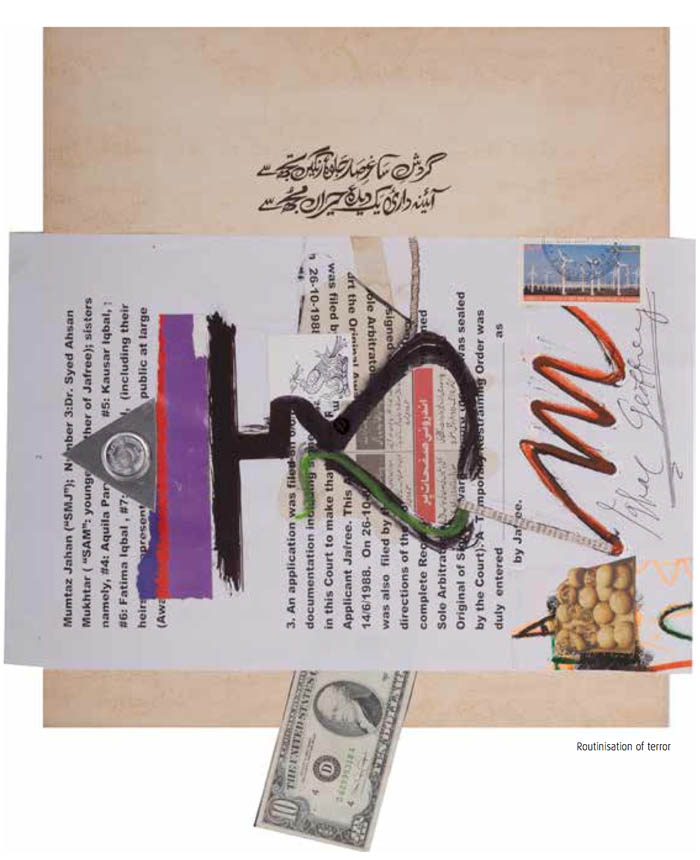
In the exhibition at Zahor ul Akhlaq Gallery, the surprise factor is evident, with collages composed on Sadequain’s calligraphy of Ghalib’s poetry. Recalling Sadequain, Iqbal Geoffrey once told me that the painter used to visit him in Karachi and as Sadequain was constantly producing work, he asked for papers and made a couple of drawings at Geoffrey’s place. "During that period, I used to burn two of my works daily. One day, I couldn’t find any of my works so I burned Sadeqauin’s drawings instead," he recalls. This anecdote illustrates that for Iqbal Geoffrey art as an experience is more important than a collectible item.
Considering the relation of art and market, Geoffrey says: "There is no connection between the two. With the exception of two or three artists, no artist selling high is of any consequence. When Vincent Van Gogh died, his sister in law was offered 100 pounds for his entire production."
In his law practice, too, Iqbal Geoffrey is not seeking monetary benefits, but concentrates on cases of human rights and society’s interest. Some years ago, a lawyer who has no link with art shared his admiration for Iqbal Geoffrey’s case that he filed on behalf of trees of Washington Square against the government of the Unites States. According to him, this case is revered by jurists for the fact that it took up environmental issues at a time when nobody was concerned about these. Iqbal Geoffrey finds a peculiar link in his career as a lawyer and an artist: "Law as well as art is a wasted activity in the sense that there is no fair criterion in both. Any ordinary judge can dismiss your case; likewise any Tom, Dick and Harry can discard your art."
Yet he practices both. As lawyers are supposed to define reality in the court of law, I asked Iqbal Geoffrey to define art. "What I call art is art, what I don’t call art is also art".