

Print Story
X




An English translation of the original French book about Nusrat Fateh Ali now available in a well-produced edition
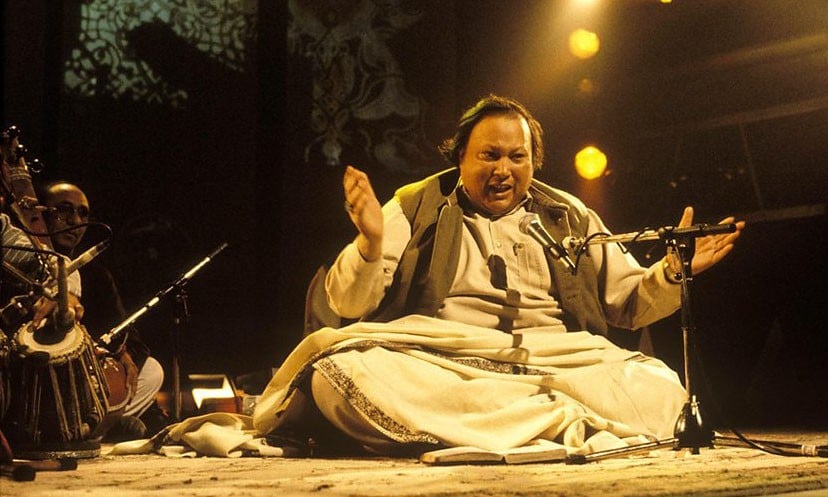
Nusrat Fateh Ali Khan was surely the best known Pakistani musician. His fame spread far and wide and in a short period of time. It seemed he was in a hurry for he was barely fifty when he died in 1997 leaving many all over the world to grieve for him and wonder as to how much more he could have contributed to music.
Pierre-Allain Baud had been friends with Nusrat Fateh Ali Khan and visited him in Pakistan and trailed him to many other places that Nusrat performed or toured. He initially wrote his book on Nusrat Fateh Ali in his native language French. That was translated by Shaukat Niazi in Urdu and was published from Pakistan and reviewed in The News on Sunday. Now the same book has been translated into English by Renuka George and titled Nusrat -- The Voice of Faith and published by Harper Collins Publishers, India.
Since Nusrat Fateh Ali gave so much pleasure to audiences all over the world and he was the flag carrier of a sensibility that has been buried in the dust of extremism, any occasion is good enough to remember and talk about his total dedication and single-minded devotion to his genres of music. Artistes in general and musicians in particular are not respected in Pakistan. Though they may have a huge fan following and there may be admiration, there is little respect and a relationship of equals.
But if musicians from Pakistani get recognition in the West, there is that renewed, reinvigorated interest embedded at the heart of discovering a treasure. If a white man says well, the native has to follow. Even the proper names of the artistes and the various terms are pronounced in imitation of the manner of Englishmen or Americans. Nusrat Fateh Ali’s fame at home was only the reflected glory of the adulation and recognition that he got abroad especially in the cultural capitals of the world.
Singing and performing on shrines to the various melas and urs of the Sufis, the qawwals were seldom invited to perform in concert halls and people’s houses. It all changed during Nusrat Fateh Ali’s lifetime. He was invited to the homes of high and mighty because he was invited to some of the biggest international venues known for hosting the very best and the most popular.
At about the same time people in countries like Pakistan were becoming more comfortable with music that could be explained in terms of its religious connotation. Thus qawwali did not stricken the conscience of the believers as much as other forms of music did. He happened to arrive at the right time for bridging this gap between the religious and the non-religious and between the traditional and the modern. The use of contemporary instrumentation helped him communicate with an audience that was diverse and varied. He could access the international listener and become the representative sound of a new age.
According to Baud, the popularity of Nusrat Fateh Ali increased all round the world after his death and many indicators point towards that direction. A postage stamp was issued in Pakistan by Pakistan Post after his death and in 2001, a film was made on him by Giuseppe Asaro Nusrat Fateh Ali Khan -- A Voice from Heaven". This was the second film made on him as earlier during his lifetime Nusrat Fateh Ali Khan -- The Last Prophet was produced. In 2001 Womex (The World of Music Expo) bestowed upon him a posthumous award. In 2006 the New York Times placed him among the sixty "Most Influential Asians". NPR (National Public Radio) in 2010 placed him in the fifty great voices and the same year CNN listed him in the "The Fifty Great Voices of the half century".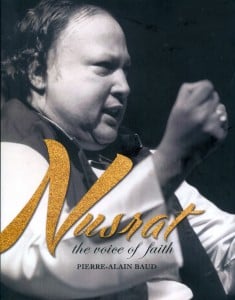
It must be said that the current edition is more visually pleasing than the other two editions. The layout is much better and it is easier to read, and then it is laced with so many better quality photographs that make the life of the great man come alive. Despite the great popularity of Nusrat Fateh Ali Khan, not much has been written on him in Pakistan. Aqeel Ruby wrote on him in a book format called Nusrat Fateh Ali Khan -- a Living Legend. Pierre-Alain Baud then wrote in his native language.
The popularity of Nusrat Fateh Ali only percolates down to us through the English language media and those organisations which use English language as the medium of communication. But if one goes through the book under review, it becomes apparent that much was written on him in other major languages of the world like French, Japanese, Spanish, Portuguese and German. He was exposed to a whole range of cultures, languages and nationalities and all that information, analytical understanding and acknowledgement is still not known to us since we are only familiar with the English language.
As a good quality photograph proverbially is worth a thousand words, the way the book is produced enhances the quality of what is written. The text has not been altered or changed or made different but the quality of production, the printing, the design, the layout is what seduces you sufficiently to pay due attention to the text as well. Usually badly produced books take the attention away from the textual content. It is not only vital for the coffee table edition to be alluring and inviting; every book should have sufficient aesthetic quality about it to draw the reader. Mercifully, this edition has it in requisite quantity.
(Nusrat -- The Voice of Faith is available at Liberty Books)