Print Story
X




A form of singing that travelled form the salons of courtesans to a more serious form of musical expression
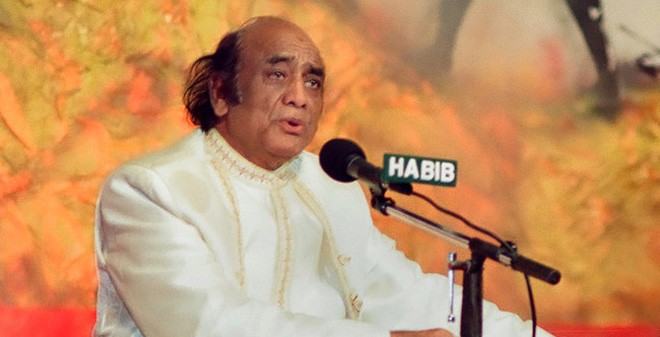
Mir Taqi Mir who passed away in the month of September in 1810 was not only one of the greatest poets of Urdu but has been sung by some of the most well known vocalists of the subcontinent.
One wonders when Mir started being sung and when his poetry become acceptable to be sung by songsters because ghazal in the middle of the 18th century and the early 20th century was not considered to be very high on the hierarchy of musical forms.
Ghazals, both Persian and Urdu, were sung usually by the courtesans in their salons. In its initial phase it was considered to be an accompaniment to dance.
While in the central court in Delhi kheyal was gradually easing out the dhrupad as the major form of vocal music in some other courts like Jaipur, Patiala, Rampur and Gwalior kheyal developed in a more variegated style. It remained the major form of musical expression. It was rigidly autonomous not taking recourse to either the lyrics or dance. It focused on exploring and exploiting the possibility of the music inherent in the sur.
The lighter forms of music like the thumri and dadra did not develop in the central court in Delhi despite the gradual decline and the loss of political power and prestige after the pillage and destruction by the invasions of Nadir Shah and Ahmed Shah Abdali (Durrani). But instead they progressed in the provincial courts which with the passage of time also became autonomous and enormously wealthy and had started to exercise their authority without reference to the central court in Delhi. Musicians and poets including Mir Taqi Mir moved out of Delhi for security and patronage.
Kathak the classical form of dance too developed in the same era in the three provincial centres of Lucknow, Jaipur and Banaras while thumri too thrived in tandem with the same dance form in Lucknow and Banaras. The Punjabi ang of the thumri blossomed much later probably in the late 19th century by the exponents of the Patiala Gharana.
Also read: The days of ghazal
The thumri gaiks were specialists who sang while dancers, either one or many, just danced. They either did not did not sing or just mimed the lyrics. Over a passage of time the two became specialised forms of expressions and among the more prestigious platforms the two were separated but for the ordinary listener and participant they were performed by the same exponent. It can be said, stretching the same argument, that the ghazal too was not sung at the courts but only by the courtesans who were considered not the very best. It was gradually replaced by thumri and later a combination with dadra and only those vocalists who were not considered very good sang the ghazal to the accompaniment of dance.
Probably during the course of the 19th century ghazal that the Urdu ghazal started being sung in the salons of the dancing girls and it appears that the kalam of the very best was not sung by them. Usually the poets who wrote more sensational stuff or poetry dripping with sentimentality were sung by the dancing girls as an accompaniment to dance. Thus, developed the mujari ang of ghazal gaiki.
This was also the period when Urdu was only emerging from its status of being a dialect to being a proper language -- Rekhta as the poetical idiom was known but was not the preserve of the best poets and it was used more by poets specialising in the doggerel. Most of the poets wrote their serious stuff in Persian while penning their more licentious outpouring in what came to be known as Urdu.
When Wali Dakni showed the way that serious stuff could be written in Urdu, the first truly great poet of the language, Mir Taqi Mir emerged who lived in the 18th century and died immediately after the first decade of the 19th century. But it can be said with a degree of certainty that Urdu ghazal only started being sung seriously in the 20th century.
The first poet who caught the fancy of the vocalists was Daagh. On surface, Daagh was a blend of the ghazal when it was only meant to be sung in the salon and its more serious expression already established by the likes of Mir Taqi Mir. This ambivalence in the case of Daagh made it easier for the vocalists to switch from one ang to the other with ease and facility.
By the middle of the 20th century ghazal, Urdu ghazal became a serious endeavour with the leading vocalists of the subcontinent taking it up. It was also partly due to Ustad Barkat Ali Khan singing hasti apni hubab ki si hai and Begum Akhtar ulti ho gai sub tadbeerain kuch na dawa ney kaam kiya and dil ki baat kahi nahi jaati chup ke rahna thana hai to offset the monopoly of the ghazals of Daagh and upstage the mujrai ang which had dominated ghazal gaiki for about a 100 years.
In Pakistan as the classical forms simply disappeared with the change of patronage and the sudden emergence of new classes due to partition and mass migration, ghazal became a serious form of musical expression. Mir was sung by Mehdi Hassan chalte ho to chaman ko chaliye, mulkon mulkon, pata pata boota boota haal hamara janey hai, aa kay sajada nasheen qais hua merey baad and dekh to jey ke jaan sey uthta hai, yeg dhuaan sa kahan sey uthta hai.
These serious vocalists placed ghazal gaiki on a higher pedestal when they liberated the melodic structure from its poetical content. As long as the poetical content dominated singing, it happened to be only an appendage to poetry but as it liberated the sur from the word the musical possibility became clearer. The vocalists treated the word as being incidental as they did in other higher musical forms and that established the autonomy of ghazal gaiki as a music form.