

Print Story
X

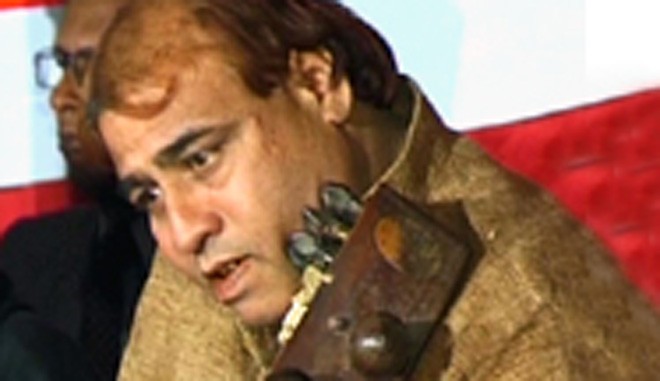
Khawar Hussain, probably the last exponent of sarangi had to be shifted to the hospital after suffering a stroke last week. This news is alarming because over the years one has seen the decline and extinction of many of the traditional music instruments.
Being closest to human voice there is no instrument better than sarangi to represent and explore the intricacies of South Asian Classical Music. It has primarily been used as a melodic accompanying instrument for vocal music, especially kheyal and thumri but very little is known about the historical and technical aspect of this instrument, outside the circle of people who play it. Due to some bias, social taboo, the difficulty of making and playing it combined with lack of proper research its popularity has diminished greatly in recent times.
Khawar Hussain is the current torch-bearer of Amritsar clan of sarangi players. His grandfather Aziz-ud-din used to play the sarangi and was the disciple of Fateh Din, the father of Hussain Buksh, another legendry sarangi player. His own father Abdul Majeed was a tabla player. Khawar Hussain initially played violin but to carry the great tradition of his elders, he became the disciple of Peeru Khan in the mid 1980s.
He is now the leading sarangi player in the country. He has accompanied almost all the current leading vocalists and also plays the sarangi solo. He has worked in film and television as well.
The instrument is truly on the verge of extinction in Pakistan. Very few sarangi players are left, and most are very elderly whose best years of being musicians are behind them. The incentive and the inspiration for the young to join in learning and playing this difficult instrument is lacking.
Sarangi playing has two major streams -- one as a solo instrument and the other as an accompaniment. Since the rise of the kheyal gaiki by the beginning of the 19th century sarangi became an accompanying instrument, its performance often became a match of virtuosity between the vocalist and the sarangi players. Many anecdotes about legendry displays have come down to us in the oral tradition of such matching virtuosity.
Five regional clusters produced the largest number of sarangi players -- Uttar Pradesh, a group of towns and cities around Delhi (including Sonipat, Panipat, Jhajjar, Kirana, Meerut, Muradabad, Banaras, Amritsar and Kasur). Sarangi as a classical instrument developed in the Panipat/ Sonipat area particularly at the shrine of Boo Ali Qalander, its birthplace and home, and then spread out to other aforementioned centres. Some of the founders of the kheyal gharanas and some of the greatest kheyal vocalists too were either sarangi players themselves or were the progeny of sarangi players.
Being closest to the human voice, its versatility, which enables it to reproduce very subtle nuances of vocal music, with its soothing and attractive timbre made it an ideal accompaniment to classical vocal music, particularly kheyal gaiki. By the middle of the 19th century it became the preferred accompanying instrument to kheyal and other light classical forms like thumri and dadra, etc.
Khawar Hussain belongs to the Amritsar tradition of playing the sarangi and therefore is adroit at playing it as a solo instrument. He is very good at playing certain raags and brings out the evocative quality to the fullest. The mizaj of the raag, through the proper intonation of the vadi/ samvadi and the progressive expansion is his hallmark. As he moves into the faster rhythm the virtuosity at intonating the note at that tempo is the real challenge and he has the required expertise not to falter there.
Many bodies for the welfare of the artistes have been set up -- actually far too many -- at the federal, provincial and district levels with their own vested bureaucracies. These apportion funds for the welfare of the artistes and since the allocated amount for culture on the whole is not very substantial, the segment for welfare whittles down to puny sums.
It defies common sense as to why so many bodies have been formed for one purpose. It would be much better and more workable if most of these funds are consolidated and payments made to the artistes which then can work out to be a sizable packet in relative terms than the one that they get now. At times the amount spent on receiving the payment is more than the payment or the stipend that is being received. It is not very dignified either for the artistes to be making appeals in the media from well to do individuals, bodies, usually the government to step in on an emergency basis. There should be a regular and functioning system that assists the artistes without making a public spectacle of dispensing charity.