

Print Story
X

Peter Pannke may be accredited for having introduced to the West the musical expression that is pervasive in the shrines of the subcontinent.
Today, Sufi music has become a kind of a generic expression -- as if there is a musical component to the worldview of the Sufis in this part of the world. But this blanket association of a particular type of music with Sufism is too broad a generalisation and may also be inaccurate at places.
There are many forms of musical expression as there are many forms of Sufism, or in exact parlance, the various silsilas that have originated and then thrived as mystical orders within the Muslim world.
But their approach or sanction of the arts, particularly literature, music and dance has not been uniform. Some silsilas have made music an integral part of their expression or message, others approve of it without stressing on its essentialness, and some outrightly reject it -- more in line with the orthodox approach practised by the ulemas or religious scholars.
Peter Pannke studied Sinology, Indology and Comparative Religions in Hamburg Marburg, Benares and Munich. After many years of travel in the Near East, Africa, India and Pakistan in the 1990s, he settled in Berlin as an independent writer and composer.
For 20 years, he directed a music show at the radio SFB/RBB and, as a musician/producer, he has more than eight CDs and LPs to his credit. Having studied the dhrupad, he went on to create a personal style of singing and founded Troubadours United, a colourful and proficient troupe of Turkish, Syrian and Indian musicians.
It all started when his professor of the Comparative Musicology Course in Berlin University in the late 1960s insisted on transcribing music in the western staff notation. Pannke realised it was totally Eurocentric and wanted to visit the area personally and "be overwhelmed by sound itself". This he did but it was limited to Sindh, particularly Sehwan Sharif. But in 1999, on his second visit, he discovered music and musicians across the length and breadth of the country, and wrote a book in German.
Recently, the English translation of that book with a new preface has been published. Though he found out later that much had changed around the shrines and the general attitude of the people, he did not change the original text of the German edition because he wanted to stay faithful to what he had written about 14 years ago.
This a very personal account of the travels through the music and culture of the Indus Valley, for while travelling up and down the Indus, Pannke found music to be even much more richer and varied than what he remembered from his first visit.
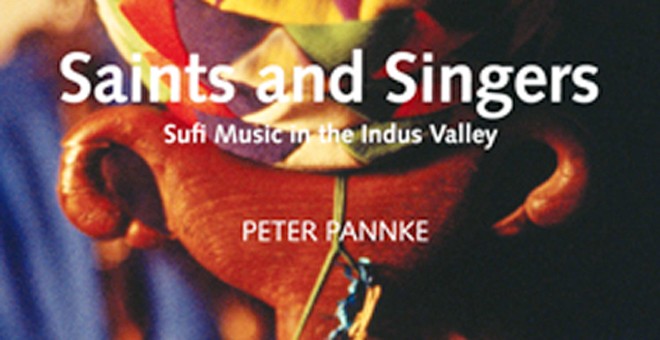
The book is a guide to the heart of Sufi music traditions, through a combination of text, photographs and music. It has two music CDs as part of the entire package of the publication.
The first question that confronted Pannke was the definition of the term Sufi or Sufism. He found the term somewhat opaque, that in every Islamic country --from Malayasia to Morocco -- the music performed by dervishes and fakirs do not have a single coherent form, on the contrary, they display a great variety of local traditions with different characteristics and use different languages recognised under local designations.
He stressed that Sufism as a single system of thought was first conceived by a western August Gottreu Tholuck in his book Theosophia Persarum Pantheistica, published in Berlin in 1821. It was a fallacy from the very start because it was neither pantheism nor theosophy.
The Sufis have always managed to absorb influences from many different quarters, taking on ever new shapes, surfacing in new and surprising ways, sometimes even shedding their names.
In his new English preface, Pannke seems worried about the immense change in the last 50-odd years in the cultural landscape of the Indus and its tributaries and how the traditional musicians and the genres of the Indus Valley are going to survive.
The future of unique and multilayered musical traditions lies in the hands of the bearers of culture as well as its lovers and listeners. As long as the people recognise the Sufi saints, whose shrines they have visited for many centuries and who have helped them cope with their lives as spiritual authorities, surviving political and social upheavals, their music will continue to live.
It is not only the situation around the shrines that has changed. The general social and political context has altered as well. Sufis were described as representing the tolerant side of Islam. The term has a double meaning --it means being tolerant and tolerated. The Sufis have come under attack in many countries, and in Pakistan, under the given situation, the patronage of radio and TV is still lacking and support from other countries can only be limited.
Pannke realised that some of the genres adjusted easily to a concert format while others might suffer in content and impact if taken out of their traditional context and put on stage. The question remains that how far the concert can transfer not just the musical genre but also the cultural and spiritual meaning.
Travelling along the Indus and its tributaries, he has written about the various shrines and hamlets that are responsible for patronising the musical expression around shrines, like Uch, Kot Mithan, Bhit Shah, Malir, Makli Hills, Data Ganj Buksh, Umerkot, Mithi, Pakpattan, Malka Hans, Kot Addu, Kasur, Multan, Tando Muhammad Khan, Talpur Wada, Sakhi Sarwar and Sehwan Sharif.
The book also succinctly describes the various forms of music and the peculiarity of various musical instruments that are played. The brilliant photographs by Horst A. Friedrichs add to the overall flavour of the book.